


The death toll yesterday rose to 170 in the 2019 novel coronavirus outbreak in China, as foreign evacuees from the worst-hit region begin returning home under close observation and world health officials expressed “great concern” that the disease is starting to spread between people outside of China.
Yesterday’s figures covered the previous 24 hours and represented an increase of 38 deaths and 1,737 cases to 7,711.
Of the new deaths, 37 were in the epicenter of the outbreak in Hubei Province and one was in Sichuan Province.
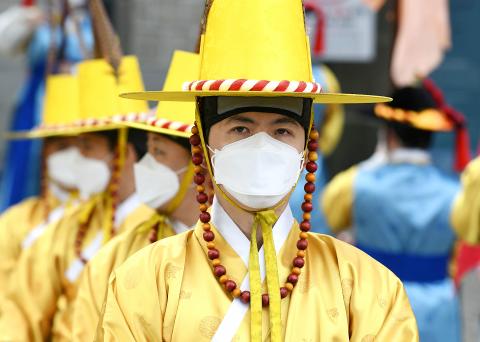
Photo: AFP
The news came as the 195 Americans evacuated from the epicenter of the outbreak in Wuhan were undergoing three days of testing and monitoring at a southern California military base to make sure that they do not show signs of the virus.
A group of 210 Japanese evacuees from Wuhan landed at Tokyo’s Haneda Airport on a second government chartered flight, the Japanese Ministry of Foreign Affairs said.
Reports said that nine of those aboard the flight showed signs of cough and fever.
Three of the 206 Japanese who returned on Wednesday tested positive for the coronavirus, Japanese Prime Minister Shinzo Abe said in parliament.
Two of them showed no symptoms of the disease.
The Japanese Ministry of Health, Labor and Welfare earlier confirmed a second suspected human transmission in a tour bus guide who had escorted a group of travelers from Wuhan. The bus driver was also infected. Neither had traveled to China.
France, New Zealand, Australia, Singapore and other nations were also pulling out their citizens or making plans to do so.
In South Korea, residents of two cities where quarantine facilities are being prepared threw eggs and plastic water bottles at government officials to protest plans to isolate the 700 South Koreans the government plans to evacuate from China and isolate in their neighborhoods.
US President Donald Trump has been relatively tight-lipped about the crisis.
Aides and confidants say Trump’s careful approach is part of a political strategy to avoid upsetting the stock market or angering China by calling too much attention to the virus or blaming Beijing for not managing the situation better.
“We’re very much involved with them, right now, on the virus that’s going around,” Trump said of China before signing a trade deal at the White House on Wednesday.
Trump said that he had discussed the situation with Chinese President Xi Jinping (習近平).
“We’re working very closely with China,” he added.
There have been just five confirmed cases of the virus in the US.
Amid reports of shortages in food and daily necessities in hot-spot areas in China, authorities are “stepping up efforts to ensure continuous supply and stable prices,” Xinhua news agency reported.
It cited Chinese Ministry of Commerce data showing reserves in Wuhan can ensure a secure supply of rice and cooking oil for more than 15 days; pork and eggs for more than 10 days; and vegetables for about five days.
The government has offered no estimates as to when it can contain the outbreak, although some specialists have speculated that the spread of the disease would reach its peak in about two weeks.
The WHO said that the few cases of human-to-human transmission of the virus outside China — in Japan, Germany, Canada and Vietnam — were of “great concern” and were part of the reason the UN health agency was yesterday reconvening a committee of experts to assess whether the outbreak should be declared a global emergency.
In a report published on Wednesday, Chinese researchers suggested that person-to-person transmission among close contacts occurred as early as the middle of last month.
“Considerable efforts” will be needed to control the spread if this ratio holds up elsewhere, researchers wrote in the report, published in the New England Journal of Medicine.
They reported that the average incubation period was five days.

CROSS-STRAIT COLLABORATION: The new KMT chairwoman expressed interest in meeting the Chinese president from the start, but she’ll have to pay to get in Beijing allegedly agreed to let Chinese Nationalist Party (KMT) Chairwoman Cheng Li-wun (鄭麗文) meet with Chinese President Xi Jinping (習近平) around the Lunar New Year holiday next year on three conditions, including that the KMT block Taiwan’s arms purchases, a source said yesterday. Cheng has expressed interest in meeting Xi since she won the KMT’s chairmanship election in October. A source, speaking on condition of anonymity, said a consensus on a meeting was allegedly reached after two KMT vice chairmen visited China’s Taiwan Affairs Office Director Song Tao (宋濤) in China last month. Beijing allegedly gave the KMT three conditions it had to

STAYING ALERT: China this week deployed its largest maritime show of force to date in the region, prompting concern in Taipei and Tokyo, which Beijing has brushed off Deterring conflict over Taiwan is a priority, the White House said in its National Security Strategy published yesterday, which also called on Japan and South Korea to increase their defense spending to help protect the first island chain. Taiwan is strategically positioned between Northeast and Southeast Asia, and provides direct access to the second island chain, with one-third of global shipping passing through the South China Sea, the report said. Given the implications for the US economy, along with Taiwan’s dominance in semiconductors, “deterring a conflict over Taiwan, ideally by preserving military overmatch, is a priority,” it said. However, the strategy also reiterated
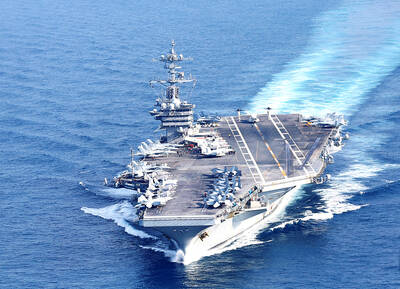
‘BALANCE OF POWER’: Hegseth said that the US did not want to ‘strangle’ China, but to ensure that none of Washington’s allies would be vulnerable to military aggression Washington has no intention of changing the “status quo” in the Taiwan Strait, US Secretary of Defense Pete Hegseth said on Saturday, adding that one of the US military’s main priorities is to deter China “through strength, not through confrontation.” Speaking at the annual Reagan National Defense Forum in Simi Valley, California, Hegseth outlined the US Department of Defense’s priorities under US President Donald Trump. “First, defending the US homeland and our hemisphere. Second, deterring China through strength, not confrontation. Third, increased burden sharing for us, allies and partners. And fourth, supercharging the US defense industrial base,” he said. US-China relations under
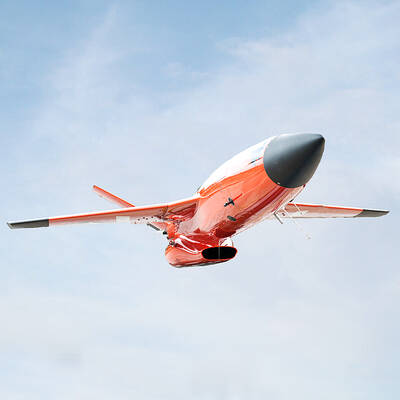
The Chien Feng IV (勁蜂, Mighty Hornet) loitering munition is on track to enter flight tests next month in connection with potential adoption by Taiwanese and US armed forces, a government source said yesterday. The kamikaze drone, which boasts a range of 1,000km, debuted at the Taipei Aerospace and Defense Technology Exhibition in September, the official said on condition of anonymity. The Chungshan Institute of Science and Technology and US-based Kratos Defense jointly developed the platform by leveraging the engine and airframe of the latter’s MQM-178 Firejet target drone, they said. The uncrewed aerial vehicle is designed to utilize an artificial intelligence computer


 RSS
RSS