


US President Donald Trump on Tuesday released his long delayed Israeli-Palestinian peace plan, promising “a new dawn,” but angry Palestinians called it biased and deserving to go in the “dustbin of history.”
Standing alongside Israeli Prime Minister Benjamin Netanyahu in the White House’s East Room, Trump said his plan could succeed where decades of previous US attempts to intervene had failed.
“Together we can bring about a ... new dawn in the Middle East,” Trump said to an enthusiastic audience that included throngs of Israeli and Jewish American guests — but apparently no Palestinian representatives.
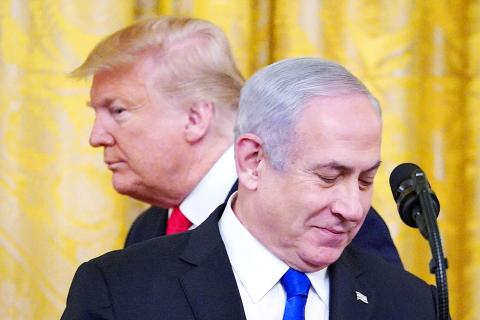
Photo: AFP
They are flat out rejecting the plan, which grants Israel much of what it has sought in decades of international diplomacy, namely control over Jerusalem as its “undivided” capital, rather than a city to share with the Palestinians.
The plan also lets Israel annex West Bank settlements.
Trump praised Israel for taking “a giant step toward peace” with the plan, which lays out a vision for future Palestinian statehood if a series of strict conditions are met.
These include requiring the future Palestinian state to be “demilitarized,” while formalizing Israeli sovereignty over settlements built in occupied territory.
Palestinians angrily rejected the entire plan.
“This conspiracy deal will not pass. Our people will take it to the dustbin of history,” Palestinian President Mahmud Abbas said.
Trump promised a “contiguous” future Palestinian state, addressing the current situation where Israel controls broad territory separating the two main population centers of the Gaza Strip and the West Bank.
Yet the map showed the West Bank remaining riddled with Jewish settlements linked to Israel and only a long road tunnel connecting the area with the seaside Gaza Strip.
The plan makes it clear that Israel is free to annex its settlements on Palestinian lands right away.
On the flashpoint issue of Jerusalem, Trump said Israel should retain control over the city as its “undivided capital,” Trump said.
Israeli Minister of Defense Naftali Bennett yesterday said that Trump’s plan created a window for applying Israeli sovereignty on nearly one-third of the occupied West Bank.
“Last night history knocked on the door of our home and gave us a one-time opportunity to apply Israeli law on all settlements in Samaria, Judea, the Jordan Valley and the northern Dead Sea,” Bennett said, using the Hebrew names for areas in the Israeli-occupied West Bank.
Bennett said he had already given orders to form a special team within Israel’s security establishment to “implement the application of Israeli law and sovereignty on all Jewish settlements” in the West Bank.
Additional reporting by Reuters

CROSS-STRAIT COLLABORATION: The new KMT chairwoman expressed interest in meeting the Chinese president from the start, but she’ll have to pay to get in Beijing allegedly agreed to let Chinese Nationalist Party (KMT) Chairwoman Cheng Li-wun (鄭麗文) meet with Chinese President Xi Jinping (習近平) around the Lunar New Year holiday next year on three conditions, including that the KMT block Taiwan’s arms purchases, a source said yesterday. Cheng has expressed interest in meeting Xi since she won the KMT’s chairmanship election in October. A source, speaking on condition of anonymity, said a consensus on a meeting was allegedly reached after two KMT vice chairmen visited China’s Taiwan Affairs Office Director Song Tao (宋濤) in China last month. Beijing allegedly gave the KMT three conditions it had to

STAYING ALERT: China this week deployed its largest maritime show of force to date in the region, prompting concern in Taipei and Tokyo, which Beijing has brushed off Deterring conflict over Taiwan is a priority, the White House said in its National Security Strategy published yesterday, which also called on Japan and South Korea to increase their defense spending to help protect the first island chain. Taiwan is strategically positioned between Northeast and Southeast Asia, and provides direct access to the second island chain, with one-third of global shipping passing through the South China Sea, the report said. Given the implications for the US economy, along with Taiwan’s dominance in semiconductors, “deterring a conflict over Taiwan, ideally by preserving military overmatch, is a priority,” it said. However, the strategy also reiterated

‘BALANCE OF POWER’: Hegseth said that the US did not want to ‘strangle’ China, but to ensure that none of Washington’s allies would be vulnerable to military aggression Washington has no intention of changing the “status quo” in the Taiwan Strait, US Secretary of Defense Pete Hegseth said on Saturday, adding that one of the US military’s main priorities is to deter China “through strength, not through confrontation.” Speaking at the annual Reagan National Defense Forum in Simi Valley, California, Hegseth outlined the US Department of Defense’s priorities under US President Donald Trump. “First, defending the US homeland and our hemisphere. Second, deterring China through strength, not confrontation. Third, increased burden sharing for us, allies and partners. And fourth, supercharging the US defense industrial base,” he said. US-China relations under

The Chien Feng IV (勁蜂, Mighty Hornet) loitering munition is on track to enter flight tests next month in connection with potential adoption by Taiwanese and US armed forces, a government source said yesterday. The kamikaze drone, which boasts a range of 1,000km, debuted at the Taipei Aerospace and Defense Technology Exhibition in September, the official said on condition of anonymity. The Chungshan Institute of Science and Technology and US-based Kratos Defense jointly developed the platform by leveraging the engine and airframe of the latter’s MQM-178 Firejet target drone, they said. The uncrewed aerial vehicle is designed to utilize an artificial intelligence computer


 RSS
RSS