


Hundreds of Americans and Japanese yesterday escaped the quarantined Chinese city at the center of a coronavirus epidemic aboard charter flights, as the death toll soared to 132 and confirmed infections neared 6,000.
The scale of the deepening crisis was emphasized with the new infection number on the Chinese mainland exceeding that of the SARS outbreak in 2002 to 2003.
SARS, another respiratory coronavirus transmitted between people, went on to claim nearly 800 lives around the world, with most of those fatalities in mainland China and Hong Kong.
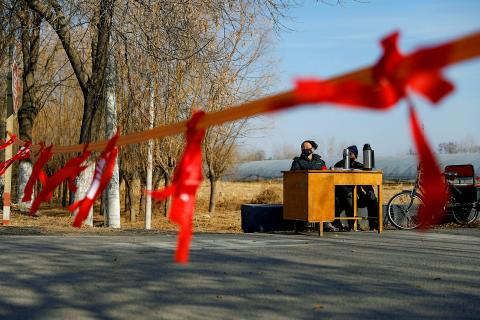
Photo: Reuters
The new disease has spread to more than 15 countries since it emerged out of Wuhan late last year, although all the confirmed fatalities have so far been in China.
Authorities last week imposed transport bans in and around Wuhan in an unprecedented quarantine effort, leaving more than 50 million people effectively trapped.
“We were not able to move freely, so we only had partial information,” said Takeo Aoyama, a Nippon Steel worker who was among the Japanese nationals airlifted early yesterday. “The number of patients began increasing rapidly at a certain point. That was very worrying.”
China has taken other extraordinary measures to try and stop the disease spreading, including bans on tour groups traveling overseas, suspending schools and extending the Lunar New Year holiday.
Thousands of foreigners have been among those trapped in Wuhan, which has become a near ghost town with vehicle travel banned and residents staying indoors.
Countries have for days been scrambling to try and get their citizens out of Wuhan safely, but have faced huge logistical, medical and bureaucratic hurdles.
About 200 people were aboard the Japanese flight that landed in Tokyo yesterday morning.
Medical professionals were on the plane to carry out checks but the Japanese Ministry of Health, Labor and Welfare said that there were no plans to quarantine the passengers.
They would instead be asked to remain at home and avoid crowds at least until the results of their tests are known.
A US charter flight also left Wuhan with about 200 Americans on board, including employees from the local US consulate.
The EU plans to fly its citizens out aboard two French planes this week, and South Korea is due to do the same.
Australia said it would evacuate about 600 of its citizens from Wuhan and quarantine them on Christmas Island, which is normally used to detain asylum seekers.
Meanwhile, the virus continued to spread and kill in China.
Authorities said the number of cases in Hubei Province, the epicenter of the virus of which Wuhan is the capital, soared by more than 800 from the previous day.
The number of confirmed cases across the country climbed to 5,974, while the death toll nationwide jumped 26 to 132.
All of those new reported deaths were in Hubei except for one, in a province just to the north.
Until Tuesday, all reported cases in more than a dozen countries had involved people who had been in or around Wuhan, but Japan and Germany then reported the first confirmed human-to-human transmission of the illness outside China. Vietnam is investigating another case.
Germany now has four confirmed cases, all of them employees at a Bavarian firm recently visited by a Chinese colleague, health officials said.
The United Arab Emirates yesterday announced its first case of the virus, in a family from Wuhan, in what is thought to be the first confirmed case in the Middle East.

CROSS-STRAIT COLLABORATION: The new KMT chairwoman expressed interest in meeting the Chinese president from the start, but she’ll have to pay to get in Beijing allegedly agreed to let Chinese Nationalist Party (KMT) Chairwoman Cheng Li-wun (鄭麗文) meet with Chinese President Xi Jinping (習近平) around the Lunar New Year holiday next year on three conditions, including that the KMT block Taiwan’s arms purchases, a source said yesterday. Cheng has expressed interest in meeting Xi since she won the KMT’s chairmanship election in October. A source, speaking on condition of anonymity, said a consensus on a meeting was allegedly reached after two KMT vice chairmen visited China’s Taiwan Affairs Office Director Song Tao (宋濤) in China last month. Beijing allegedly gave the KMT three conditions it had to

STAYING ALERT: China this week deployed its largest maritime show of force to date in the region, prompting concern in Taipei and Tokyo, which Beijing has brushed off Deterring conflict over Taiwan is a priority, the White House said in its National Security Strategy published yesterday, which also called on Japan and South Korea to increase their defense spending to help protect the first island chain. Taiwan is strategically positioned between Northeast and Southeast Asia, and provides direct access to the second island chain, with one-third of global shipping passing through the South China Sea, the report said. Given the implications for the US economy, along with Taiwan’s dominance in semiconductors, “deterring a conflict over Taiwan, ideally by preserving military overmatch, is a priority,” it said. However, the strategy also reiterated
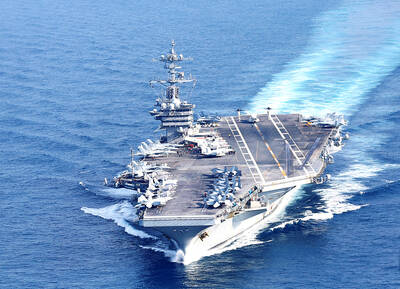
‘BALANCE OF POWER’: Hegseth said that the US did not want to ‘strangle’ China, but to ensure that none of Washington’s allies would be vulnerable to military aggression Washington has no intention of changing the “status quo” in the Taiwan Strait, US Secretary of Defense Pete Hegseth said on Saturday, adding that one of the US military’s main priorities is to deter China “through strength, not through confrontation.” Speaking at the annual Reagan National Defense Forum in Simi Valley, California, Hegseth outlined the US Department of Defense’s priorities under US President Donald Trump. “First, defending the US homeland and our hemisphere. Second, deterring China through strength, not confrontation. Third, increased burden sharing for us, allies and partners. And fourth, supercharging the US defense industrial base,” he said. US-China relations under
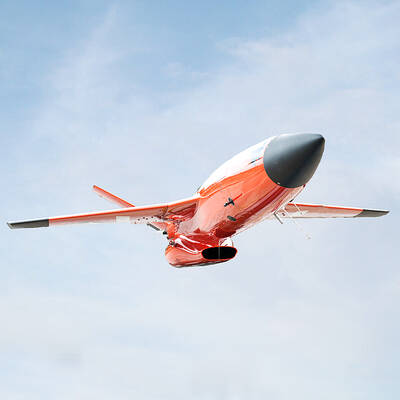
The Chien Feng IV (勁蜂, Mighty Hornet) loitering munition is on track to enter flight tests next month in connection with potential adoption by Taiwanese and US armed forces, a government source said yesterday. The kamikaze drone, which boasts a range of 1,000km, debuted at the Taipei Aerospace and Defense Technology Exhibition in September, the official said on condition of anonymity. The Chungshan Institute of Science and Technology and US-based Kratos Defense jointly developed the platform by leveraging the engine and airframe of the latter’s MQM-178 Firejet target drone, they said. The uncrewed aerial vehicle is designed to utilize an artificial intelligence computer


 RSS
RSS