


New Zealand Prime Minister Jacinda Ardern has called a general election for September, in a vote that will test whether her widespread popularity overseas is matched by support at home.
The center-left leader yesterday announced that Kiwis would go to the polls on Sept. 19, two months ahead of the last possible date for the ballot, when she would seek a second three-year term.
“I will be asking New Zealanders to continue to support my leadership and the current direction of the government, which is grounded in stability, a strong economy and progress on the long-term challenges facing New Zealand,” Ardern said.
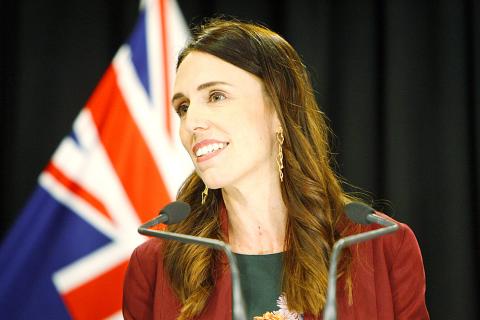
Photo: AP
The 39-year-old’s first term won her international fame — she became a mother while in office and received praise for her sensitive handling of the Christchurch mosques killings and the White Island volcano tragedy.
But while she has been feted overseas, opinion polls show her standing at home has slipped.
Opposition leader Simon Bridges has led the center-right National Party into more populist territory, attacking Ardern over a land dispute with Maori groups and attacking her gun buy-back scheme introduced after Christchurch.
Ardern has also come under fire for her party’s long-running KiwiBuild scheme, which was designed to make owning a home more affordable by constructing 100,000 homes, but has so far failed to match expectations.
Bridges reacted to the election announcement by pledging to lead a government that “will deliver” on its promises.
“New Zealanders know we will get things done, whether it’s more money in your pocket, a stronger economy, less tax, building infrastructure and roads or keeping families safer from increasing gang violence,” he said.
The most recently published opinion polls, both produced late last year, showed Bridges’ National Party ahead, but Labour, with its New Zealand First and Green Party allies, could muster enough support to remain in power.
The election announcement came just days before the government is to announce details of a NZ$12 billion (US$7.85 billion) infrastructure spending package designed to stimulate the economy.
The New Zealand economy has struggled under low growth, while the cost of living has risen.
New Zealand Minister of Finance Grant Robertson said the infrastructure spend to be released this week would target roads, rail, schools and healthcare projects across the nation.
The poll date avoids school holidays and All Blacks matches, which are said to have a bearing on election outcomes.

CROSS-STRAIT COLLABORATION: The new KMT chairwoman expressed interest in meeting the Chinese president from the start, but she’ll have to pay to get in Beijing allegedly agreed to let Chinese Nationalist Party (KMT) Chairwoman Cheng Li-wun (鄭麗文) meet with Chinese President Xi Jinping (習近平) around the Lunar New Year holiday next year on three conditions, including that the KMT block Taiwan’s arms purchases, a source said yesterday. Cheng has expressed interest in meeting Xi since she won the KMT’s chairmanship election in October. A source, speaking on condition of anonymity, said a consensus on a meeting was allegedly reached after two KMT vice chairmen visited China’s Taiwan Affairs Office Director Song Tao (宋濤) in China last month. Beijing allegedly gave the KMT three conditions it had to

STAYING ALERT: China this week deployed its largest maritime show of force to date in the region, prompting concern in Taipei and Tokyo, which Beijing has brushed off Deterring conflict over Taiwan is a priority, the White House said in its National Security Strategy published yesterday, which also called on Japan and South Korea to increase their defense spending to help protect the first island chain. Taiwan is strategically positioned between Northeast and Southeast Asia, and provides direct access to the second island chain, with one-third of global shipping passing through the South China Sea, the report said. Given the implications for the US economy, along with Taiwan’s dominance in semiconductors, “deterring a conflict over Taiwan, ideally by preserving military overmatch, is a priority,” it said. However, the strategy also reiterated

‘BALANCE OF POWER’: Hegseth said that the US did not want to ‘strangle’ China, but to ensure that none of Washington’s allies would be vulnerable to military aggression Washington has no intention of changing the “status quo” in the Taiwan Strait, US Secretary of Defense Pete Hegseth said on Saturday, adding that one of the US military’s main priorities is to deter China “through strength, not through confrontation.” Speaking at the annual Reagan National Defense Forum in Simi Valley, California, Hegseth outlined the US Department of Defense’s priorities under US President Donald Trump. “First, defending the US homeland and our hemisphere. Second, deterring China through strength, not confrontation. Third, increased burden sharing for us, allies and partners. And fourth, supercharging the US defense industrial base,” he said. US-China relations under

The Chien Feng IV (勁蜂, Mighty Hornet) loitering munition is on track to enter flight tests next month in connection with potential adoption by Taiwanese and US armed forces, a government source said yesterday. The kamikaze drone, which boasts a range of 1,000km, debuted at the Taipei Aerospace and Defense Technology Exhibition in September, the official said on condition of anonymity. The Chungshan Institute of Science and Technology and US-based Kratos Defense jointly developed the platform by leveraging the engine and airframe of the latter’s MQM-178 Firejet target drone, they said. The uncrewed aerial vehicle is designed to utilize an artificial intelligence computer


 RSS
RSS