


Escalating protest violence is not the way to bring about change, Hong Kong democracy activist Jason Ng said, urging demonstrators to embrace non-violent means in the struggle to throw off a feared tightening of Beijing’s control.
With the movement in a less frenetic and ferocious stage after seven months of unrest, Ng, a lawyer, said people in Hong Kong were taking time to process what had happened and reflect on the way forward.
In an interview in Barcelona, Ng said that he hoped the protests would return to the non-violent ethos that had characterized the “Umbrella movement.”
“One of the core values of the 2014 movement was non-violent civil disobedience and we really want to continue that,” said Ng, whose involvement in those protests spawned a friendship with one of its leaders, Joshua Wong (黃之鋒), with whom he is publishing a book this month.
“I understand why some of the violence happens, it’s human nature. If you are beaten by the police so many times and so aggressively, you’re bound to hit back,” the 48-year-old said, referring to the fierce clashes with police that have erupted in recent months.
However, using violence was a slippery slope, particularly when news outlets became immune to covering repeated stories involving Molotov cocktails and bloodied demonstrators.
“Violence is almost addictive,” Ng said. “Once you develop this immunity to the violence, the only way to continue [getting media] attention is to escalate... You sort of become addicted to media attention by creating more violence and I don’t want that to happen in Hong Kong.”
Many protesters believe it would be “very difficult” to get the government’s attention and that of the international community without escalating the violence in the territory, he said.
“But I disagree with that argument,” he said. “There are things that in the future we hope we will see less, and I think the most obvious thing is some of the violence.”
Born in Hong Kong, Ng emigrated with his family to Canada, where he grew up and began his legal training, which also took him to the US and Italy. He returned to Hong Kong in 2005 and went on to serve as president of the local champer of PEN International, a writers’ group that advocates for free speech.
Today he is involved in running the Progressive Lawyers Group that advocates for the rule of law, democracy and human rights, and was in Barcelona to visit a Catalan separatist activist who was jailed for his role in a failed 2017 independence bid.
Despite the slide into violence, Ng hailed the successes chalked up by the territory’s pro-democracy movement, describing as “miraculous” Beijing’s move to drop plans for extraditions to mainland China and the “unprecedented landslide victory” with a record turnout in district-level elections.
Since then, the protest had calmed down a lot, leading many people both at home and abroad to mistakenly think the protest was over — which it is not, he said.
“I think people just need time to process what has happened over the past seven months,” he said.
“I think taking a break is healthy. After all, we have been fighting for democracy for decades and we know that it is definitely not a sprint, it’s a marathon,” he said. “So as long as a spirit is there, taking a couple of weeks off I don’t think is an issue.”

CROSS-STRAIT COLLABORATION: The new KMT chairwoman expressed interest in meeting the Chinese president from the start, but she’ll have to pay to get in Beijing allegedly agreed to let Chinese Nationalist Party (KMT) Chairwoman Cheng Li-wun (鄭麗文) meet with Chinese President Xi Jinping (習近平) around the Lunar New Year holiday next year on three conditions, including that the KMT block Taiwan’s arms purchases, a source said yesterday. Cheng has expressed interest in meeting Xi since she won the KMT’s chairmanship election in October. A source, speaking on condition of anonymity, said a consensus on a meeting was allegedly reached after two KMT vice chairmen visited China’s Taiwan Affairs Office Director Song Tao (宋濤) in China last month. Beijing allegedly gave the KMT three conditions it had to

STAYING ALERT: China this week deployed its largest maritime show of force to date in the region, prompting concern in Taipei and Tokyo, which Beijing has brushed off Deterring conflict over Taiwan is a priority, the White House said in its National Security Strategy published yesterday, which also called on Japan and South Korea to increase their defense spending to help protect the first island chain. Taiwan is strategically positioned between Northeast and Southeast Asia, and provides direct access to the second island chain, with one-third of global shipping passing through the South China Sea, the report said. Given the implications for the US economy, along with Taiwan’s dominance in semiconductors, “deterring a conflict over Taiwan, ideally by preserving military overmatch, is a priority,” it said. However, the strategy also reiterated

‘BALANCE OF POWER’: Hegseth said that the US did not want to ‘strangle’ China, but to ensure that none of Washington’s allies would be vulnerable to military aggression Washington has no intention of changing the “status quo” in the Taiwan Strait, US Secretary of Defense Pete Hegseth said on Saturday, adding that one of the US military’s main priorities is to deter China “through strength, not through confrontation.” Speaking at the annual Reagan National Defense Forum in Simi Valley, California, Hegseth outlined the US Department of Defense’s priorities under US President Donald Trump. “First, defending the US homeland and our hemisphere. Second, deterring China through strength, not confrontation. Third, increased burden sharing for us, allies and partners. And fourth, supercharging the US defense industrial base,” he said. US-China relations under
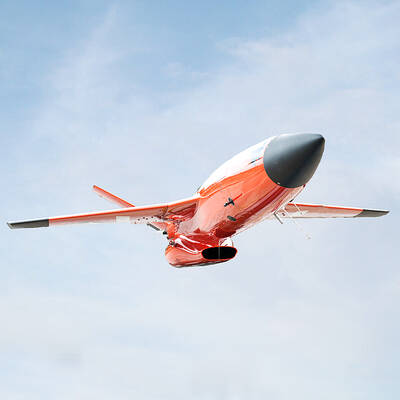
The Chien Feng IV (勁蜂, Mighty Hornet) loitering munition is on track to enter flight tests next month in connection with potential adoption by Taiwanese and US armed forces, a government source said yesterday. The kamikaze drone, which boasts a range of 1,000km, debuted at the Taipei Aerospace and Defense Technology Exhibition in September, the official said on condition of anonymity. The Chungshan Institute of Science and Technology and US-based Kratos Defense jointly developed the platform by leveraging the engine and airframe of the latter’s MQM-178 Firejet target drone, they said. The uncrewed aerial vehicle is designed to utilize an artificial intelligence computer


 RSS
RSS