


A powerful earthquake on Friday night has killed at least 21 people and injured more than 1,000 in eastern Turkey, as rescue teams searched through the rubble of collapsed buildings for survivors yesterday.
The Turkish government’s disaster and emergency management agency (AFAD) said in a series of tweets early yesterday that five people were pulled alive from the rubble in the eastern province of Elazig.
State news agency Anadolu said among those found alive was a pregnant woman who was rescued 12 hours after the quake hit.
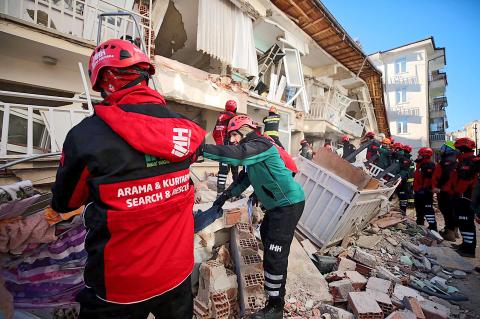
Photo: AP / IHH / Humanitarian Relief Foundation
At least 30 people were missing following the magnitude 6.8 quake, which had its epicenter in the small lakeside town of Sivrice in Elazig.
“It was very scary, furniture fell on top of us. We rushed outside,” said 47-year-old Melahat Can, who lives in the provincial capital of Elazig.
Eray Ernek described how he was watching television when the quake took place: “I was on the sofa and then fell on the floor. My sleeping father was woken up.”
“After we found a way out, we broke the door and got out. We saw other houses had collapsed,” Ernek said.
Turkish President Recep Tayyip Erdogan said all steps were being taken to aid people affected by the quake, which caused widespread fear.
AFAD said the quake hit Sivrice at about 8.55pm.
Turkish television showed images of people rushing outside in panic, as well as a fire on the roof of a building.
Interior, environment and health ministers, who were in the quake zone, said the casualties were in Elazig Province and in neighboring Malatya Province.
At least 21 people died — 17 in Elazig and four in Malatya — and 1,030 were injured, AFAD said.
Rescue teams were searching for survivors trapped in a five-story collapsed building in a village about 30km from Elazig, journalists said.
The US Geological Survey assessed the magnitude as 6.7, slightly lower than AFAD, adding that it struck near the East Anatolian Fault in an area that has suffered no documented large ruptures since an earthquake in 1875.
“My wholehearted sympathy to President @RTErdogan and the Turkish people following the devastating earthquake that has hit Turkey. Our search and rescue teams stand ready to assist,” Greek Prime Minister Kyriakos Mitsotakis wrote on Twitter.
The Greek prime minister’s office said later that Mitsotakis had spoken by phone to Erdogan, who said “Turkish teams had the situation under control for now.”

CROSS-STRAIT COLLABORATION: The new KMT chairwoman expressed interest in meeting the Chinese president from the start, but she’ll have to pay to get in Beijing allegedly agreed to let Chinese Nationalist Party (KMT) Chairwoman Cheng Li-wun (鄭麗文) meet with Chinese President Xi Jinping (習近平) around the Lunar New Year holiday next year on three conditions, including that the KMT block Taiwan’s arms purchases, a source said yesterday. Cheng has expressed interest in meeting Xi since she won the KMT’s chairmanship election in October. A source, speaking on condition of anonymity, said a consensus on a meeting was allegedly reached after two KMT vice chairmen visited China’s Taiwan Affairs Office Director Song Tao (宋濤) in China last month. Beijing allegedly gave the KMT three conditions it had to

STAYING ALERT: China this week deployed its largest maritime show of force to date in the region, prompting concern in Taipei and Tokyo, which Beijing has brushed off Deterring conflict over Taiwan is a priority, the White House said in its National Security Strategy published yesterday, which also called on Japan and South Korea to increase their defense spending to help protect the first island chain. Taiwan is strategically positioned between Northeast and Southeast Asia, and provides direct access to the second island chain, with one-third of global shipping passing through the South China Sea, the report said. Given the implications for the US economy, along with Taiwan’s dominance in semiconductors, “deterring a conflict over Taiwan, ideally by preserving military overmatch, is a priority,” it said. However, the strategy also reiterated

‘BALANCE OF POWER’: Hegseth said that the US did not want to ‘strangle’ China, but to ensure that none of Washington’s allies would be vulnerable to military aggression Washington has no intention of changing the “status quo” in the Taiwan Strait, US Secretary of Defense Pete Hegseth said on Saturday, adding that one of the US military’s main priorities is to deter China “through strength, not through confrontation.” Speaking at the annual Reagan National Defense Forum in Simi Valley, California, Hegseth outlined the US Department of Defense’s priorities under US President Donald Trump. “First, defending the US homeland and our hemisphere. Second, deterring China through strength, not confrontation. Third, increased burden sharing for us, allies and partners. And fourth, supercharging the US defense industrial base,” he said. US-China relations under
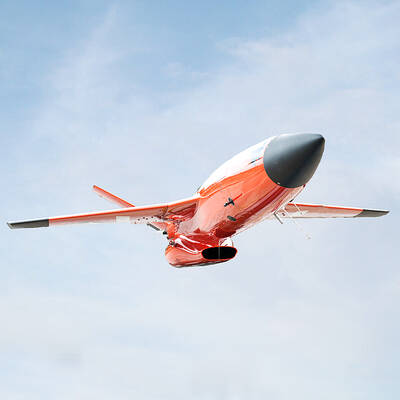
The Chien Feng IV (勁蜂, Mighty Hornet) loitering munition is on track to enter flight tests next month in connection with potential adoption by Taiwanese and US armed forces, a government source said yesterday. The kamikaze drone, which boasts a range of 1,000km, debuted at the Taipei Aerospace and Defense Technology Exhibition in September, the official said on condition of anonymity. The Chungshan Institute of Science and Technology and US-based Kratos Defense jointly developed the platform by leveraging the engine and airframe of the latter’s MQM-178 Firejet target drone, they said. The uncrewed aerial vehicle is designed to utilize an artificial intelligence computer


 RSS
RSS