


A somber European Commission President Ursula von der Leyen and European Council President Charles Michel yesterday formally signed the withdrawal agreement as Brussels prepares for the UK’s exit from the EU in seven days’ time.
In photographs issued of the signing ceremony in the EU’s Europa building yesterday morning, European Chief Negotiator for the UK Exiting the EU Michel Barnier can be seen standing behind the two presidents.
Michel, who will now chair meetings of 27 rather than 28 heads of state and government at the regular summits in the Belgian capital, issued a short statement.
“Things will inevitably change, but our friendship will remain. We start a new chapter as partners and allies,” he said.
Von der Leyen tweeted: “Charles Michel and I have just signed the agreement on the withdrawal of the UK from the EU, opening the way for its ratification by the European parliament.”
No reporters or photographers were allowed to witness the low-key ceremony, despite news agencies offering to organise a pool.
The signed copy of the agreement was sent in a diplomatic bag to Downing Street for British Prime Minister Boris Johnson’s signature.
Number 10 said that Johnson would sign it later in the day, then return it to Brussels, where the EU is to make a copy for each party.
The withdrawal agreement on Thursday received royal assent from Queen Elizabeth II.
The document, which runs to nearly 600 pages, contains among other issues agreements on citizens’ rights, the UK’s £33 billion (US$43.2 billion) worth of financial obligations to the bloc and the Northern Ireland protocol, establishing the arrangements for maintaining an open border on the island of Ireland.
The European Parliament’s Constitutional Affairs Committee on Thursday backed the agreement by 23 votes in favor to three against, setting up the final act on Wednesday next week when a plenary session of the parliament stages its final vote to ratify the deal.
The following day diplomats from the EU member states are to approve the deal in writing.
Under the agreement, the UK is to leave the EU at midnight central European time on Friday next week.
The UK will remain in the EU’s single market and customs union, but none of the decisionmaking bodies, until the end of this year.
Johnson has said he will not take the option available to him in the withdrawal agreement of extending this transition period.
He has said the 11-month period available without further extension is “ample” time to reach agreement on a comprehensive deal.
Most experts regard the idea that London and Brussels could agree on a comprehensive free trade agreement in that time as ambitious, but officials have expressed cautious optimism that some kind of agreement can be reached.
Formal trade talks are not expected to begin until the end of next month or even March.
The EU’s negotiating position, known as a mandate, is due to be adopted on Feb. 25 by EU ministers attending a general affairs council, and formal negotiations will then begin on the future relationship.
A political declaration on the outlines of the future relationship, which has already been given the political seal of approval in London and the EU capitals, is to set the parameters of the talks to come as the two sides seek to replace the terms of the UK’s 45 years of membership with new arrangements.
Additional reporting by AFP

CROSS-STRAIT COLLABORATION: The new KMT chairwoman expressed interest in meeting the Chinese president from the start, but she’ll have to pay to get in Beijing allegedly agreed to let Chinese Nationalist Party (KMT) Chairwoman Cheng Li-wun (鄭麗文) meet with Chinese President Xi Jinping (習近平) around the Lunar New Year holiday next year on three conditions, including that the KMT block Taiwan’s arms purchases, a source said yesterday. Cheng has expressed interest in meeting Xi since she won the KMT’s chairmanship election in October. A source, speaking on condition of anonymity, said a consensus on a meeting was allegedly reached after two KMT vice chairmen visited China’s Taiwan Affairs Office Director Song Tao (宋濤) in China last month. Beijing allegedly gave the KMT three conditions it had to
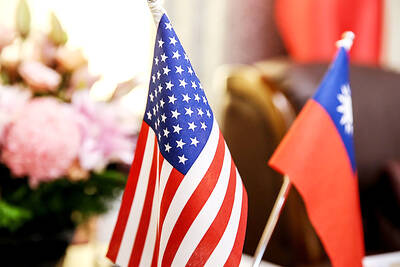
STAYING ALERT: China this week deployed its largest maritime show of force to date in the region, prompting concern in Taipei and Tokyo, which Beijing has brushed off Deterring conflict over Taiwan is a priority, the White House said in its National Security Strategy published yesterday, which also called on Japan and South Korea to increase their defense spending to help protect the first island chain. Taiwan is strategically positioned between Northeast and Southeast Asia, and provides direct access to the second island chain, with one-third of global shipping passing through the South China Sea, the report said. Given the implications for the US economy, along with Taiwan’s dominance in semiconductors, “deterring a conflict over Taiwan, ideally by preserving military overmatch, is a priority,” it said. However, the strategy also reiterated
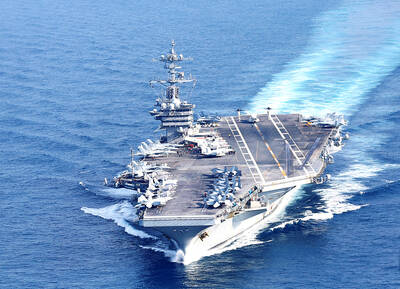
‘BALANCE OF POWER’: Hegseth said that the US did not want to ‘strangle’ China, but to ensure that none of Washington’s allies would be vulnerable to military aggression Washington has no intention of changing the “status quo” in the Taiwan Strait, US Secretary of Defense Pete Hegseth said on Saturday, adding that one of the US military’s main priorities is to deter China “through strength, not through confrontation.” Speaking at the annual Reagan National Defense Forum in Simi Valley, California, Hegseth outlined the US Department of Defense’s priorities under US President Donald Trump. “First, defending the US homeland and our hemisphere. Second, deterring China through strength, not confrontation. Third, increased burden sharing for us, allies and partners. And fourth, supercharging the US defense industrial base,” he said. US-China relations under
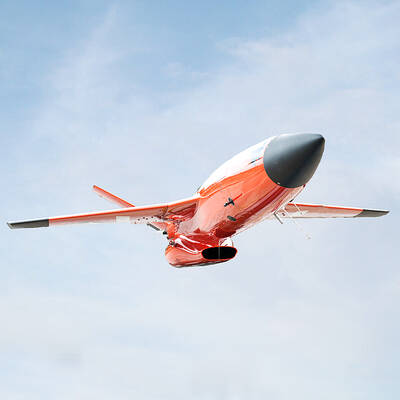
The Chien Feng IV (勁蜂, Mighty Hornet) loitering munition is on track to enter flight tests next month in connection with potential adoption by Taiwanese and US armed forces, a government source said yesterday. The kamikaze drone, which boasts a range of 1,000km, debuted at the Taipei Aerospace and Defense Technology Exhibition in September, the official said on condition of anonymity. The Chungshan Institute of Science and Technology and US-based Kratos Defense jointly developed the platform by leveraging the engine and airframe of the latter’s MQM-178 Firejet target drone, they said. The uncrewed aerial vehicle is designed to utilize an artificial intelligence computer


 RSS
RSS