


Tour groups, but not individual travelers, are banned from visiting China as of today, the Tourism Bureau said yesterday as the government stepped up its efforts to prevent the spread of the 2019 novel coronavirus (2019-nCoV).
The announcement came as the Central Epidemic Command Center confirmed two more cases of 2019-nCoV, bringing the nation’s total to three.
The center said free antiviral drugs would be available to anyone clinically confirmed to have flu-like symptoms, regardless of nationality, and.
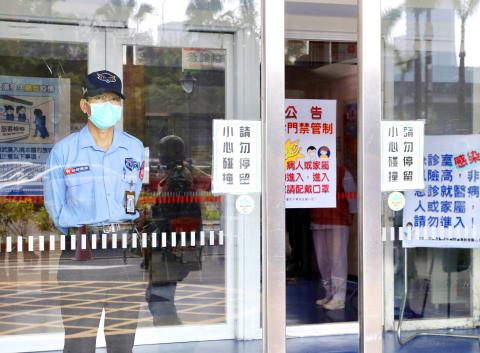
Photo: CNA
The bureau’s ban follows China banning Chinese tour groups from leaving the nation, Tourism Bureau Director-General Chou Yung-hui (周永暉) said.
The decision was made after Ministry of Transportation and Communications officials met with Travel Agents Association representatives.
The bureau backed regulating tour groups headed for China, as Chinese travel agencies might not be able to receive them, and it would be dangerous for them to visit China, Chou said.
The bureau respects people’s freedom to visit China as individual, but it is urging people not to go unless absolutely necessary, in which case they should pay special attention to their health, he said.
Taiwanese returning from China are to be monitored for two weeks to make sure that they have not been infected with the virus, which could strain resources, he added.
The Central Epidemic Command Center said free antiviral drugs would be available through the end of next month.
If the antiviral drugs prove effective, it would rule out 2019-nCoV, because there is no treatment for that virus at present.
This approach would help differentiate between the new virus and influenza, as Taiwan is now in its peak flu season, Centers for Disease Control (CDC) Deputy Director-General Chuang Jen-hsiang (莊人祥) said.
The command center has also widened its requirements for reporting suspected cases of 2019-nCoV.
Under the latest government directive, doctors are required to report to the CDC if a patient has h a fever or acute respiratory infection and has been to Wuhan, China, at least 14 days prior to falling ill, Chuang told a news conference in Taipei.
Previously, suspected cases were identified as having both a fever and acute respiratory infection, and having been in Wuhan at least 14 days before the symptoms appeared.
As of 4pm yesterday, 168 cases of people displaying pneumonia-like symptoms had been reported, including 35 reported yesterday and 70 on Thursday, the command center said.
Of the 168 cases, 2019-nCoV has been ruled out in 42, preliminary tests were negative in 23 more and 103 people remain under quarantine, it added.
In the two new confirmed cases of 2019-nCoV, one patient is a Chinese tourist from Wuhan and the other is a Taiwanese man who had been to Wuhan, it said.
The nation’s first case was confirmed on Tuesday.
The Coast Guard Administration yesterday announced it would increase inspections of people and crew of civilian ships that have recently visited Chinese cities hit by the new virus and would pay close attention to anyone trying to enter the nation illegally.
It would work closely with the CDC and the Bureau of Animal and Plant Health Inspection and Quarantine, and focus its inspections on the “small three links” ports in Kinmen, Lienchiang and Penghu counties, it said.
The National Palace Museum yesterday began taking the temperature of Chinese visitors, while employees at the museum — as well as staff at the Taipei Children’s Amusement Park, the Taipei Arena and Taipei Rapid Transit Corp (TRTC) — began wearing masks at work.
TRTC said it has increased disinfection of MRT cars to twice a week and has been urging passengers to wash their hands frequently and wear masks if they are experiencing any discomfort.
Additional reporting by CNA

The Tourism Administration yesterday announced that it would reward repeat international visitors with incentives of up to NT$8,000 to boost inbound tourism. The incentives are available to all international tourists, it said, adding that repeat visitors would be rewarded with NT$5,000 and would receive an additional NT$3,000 if they bring travel companions. The nation received 2,990,657 inbound visitors during the first quarter, marking a 3.8 percent increase from the same period last year, agency data showed. Japanese nationals are among groups visiting Taiwan the most. About 1.48 million Japanese tourists arrived last year, a year-on-year increase of more than 12

66 FIGHTER JETS: The aircraft is likely undergoing preparations for its transfer to Taiwan — a significant step forward in the nation’s modernization program, a lawmaker said The first of Taiwan’s order of F-16V Block 70 aircraft has been sighted in Texas ahead of delivery, Democratic Progressive Party (DPP) Legislator Wang Ting-yu (王定宇) said. Taiwan’s first F-16V Block 70 two-seat aircraft, tail number 6831, was seen flying from Lockheed Martin’s production facility in Greenville, South Carolina, to Naval Air Station Joint Reserve Base Fort Worth in Texas, Wang wrote on Facebook yesterday. The plane is likely undergoing preparations for its transfer to Taiwan, marking a significant step forward in the Republic of China Air Force’s modernization program, Wang said, citing military analysts. The F-16V Block 70 is a new-build version

‘BRAZEN’: The holiday did not stop China from activities that infringe on Taiwan’s maritime jurisdiction, but the CGA is ready to defend the nation, Kuan Bi-ling said Beijing is intensifying maritime pressure on Taiwan, but the nation will never yield, Ocean Affairs Council Deputy Minister Sung Chen-en (宋承恩) said. The Coast Guard Administration (CGA) has adopted a “shadowing and monitoring” approach to avoid falling into a Chinese trap to escalate tensions and deepen the conflict, Sung said in an interview published yesterday in the Chinese-language Liberty Times (the Taipei Times’ sister newspaper). China Coast Guard formations patrolling waters east of Taiwan, as well as official Chinese vessels entering areas around Itu Aba Island (Taiping Island, 太平島) and Pratas Islands (Dongsha Islands, 東沙群島) show Beijing’s attempts to significantly step up
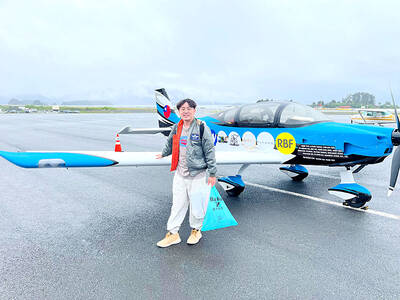
Taiwanese aviator Roger Lin (林睿哲) returned to Taiwan on Saturday after completing a nine-day round-the-world journey in a single-engine aircraft, becoming the first Taiwanese pilot to achieve the feat. Lin departed on June 5 from Los Angeles, California, and continued through Alaska, Japan, Taiwan, the Philippines, Indonesia, Malaysia, Thailand, Nepal, Jordan, Norway, Iceland and Canada before landing at the Taipei International Airport (Songshan) via Los Angeles and Japan. Lin shared numerous photos and videos of his journey on a Facebook page titled “Pilot Roger’s Around the World Flight,” including a video showing his aircraft flying over the Danjiang Bridge and


 RSS
RSS