


Three people yesterday died when a C-130 Hercules aerial water tanker crashed while battling wildfires in the Snowy Monaro region of Australia’s New South Wales, officials said.
New South Wales Premier Gladys Berejiklian confirmed the deaths and crash in comments to reporters, as Australia attempts to deal with an unprecedented fire season that has left a large swath of destruction.
“The only thing I have from the field reports are that the plane came down. It’s crashed and there was a large fireball associated with that crash,” New South Wales Rural Fire Service Commissioner Shane Fitzsimmons said, adding that all three aboard were US residents.
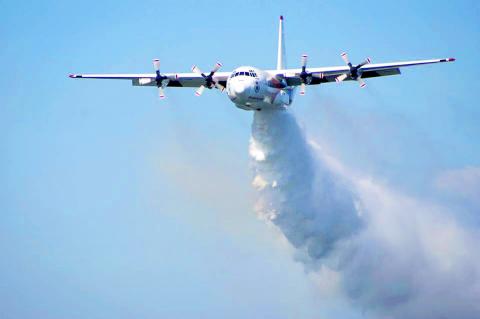
Photo: AP
“Unfortunately, all we’ve been able to do is locate the wreckage and the crash site, and we have not been able to locate any survivors,” he said.
There are more than 1,700 volunteers and personnel in the field, and five fires are being described at an “emergency warning level,” Berejiklian said.
Also yesterday, the Canberra Airport closed because of nearby wildfires and residents south of Australia’s capital were told to seek shelter.
The blaze started on Wednesday, but strong winds and high temperatures caused conditions in Canberra to deteriorate. A second fire near the airport, which started yesterday morning, is at the “watch and act” level.
“Arrivals and departures are affected due to aviation firefighting operations,” the airport authority said in a tweet.
Another tweet from traffic police said that “the fire is moving fast and there are multiple road closures in the area. Please avoid the area. Local road blocks in place.”
Residents in some Canberra suburbs were advised to seek shelter and others to leave immediately.
“The defense force is both assisting to a degree and looking to whether that needs to be reinforced,” Australian Defense Force Chief General Angus Campbell told reporters.

CROSS-STRAIT COLLABORATION: The new KMT chairwoman expressed interest in meeting the Chinese president from the start, but she’ll have to pay to get in Beijing allegedly agreed to let Chinese Nationalist Party (KMT) Chairwoman Cheng Li-wun (鄭麗文) meet with Chinese President Xi Jinping (習近平) around the Lunar New Year holiday next year on three conditions, including that the KMT block Taiwan’s arms purchases, a source said yesterday. Cheng has expressed interest in meeting Xi since she won the KMT’s chairmanship election in October. A source, speaking on condition of anonymity, said a consensus on a meeting was allegedly reached after two KMT vice chairmen visited China’s Taiwan Affairs Office Director Song Tao (宋濤) in China last month. Beijing allegedly gave the KMT three conditions it had to

STAYING ALERT: China this week deployed its largest maritime show of force to date in the region, prompting concern in Taipei and Tokyo, which Beijing has brushed off Deterring conflict over Taiwan is a priority, the White House said in its National Security Strategy published yesterday, which also called on Japan and South Korea to increase their defense spending to help protect the first island chain. Taiwan is strategically positioned between Northeast and Southeast Asia, and provides direct access to the second island chain, with one-third of global shipping passing through the South China Sea, the report said. Given the implications for the US economy, along with Taiwan’s dominance in semiconductors, “deterring a conflict over Taiwan, ideally by preserving military overmatch, is a priority,” it said. However, the strategy also reiterated
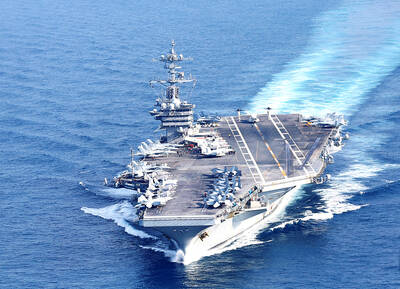
‘BALANCE OF POWER’: Hegseth said that the US did not want to ‘strangle’ China, but to ensure that none of Washington’s allies would be vulnerable to military aggression Washington has no intention of changing the “status quo” in the Taiwan Strait, US Secretary of Defense Pete Hegseth said on Saturday, adding that one of the US military’s main priorities is to deter China “through strength, not through confrontation.” Speaking at the annual Reagan National Defense Forum in Simi Valley, California, Hegseth outlined the US Department of Defense’s priorities under US President Donald Trump. “First, defending the US homeland and our hemisphere. Second, deterring China through strength, not confrontation. Third, increased burden sharing for us, allies and partners. And fourth, supercharging the US defense industrial base,” he said. US-China relations under
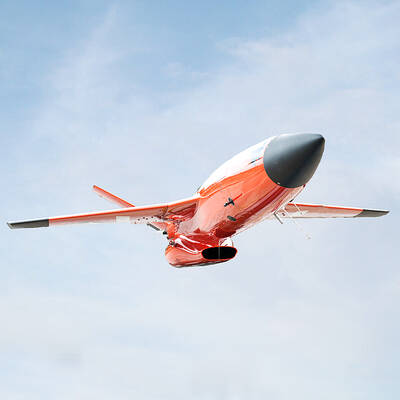
The Chien Feng IV (勁蜂, Mighty Hornet) loitering munition is on track to enter flight tests next month in connection with potential adoption by Taiwanese and US armed forces, a government source said yesterday. The kamikaze drone, which boasts a range of 1,000km, debuted at the Taipei Aerospace and Defense Technology Exhibition in September, the official said on condition of anonymity. The Chungshan Institute of Science and Technology and US-based Kratos Defense jointly developed the platform by leveraging the engine and airframe of the latter’s MQM-178 Firejet target drone, they said. The uncrewed aerial vehicle is designed to utilize an artificial intelligence computer


 RSS
RSS