


Hong Kong Chief Executive Carrie Lam (林鄭月娥) yesterday said that the government was about to announce the formation of an independent committee to study the situation in the territory, which has been rocked by seven months of protests.
Lam said during the annual meeting of the World Economic Forum in Davos, Switzerland, that Chinese President Xi Jinping (習近平) was committed to Hong Kong’s special status.
She also appealed to what she called “violent protesters” not to destroy Hong Kong and said that nothing was more important to the territory than the rule of law.
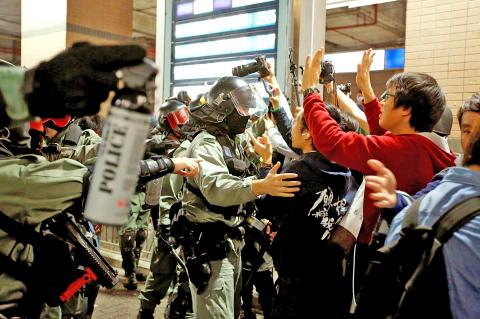
Photo: Reuters
On Tuesday, Lam sought to convince global business and political leaders at Davos that the Asian financial hub is open for business.
Hong Kong’s status has come under scrutiny as seven months of sometimes violent demonstrations have paralyzed parts of the territory and forced businesses to close, posing the gravest popular challenge to Xi since he took power in 2012.
Lam and “Team HK,” including Hong Kong Secretary for Commerce and Economic Development Edward Yau (邱騰華), top officials from the stock exchange, the Airport Authority of Hong Kong, MTR Corp and the head of Swire Group, are at the Swiss mountain resort after Moody’s Investors Service this week downgraded Hong Kong.
HKEX chairman Laura Cha (史美倫) on Tuesday said that Hong Kong has held up remarkably well despite the protests.
“We are resilient. We are stable and investors still have confidence in us,” Cha said in Davos. “The rule of law is sound in Hong Kong.”
Speaking in an interview with CNBC in Davos, Lam said that she was “very disappointed” by the Moody’s decision.
Another challenge is to tame the protest movement — which kicked off the year with rally that organizers said drew 1 million people — and bolster support for the beleaguered government ahead of key elections in September.
On Sunday, police fired teargas to disperse thousands gathered in Chater Garden, a small open park ringed by the Asian headquarters of leading global investment banks and law firms.
“There will be a major crisis of governability because I think the government has no credibility and I think it faces major resistance, both in the legislature and district councils,” said Ma Ngok (馬嶽), a political scientist at the Chinese University of Hong Kong.

CROSS-STRAIT COLLABORATION: The new KMT chairwoman expressed interest in meeting the Chinese president from the start, but she’ll have to pay to get in Beijing allegedly agreed to let Chinese Nationalist Party (KMT) Chairwoman Cheng Li-wun (鄭麗文) meet with Chinese President Xi Jinping (習近平) around the Lunar New Year holiday next year on three conditions, including that the KMT block Taiwan’s arms purchases, a source said yesterday. Cheng has expressed interest in meeting Xi since she won the KMT’s chairmanship election in October. A source, speaking on condition of anonymity, said a consensus on a meeting was allegedly reached after two KMT vice chairmen visited China’s Taiwan Affairs Office Director Song Tao (宋濤) in China last month. Beijing allegedly gave the KMT three conditions it had to

STAYING ALERT: China this week deployed its largest maritime show of force to date in the region, prompting concern in Taipei and Tokyo, which Beijing has brushed off Deterring conflict over Taiwan is a priority, the White House said in its National Security Strategy published yesterday, which also called on Japan and South Korea to increase their defense spending to help protect the first island chain. Taiwan is strategically positioned between Northeast and Southeast Asia, and provides direct access to the second island chain, with one-third of global shipping passing through the South China Sea, the report said. Given the implications for the US economy, along with Taiwan’s dominance in semiconductors, “deterring a conflict over Taiwan, ideally by preserving military overmatch, is a priority,” it said. However, the strategy also reiterated

‘BALANCE OF POWER’: Hegseth said that the US did not want to ‘strangle’ China, but to ensure that none of Washington’s allies would be vulnerable to military aggression Washington has no intention of changing the “status quo” in the Taiwan Strait, US Secretary of Defense Pete Hegseth said on Saturday, adding that one of the US military’s main priorities is to deter China “through strength, not through confrontation.” Speaking at the annual Reagan National Defense Forum in Simi Valley, California, Hegseth outlined the US Department of Defense’s priorities under US President Donald Trump. “First, defending the US homeland and our hemisphere. Second, deterring China through strength, not confrontation. Third, increased burden sharing for us, allies and partners. And fourth, supercharging the US defense industrial base,” he said. US-China relations under
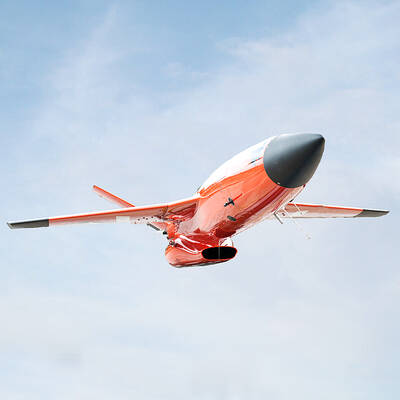
The Chien Feng IV (勁蜂, Mighty Hornet) loitering munition is on track to enter flight tests next month in connection with potential adoption by Taiwanese and US armed forces, a government source said yesterday. The kamikaze drone, which boasts a range of 1,000km, debuted at the Taipei Aerospace and Defense Technology Exhibition in September, the official said on condition of anonymity. The Chungshan Institute of Science and Technology and US-based Kratos Defense jointly developed the platform by leveraging the engine and airframe of the latter’s MQM-178 Firejet target drone, they said. The uncrewed aerial vehicle is designed to utilize an artificial intelligence computer


 RSS
RSS