


Chinese President Xi Jinping (習近平) yesterday said that it was “extremely crucial” to take every possible measure to combat a new coronavirus, which has infected 217 people in the country and as South Korea reported its first case.
Xi’s remarks, cited by state broadcaster China Central Television (CCTV), came the same day that China reported a sharp rise in the number of people infected by the novel form of viral pneumonia, including the first cases in Beijing.
The outbreak comes as China enters its busiest travel period, when millions board trains and airplanes for the Lunar New Year holiday.
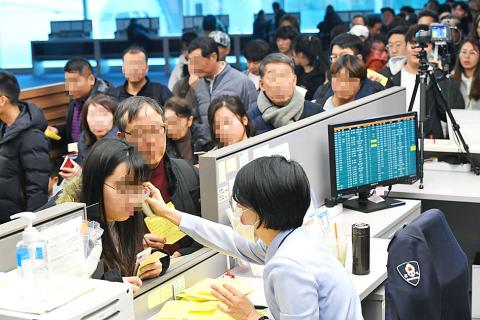
Photo: EPA-EFE
Health authorities in the central city of Wuhan, where the viral pneumonia appears to have originated, said an additional 136 cases have been confirmed in the city, which now has a total of 198 infected patients.
As of the weekend, a third patient had died.
Five people in Beijing and 14 in Guangdong Province have also been diagnosed with the new coronavirus, CCTV reported last night.
A total of seven suspected cases have been found in other parts of China, including in Sichuan and Yunnan provinces as well as Shanghai.
The outbreak has put other countries on alert as millions of Chinese travel for the Lunar New Year.
Authorities in Thailand and in Japan have already identified at least three cases, all involving recent travel from China.
South Korea yesterday reported that a 35-year-old Chinese woman from Wuhan tested positive for the new coronavirus one day after arriving at Seoul’s Incheon International Airport.
The woman has been isolated at a state-run hospital in Incheon City, the South Korean Centers for Disease Control and Prevention said in a statement.
At least a half-dozen countries in Asia and three US airports have started screening incoming airline passengers from central China.
Videos posted online show people in protective suits checking one-by-one the temperatures of plane passengers arriving in Macau from Wuhan.
Many of the initial cases of the coronavirus were linked to a seafood market in Wuhan, which was closed as authorities investigated.
Since hundreds of people who came into close contact with diagnosed patients have not gotten sick, the municipal health commission maintains that the virus is not easily transmitted between humans, although it has not ruled out limited human-to-human transmission.
China’s National Health Commission said experts have judged the outbreak to be “preventable and controllable.”
“However, the source of the new type of coronavirus has not been found, we do not fully understand how the virus is transmitted, and changes in the virus still need to be closely monitored,” the commission said in a statement on Sunday.
“The recent outbreak of novel coronavirus pneumonia in Wuhan and other places must be taken seriously,” Xi said, according to CCTV. “Party committees, governments and relevant departments at all levels should put people’s lives and health first.”
Coronaviruses cause diseases ranging from the common cold to SARS, which first infected people in southern China in late 2002 and spread to more than two dozen countries, killing nearly 800.
The Chinese government initially tried to conceal the severity of the SARS epidemic, but its cover-up was exposed by a high-ranking physician.
“In the early days of SARS, reports were delayed and covered up,” a Global Times editorial said. “That kind of thing must not happen again in China.”
Xi yesterday instructed government departments to promptly release information on the virus and deepen international cooperation.
China has notified and maintained close communication with the WHO and other relevant countries and regions, Chinese Ministry of Foreign Affairs spokesman Geng Shuang (耿爽) said at a regular news briefing.
Wuhan has also adopted measures to control the flow of people leaving the city, Geng said.

CROSS-STRAIT COLLABORATION: The new KMT chairwoman expressed interest in meeting the Chinese president from the start, but she’ll have to pay to get in Beijing allegedly agreed to let Chinese Nationalist Party (KMT) Chairwoman Cheng Li-wun (鄭麗文) meet with Chinese President Xi Jinping (習近平) around the Lunar New Year holiday next year on three conditions, including that the KMT block Taiwan’s arms purchases, a source said yesterday. Cheng has expressed interest in meeting Xi since she won the KMT’s chairmanship election in October. A source, speaking on condition of anonymity, said a consensus on a meeting was allegedly reached after two KMT vice chairmen visited China’s Taiwan Affairs Office Director Song Tao (宋濤) in China last month. Beijing allegedly gave the KMT three conditions it had to
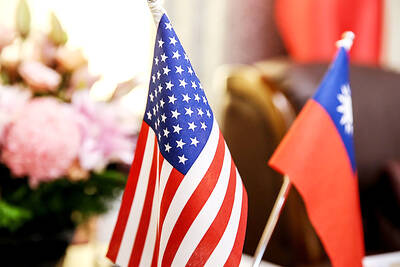
STAYING ALERT: China this week deployed its largest maritime show of force to date in the region, prompting concern in Taipei and Tokyo, which Beijing has brushed off Deterring conflict over Taiwan is a priority, the White House said in its National Security Strategy published yesterday, which also called on Japan and South Korea to increase their defense spending to help protect the first island chain. Taiwan is strategically positioned between Northeast and Southeast Asia, and provides direct access to the second island chain, with one-third of global shipping passing through the South China Sea, the report said. Given the implications for the US economy, along with Taiwan’s dominance in semiconductors, “deterring a conflict over Taiwan, ideally by preserving military overmatch, is a priority,” it said. However, the strategy also reiterated
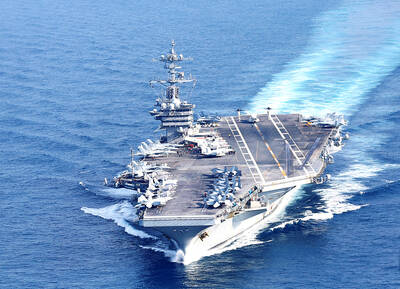
‘BALANCE OF POWER’: Hegseth said that the US did not want to ‘strangle’ China, but to ensure that none of Washington’s allies would be vulnerable to military aggression Washington has no intention of changing the “status quo” in the Taiwan Strait, US Secretary of Defense Pete Hegseth said on Saturday, adding that one of the US military’s main priorities is to deter China “through strength, not through confrontation.” Speaking at the annual Reagan National Defense Forum in Simi Valley, California, Hegseth outlined the US Department of Defense’s priorities under US President Donald Trump. “First, defending the US homeland and our hemisphere. Second, deterring China through strength, not confrontation. Third, increased burden sharing for us, allies and partners. And fourth, supercharging the US defense industrial base,” he said. US-China relations under
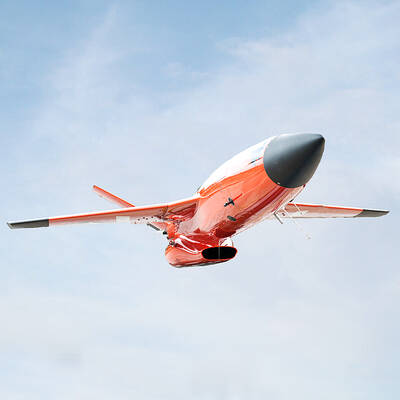
The Chien Feng IV (勁蜂, Mighty Hornet) loitering munition is on track to enter flight tests next month in connection with potential adoption by Taiwanese and US armed forces, a government source said yesterday. The kamikaze drone, which boasts a range of 1,000km, debuted at the Taipei Aerospace and Defense Technology Exhibition in September, the official said on condition of anonymity. The Chungshan Institute of Science and Technology and US-based Kratos Defense jointly developed the platform by leveraging the engine and airframe of the latter’s MQM-178 Firejet target drone, they said. The uncrewed aerial vehicle is designed to utilize an artificial intelligence computer


 RSS
RSS