


Germany yesterday brought together the key players in Libya’s long-running civil war, seeking to curb foreign military interference, solidify a ceasefire and help relaunch a political process to stop the chaos in the nation.
German Chancellor Angela Merkel invited leaders from 12 countries as well as the UN, the EU, the African Union and the Arab League to the summit at the chancellery in Berlin.
Germany’s months-long diplomatic drive seeks to bolster efforts to stop the fighting in Libya by UN Secretary-General Antonio Guterres and his envoy for Libya, Ghassan Salame.
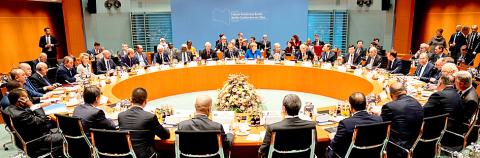
Photo: Reuters
Among those taking part were Russian President Vladimir Putin, Turkish President Recep Tayyip Erdogan, French President Emmanuel Macron, Italian Prime Minister Giuseppe Conte, British Prime Minister Boris Johnson, US Secretary of State Mike Pompeo and Libya’s rival leaders: Prime Minister Fayez Sarraj and General Khalifa Haftar.
However, the chances of the summit producing any real progress are unclear.
A truce brokered earlier this month by Russia and Turkey marked the first break in fighting in months, but the ceasefire has seen repeated violations.
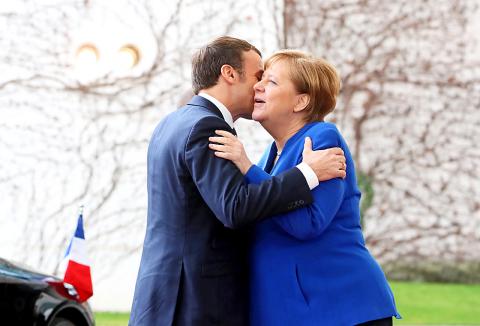
Photo: EPA-EFE
Speaking at Istanbul’s Ataturk Airport before flying to the summit, Erdogan said the world had failed to respond adequately to Haftar’s “reckless attacks” on Sarraj’s UN-recognized government.
“Hopes that flourish again with the ceasefire and the Berlin summit should not be sacrificed to the ambitions of the merchants of blood and chaos,” he said.
Libya is divided into rival administrations: the UN-recognized government based in Tripoli, headed by Sarraj, and one based in the country’s east, supported by Haftar’s forces and backed by Egypt, Russia and the United Arab Emirates.
Germany’s priority is to try to get the outside players that have interests in the conflict on the same page, stem the flow of weapons to Libya and ensure that the ceasefire sticks — creating space for UN-led efforts to re-establish a political process in Libya.
German officials have been careful to keep expectations in check.
“The conference is important, but it is a beginning, the start of a process,” spokeswoman Ulrike Demmer said.

CROSS-STRAIT COLLABORATION: The new KMT chairwoman expressed interest in meeting the Chinese president from the start, but she’ll have to pay to get in Beijing allegedly agreed to let Chinese Nationalist Party (KMT) Chairwoman Cheng Li-wun (鄭麗文) meet with Chinese President Xi Jinping (習近平) around the Lunar New Year holiday next year on three conditions, including that the KMT block Taiwan’s arms purchases, a source said yesterday. Cheng has expressed interest in meeting Xi since she won the KMT’s chairmanship election in October. A source, speaking on condition of anonymity, said a consensus on a meeting was allegedly reached after two KMT vice chairmen visited China’s Taiwan Affairs Office Director Song Tao (宋濤) in China last month. Beijing allegedly gave the KMT three conditions it had to

STAYING ALERT: China this week deployed its largest maritime show of force to date in the region, prompting concern in Taipei and Tokyo, which Beijing has brushed off Deterring conflict over Taiwan is a priority, the White House said in its National Security Strategy published yesterday, which also called on Japan and South Korea to increase their defense spending to help protect the first island chain. Taiwan is strategically positioned between Northeast and Southeast Asia, and provides direct access to the second island chain, with one-third of global shipping passing through the South China Sea, the report said. Given the implications for the US economy, along with Taiwan’s dominance in semiconductors, “deterring a conflict over Taiwan, ideally by preserving military overmatch, is a priority,” it said. However, the strategy also reiterated
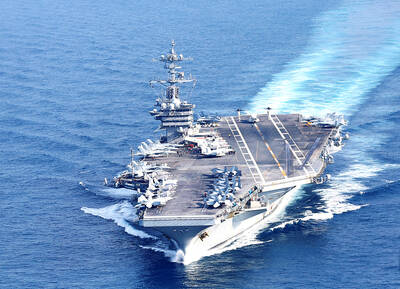
‘BALANCE OF POWER’: Hegseth said that the US did not want to ‘strangle’ China, but to ensure that none of Washington’s allies would be vulnerable to military aggression Washington has no intention of changing the “status quo” in the Taiwan Strait, US Secretary of Defense Pete Hegseth said on Saturday, adding that one of the US military’s main priorities is to deter China “through strength, not through confrontation.” Speaking at the annual Reagan National Defense Forum in Simi Valley, California, Hegseth outlined the US Department of Defense’s priorities under US President Donald Trump. “First, defending the US homeland and our hemisphere. Second, deterring China through strength, not confrontation. Third, increased burden sharing for us, allies and partners. And fourth, supercharging the US defense industrial base,” he said. US-China relations under
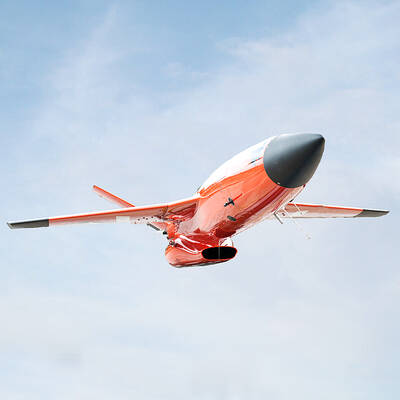
The Chien Feng IV (勁蜂, Mighty Hornet) loitering munition is on track to enter flight tests next month in connection with potential adoption by Taiwanese and US armed forces, a government source said yesterday. The kamikaze drone, which boasts a range of 1,000km, debuted at the Taipei Aerospace and Defense Technology Exhibition in September, the official said on condition of anonymity. The Chungshan Institute of Science and Technology and US-based Kratos Defense jointly developed the platform by leveraging the engine and airframe of the latter’s MQM-178 Firejet target drone, they said. The uncrewed aerial vehicle is designed to utilize an artificial intelligence computer


 RSS
RSS