


Chinese President Xi Jinping (習近平) yesterday doubled down on his support for fallen rights icon Burmese State Councilor Aung San Suu Kyi, signing dozens of infrastructure and trade deals and meeting with the Burmese army chief accused of overseeing a genocide against Rohingya Muslims.
Xi’s state visit to Myanmar’s purpose-built capital, Naypyidaw, came as Western investors are giving a wide berth to the country due to the Rohingya crisis.
A 2017 military crackdown on the minority, which UN investigators called genocide, forced about 740,000 people from western Rakhine State over the border into Bangladesh.
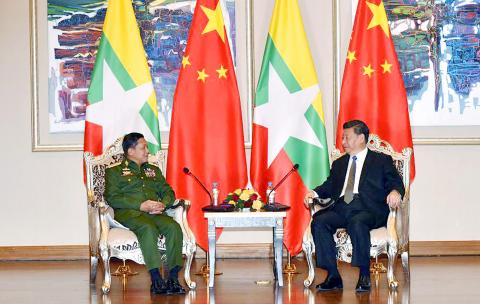
Photo: AP
Beijing has stood by the increasingly isolated nation and reaffirmed its position in a joint statement in Chinese state media as Xi’s airplane left the Burmese capital after two days, escorted by fighter jets.
China “firmly supports Myanmar’s efforts to safeguard its legitimate rights and interests and national dignity in the international arena,” and for it to advance “peace, stability and development in Rakhine State,” the statement said.
China is Myanmar’s largest investor even as distrust of its ambitions lingers among the public.
Thirty-three agreements were signed yesterday, with Aung San Suu Kyi and Xi seated across from each other on long tables alongside ministers.
Details were scant, but among the deals was a concession and shareholders’ agreement on the US$1.3 billion Kyaukhphyu deep-sea port and economic zone, located in a part of Rakhine State left largely unscathed by the 2017 violence.
There was also a letter of intent for “new urban development” in Myanmar’s biggest city, Yangon, and feasibility studies for rail links.
The aim is to carve out a so-called “China-Myanmar Economic Corridor” that would serve as Beijing’s long-awaited gateway to the Indian Ocean.
After his arrival on Friday, Xi called the visit a “historical moment” for China-Myanmar relations, state-run newspaper the Global New Light of Myanmar reported.
He also touched on the “unfairness and inequality in international relations” in what could be seen as a slight against the US, the newspaper said.

CROSS-STRAIT COLLABORATION: The new KMT chairwoman expressed interest in meeting the Chinese president from the start, but she’ll have to pay to get in Beijing allegedly agreed to let Chinese Nationalist Party (KMT) Chairwoman Cheng Li-wun (鄭麗文) meet with Chinese President Xi Jinping (習近平) around the Lunar New Year holiday next year on three conditions, including that the KMT block Taiwan’s arms purchases, a source said yesterday. Cheng has expressed interest in meeting Xi since she won the KMT’s chairmanship election in October. A source, speaking on condition of anonymity, said a consensus on a meeting was allegedly reached after two KMT vice chairmen visited China’s Taiwan Affairs Office Director Song Tao (宋濤) in China last month. Beijing allegedly gave the KMT three conditions it had to

STAYING ALERT: China this week deployed its largest maritime show of force to date in the region, prompting concern in Taipei and Tokyo, which Beijing has brushed off Deterring conflict over Taiwan is a priority, the White House said in its National Security Strategy published yesterday, which also called on Japan and South Korea to increase their defense spending to help protect the first island chain. Taiwan is strategically positioned between Northeast and Southeast Asia, and provides direct access to the second island chain, with one-third of global shipping passing through the South China Sea, the report said. Given the implications for the US economy, along with Taiwan’s dominance in semiconductors, “deterring a conflict over Taiwan, ideally by preserving military overmatch, is a priority,” it said. However, the strategy also reiterated
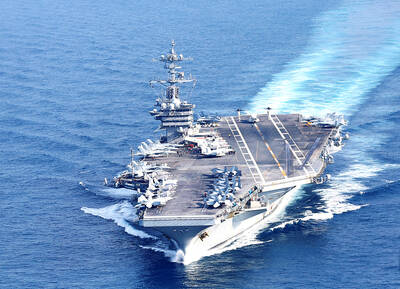
‘BALANCE OF POWER’: Hegseth said that the US did not want to ‘strangle’ China, but to ensure that none of Washington’s allies would be vulnerable to military aggression Washington has no intention of changing the “status quo” in the Taiwan Strait, US Secretary of Defense Pete Hegseth said on Saturday, adding that one of the US military’s main priorities is to deter China “through strength, not through confrontation.” Speaking at the annual Reagan National Defense Forum in Simi Valley, California, Hegseth outlined the US Department of Defense’s priorities under US President Donald Trump. “First, defending the US homeland and our hemisphere. Second, deterring China through strength, not confrontation. Third, increased burden sharing for us, allies and partners. And fourth, supercharging the US defense industrial base,” he said. US-China relations under
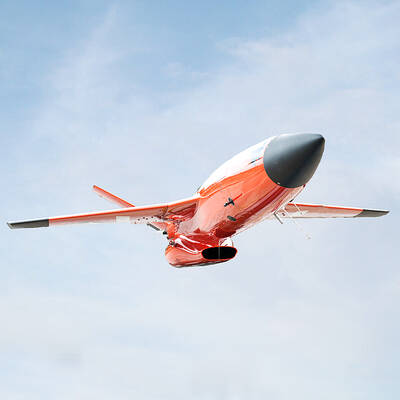
The Chien Feng IV (勁蜂, Mighty Hornet) loitering munition is on track to enter flight tests next month in connection with potential adoption by Taiwanese and US armed forces, a government source said yesterday. The kamikaze drone, which boasts a range of 1,000km, debuted at the Taipei Aerospace and Defense Technology Exhibition in September, the official said on condition of anonymity. The Chungshan Institute of Science and Technology and US-based Kratos Defense jointly developed the platform by leveraging the engine and airframe of the latter’s MQM-178 Firejet target drone, they said. The uncrewed aerial vehicle is designed to utilize an artificial intelligence computer


 RSS
RSS