


Iranian Supreme Leader Ayatollah Ali Khamenei yesterday called the accidental downing of a Ukrainian airliner a “bitter” tragedy, but said that it should not overshadow the “sacrifice” of a top commander killed in a US drone strike.
Khamenei was giving the sermon at the main weekly Muslim prayers in Tehran, after a traumatic month in which the country had appeared on the brink of war with the US and shot down the Ukrainian jet by mistake with the loss of all 176 people on board.
“The plane crash was a bitter accident, it burned through our heart,” Khamenei said in a speech punctuated by cries of “death to America” from the crowd.
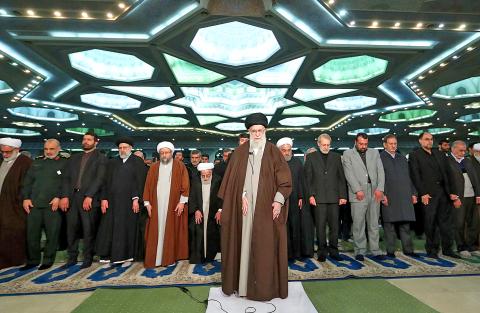
Photo: EPA-EFE / Office of the Iranian Supreme Leader / Handout
“But some tried to ... portray it in a way to forget the great martyrdom and sacrifice” of major general Qassem Soleimani, head of the Iranian Islamic Revolutionary Guard Corps’ Quds Force.
The last time Khamenei led Friday prayers at Tehran’s Mosalla mosque was in February 2012, on the 33rd anniversary of the Islamic revolution and at a time of crisis over Iran’s nuclear ambitions.
His latest appearance came at a tumultuous moment for the country, which had seemed headed for conflict earlier this month after the drone strike killed Soleimani outside Baghdad International Airport, prompting retaliatory Iranian missile strikes against Iraqi bases housing US troops.
The strikes, which caused significant material damage, wounded 11 US troops, US Central Command said on Thursday, contradicting previous reports from the US military of no casualties.
The tensions between Washington and Tehran have abated since Iran’s admission that it accidentally downed the Ukrainian airliner when it was on high alert after its retaliatory strikes against US targets in Iraq.
Most of those killed were Iranians and Canadians.
Khamenei accused Iran’s enemies of exploiting the tragedy for propaganda purposes.
“Our enemies were as happy about the plane crash as we were sad ... happy that they found something to question the [Revolutionary] Guards, the armed forces, the system,” Khamenei said.
The shooting down of the airplane triggered scattered protests in Tehran and other cities.
Praising Soleimani, Khamenei said that his actions beyond Iran’s borders were in the service of the “security” of the nation and that the people are in favor of “firmness” and “resistance” in the face of enemies.
“The few hundred who insulted the picture of general Soleimani, are they the people of Iran? Or this million-strong crowd in the streets?” Khamenei said.
He appeared to be referring to the reported tearing down of a portrait of the general by protesters in Tehran just days after hundreds of thousands of mourners turned out for his funeral.
Canadian Minister of Foreign Affairs Francois-Philippe Champagne on Thursday vowed to press Iran for answers about the tragedy.
Canadian Prime Minister Justin Trudeau has said that US President Donald Trump’s policies contributed to the heightened tensions that led to the catastrophe.
Russian Minister of Foreign Affairs Sergei Lavrov yesterday urged a “de-escalation” of tensions between Iran and the US.
The airplane tragedy “is a very serious red flag and signal to start working on de-escalation, and not on constant threats and combat aviation flights in this region,” Lavrov said.

CROSS-STRAIT COLLABORATION: The new KMT chairwoman expressed interest in meeting the Chinese president from the start, but she’ll have to pay to get in Beijing allegedly agreed to let Chinese Nationalist Party (KMT) Chairwoman Cheng Li-wun (鄭麗文) meet with Chinese President Xi Jinping (習近平) around the Lunar New Year holiday next year on three conditions, including that the KMT block Taiwan’s arms purchases, a source said yesterday. Cheng has expressed interest in meeting Xi since she won the KMT’s chairmanship election in October. A source, speaking on condition of anonymity, said a consensus on a meeting was allegedly reached after two KMT vice chairmen visited China’s Taiwan Affairs Office Director Song Tao (宋濤) in China last month. Beijing allegedly gave the KMT three conditions it had to

STAYING ALERT: China this week deployed its largest maritime show of force to date in the region, prompting concern in Taipei and Tokyo, which Beijing has brushed off Deterring conflict over Taiwan is a priority, the White House said in its National Security Strategy published yesterday, which also called on Japan and South Korea to increase their defense spending to help protect the first island chain. Taiwan is strategically positioned between Northeast and Southeast Asia, and provides direct access to the second island chain, with one-third of global shipping passing through the South China Sea, the report said. Given the implications for the US economy, along with Taiwan’s dominance in semiconductors, “deterring a conflict over Taiwan, ideally by preserving military overmatch, is a priority,” it said. However, the strategy also reiterated
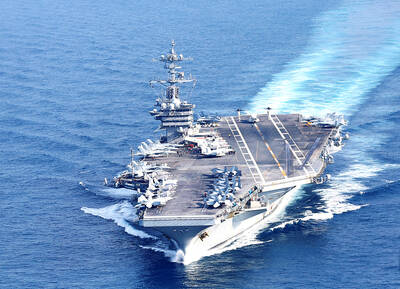
‘BALANCE OF POWER’: Hegseth said that the US did not want to ‘strangle’ China, but to ensure that none of Washington’s allies would be vulnerable to military aggression Washington has no intention of changing the “status quo” in the Taiwan Strait, US Secretary of Defense Pete Hegseth said on Saturday, adding that one of the US military’s main priorities is to deter China “through strength, not through confrontation.” Speaking at the annual Reagan National Defense Forum in Simi Valley, California, Hegseth outlined the US Department of Defense’s priorities under US President Donald Trump. “First, defending the US homeland and our hemisphere. Second, deterring China through strength, not confrontation. Third, increased burden sharing for us, allies and partners. And fourth, supercharging the US defense industrial base,” he said. US-China relations under
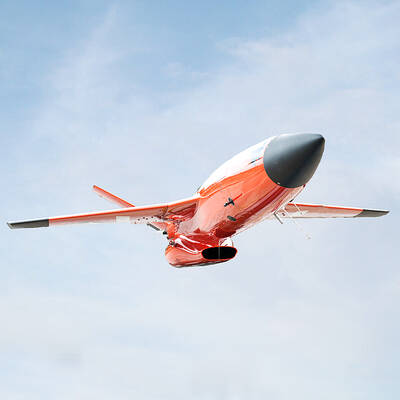
The Chien Feng IV (勁蜂, Mighty Hornet) loitering munition is on track to enter flight tests next month in connection with potential adoption by Taiwanese and US armed forces, a government source said yesterday. The kamikaze drone, which boasts a range of 1,000km, debuted at the Taipei Aerospace and Defense Technology Exhibition in September, the official said on condition of anonymity. The Chungshan Institute of Science and Technology and US-based Kratos Defense jointly developed the platform by leveraging the engine and airframe of the latter’s MQM-178 Firejet target drone, they said. The uncrewed aerial vehicle is designed to utilize an artificial intelligence computer


 RSS
RSS