


The “one country, two systems” framework under which Hong Kong enjoys freedoms unknown in China could continue after a 2047 deadline if loyalty to Beijing is upheld, Hong Kong Chief Executive Carrie Lam (林鄭月娥) said yesterday.
Lam’s comments at the Hong Kong Legislative Council appeared to be an appeal to those who see Beijing as tightening its control over the semi-autonomous territory’s civic, economic and political life.
Hong Kong has been wracked by often violent anti-government protests since June last year, although they have diminished considerably in scale following a landslide win by opposition candidates in elections for district councilors late last year.
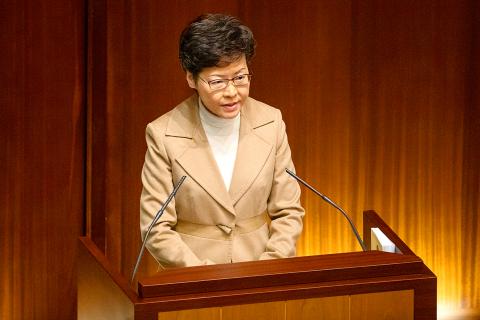
Photo: Bloomberg
Hong Kong was handed over from British to Chinese rule in 1997 with a promise that it would maintain its own capitalist economy and Western-style institutions for 50 years.
“Only if we insist on implementing the ‘one country, two systems’ principle and practice it continuously and fully ... then I think there will be enough grounds for ‘one country, two systems’ to move ahead smoothly and there would be no change after 2047,” Lam said. “We have to uphold the principle of ‘one country.’ Only by doing this, can ‘one country, two systems’ be moving forward smoothly.”
Lam’s comments echoed language from Chinese Communist Party leaders, who have said that Hong Kong’s unique system is predicated on respect for Chinese sovereignty over the territory.
Beijing routinely accuses political opponents in Hong Kong of seeking to split the territory from China with the backing of foreign forces.
While it was not clear whether Lam was speaking in her own right, or under order or in coordination with Beijing, her comments had the feeling of a final warning to the people of Hong Kong that they “need to wear their loyalty to Beijing on their sleeves ... or else,” said Steve Tsang (曾銳生), director of the China Institute at London’s School of Oriental and African Studies.
Tsang pointed to the appointment of hardliner Luo Huining (駱惠寧) as China’s top representative in Hong Kong as an indication of Chinese President Xi Jinping’s (習近平) determination to end the protests.
In that context, Lam’s statement might have been a last-ditch appeal to the opposition in hopes of avoiding more serious consequences, although it is unlikely to have the desired effect, he said.
“I would be very surprised if Lam’s warning would be heeded in Hong Kong,” Tsang said. “Instead, it may well get the hardcore of the protesters annoyed.”
Lam also said that she hoped to announce next month the formation of an independent review committee to look into the root causes of the unrest.
Academics, experts and social leaders have been recruited for the committee, although some are reportedly reluctant to join out of fear of personal attacks or online harassment if their personal information is leaked by opponents.

CROSS-STRAIT COLLABORATION: The new KMT chairwoman expressed interest in meeting the Chinese president from the start, but she’ll have to pay to get in Beijing allegedly agreed to let Chinese Nationalist Party (KMT) Chairwoman Cheng Li-wun (鄭麗文) meet with Chinese President Xi Jinping (習近平) around the Lunar New Year holiday next year on three conditions, including that the KMT block Taiwan’s arms purchases, a source said yesterday. Cheng has expressed interest in meeting Xi since she won the KMT’s chairmanship election in October. A source, speaking on condition of anonymity, said a consensus on a meeting was allegedly reached after two KMT vice chairmen visited China’s Taiwan Affairs Office Director Song Tao (宋濤) in China last month. Beijing allegedly gave the KMT three conditions it had to
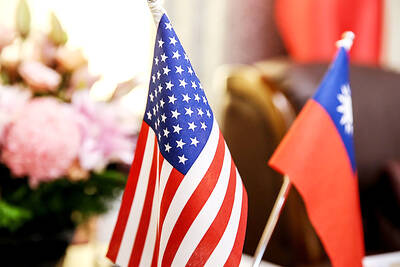
STAYING ALERT: China this week deployed its largest maritime show of force to date in the region, prompting concern in Taipei and Tokyo, which Beijing has brushed off Deterring conflict over Taiwan is a priority, the White House said in its National Security Strategy published yesterday, which also called on Japan and South Korea to increase their defense spending to help protect the first island chain. Taiwan is strategically positioned between Northeast and Southeast Asia, and provides direct access to the second island chain, with one-third of global shipping passing through the South China Sea, the report said. Given the implications for the US economy, along with Taiwan’s dominance in semiconductors, “deterring a conflict over Taiwan, ideally by preserving military overmatch, is a priority,” it said. However, the strategy also reiterated

‘BALANCE OF POWER’: Hegseth said that the US did not want to ‘strangle’ China, but to ensure that none of Washington’s allies would be vulnerable to military aggression Washington has no intention of changing the “status quo” in the Taiwan Strait, US Secretary of Defense Pete Hegseth said on Saturday, adding that one of the US military’s main priorities is to deter China “through strength, not through confrontation.” Speaking at the annual Reagan National Defense Forum in Simi Valley, California, Hegseth outlined the US Department of Defense’s priorities under US President Donald Trump. “First, defending the US homeland and our hemisphere. Second, deterring China through strength, not confrontation. Third, increased burden sharing for us, allies and partners. And fourth, supercharging the US defense industrial base,” he said. US-China relations under
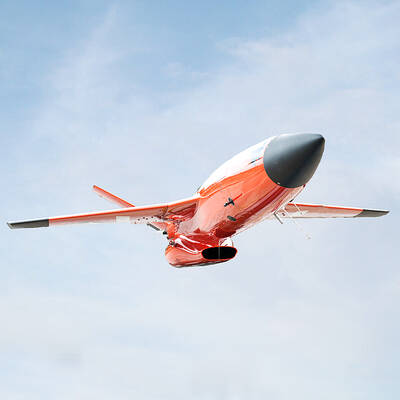
The Chien Feng IV (勁蜂, Mighty Hornet) loitering munition is on track to enter flight tests next month in connection with potential adoption by Taiwanese and US armed forces, a government source said yesterday. The kamikaze drone, which boasts a range of 1,000km, debuted at the Taipei Aerospace and Defense Technology Exhibition in September, the official said on condition of anonymity. The Chungshan Institute of Science and Technology and US-based Kratos Defense jointly developed the platform by leveraging the engine and airframe of the latter’s MQM-178 Firejet target drone, they said. The uncrewed aerial vehicle is designed to utilize an artificial intelligence computer


 RSS
RSS