


Hong Kong authorities yesterday activated a newly created “serious response” level as fears spread about a mysterious infectious disease that might have been introduced to the territory by visitors to a mainland Chinese city.
Five possible cases have been reported of a viral pneumonia that has also infected at least 44 people in Wuhan, an inland city west of Shanghai, about 900km north of Hong Kong.
The outbreak, which emerged last month, has revived memories of the 2002-2003 SARS epidemic that started in southern China and killed more than 700 people in the mainland, Hong Kong and elsewhere.
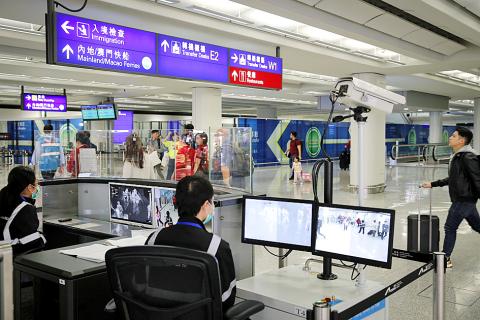
Photo: AP
The serious response level indicates a moderate effect on Hong Kong’s population of 7.5 million people. It is the second-highest in a three-tier system that is part of a new government plan launched yesterday to respond to infectious diseases of unknown cause.
The Hong Kong Department of Health on Friday added an additional thermal imaging system at Hong Kong International Airport to check the body temperature of arriving passengers. More staff have been assigned for temperature checks at the West Kowloon high-speed rail station that connects Hong Kong with China.
Hong Kong Chief Executive Carrie Lam (林鄭月娥) on a visit to the train station on Friday to review the health surveillance measures urged any travelers who develop respiratory symptoms to wear surgical masks, seek medical attention and let doctors know where they have visited.
Wuhan’s health commission said that 11 of 44 people diagnosed with the pneumonia were in a critical condition as of Friday.
All were being treated in isolation and 121 others who had been in close contact with them were under observation, it added.
Most of the cases have been traced to the South China Seafood City food market in the suburbs of sprawling Wuhan, where offerings reportedly include wild animals that can carry viruses dangerous to humans.
The market has been disinfected, the commission said.
The most common symptom has been fever, with shortness of breath and lung infections in a small number of cases, the commission said, adding that there have been no clear indications of human-to-human transmission of the disease.
The latest cases in Hong Kong are two females, aged 12 and 41, who had been to Wuhan in the past two weeks, but did not appear to have visited the food market, the Hong Kong Hospital Authority said, adding that they were in a stable condition and being treated in isolation at Princess Margaret Hospital.

CROSS-STRAIT COLLABORATION: The new KMT chairwoman expressed interest in meeting the Chinese president from the start, but she’ll have to pay to get in Beijing allegedly agreed to let Chinese Nationalist Party (KMT) Chairwoman Cheng Li-wun (鄭麗文) meet with Chinese President Xi Jinping (習近平) around the Lunar New Year holiday next year on three conditions, including that the KMT block Taiwan’s arms purchases, a source said yesterday. Cheng has expressed interest in meeting Xi since she won the KMT’s chairmanship election in October. A source, speaking on condition of anonymity, said a consensus on a meeting was allegedly reached after two KMT vice chairmen visited China’s Taiwan Affairs Office Director Song Tao (宋濤) in China last month. Beijing allegedly gave the KMT three conditions it had to
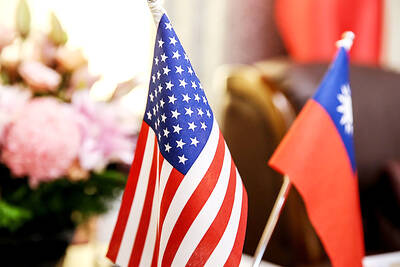
STAYING ALERT: China this week deployed its largest maritime show of force to date in the region, prompting concern in Taipei and Tokyo, which Beijing has brushed off Deterring conflict over Taiwan is a priority, the White House said in its National Security Strategy published yesterday, which also called on Japan and South Korea to increase their defense spending to help protect the first island chain. Taiwan is strategically positioned between Northeast and Southeast Asia, and provides direct access to the second island chain, with one-third of global shipping passing through the South China Sea, the report said. Given the implications for the US economy, along with Taiwan’s dominance in semiconductors, “deterring a conflict over Taiwan, ideally by preserving military overmatch, is a priority,” it said. However, the strategy also reiterated
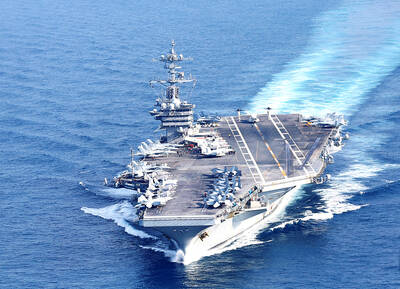
‘BALANCE OF POWER’: Hegseth said that the US did not want to ‘strangle’ China, but to ensure that none of Washington’s allies would be vulnerable to military aggression Washington has no intention of changing the “status quo” in the Taiwan Strait, US Secretary of Defense Pete Hegseth said on Saturday, adding that one of the US military’s main priorities is to deter China “through strength, not through confrontation.” Speaking at the annual Reagan National Defense Forum in Simi Valley, California, Hegseth outlined the US Department of Defense’s priorities under US President Donald Trump. “First, defending the US homeland and our hemisphere. Second, deterring China through strength, not confrontation. Third, increased burden sharing for us, allies and partners. And fourth, supercharging the US defense industrial base,” he said. US-China relations under
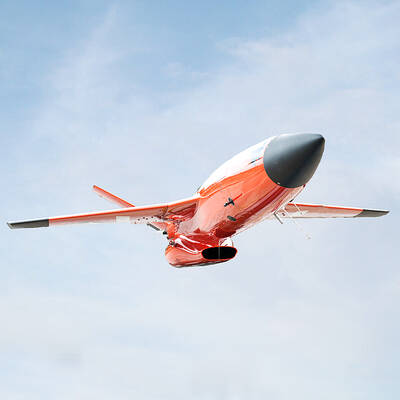
The Chien Feng IV (勁蜂, Mighty Hornet) loitering munition is on track to enter flight tests next month in connection with potential adoption by Taiwanese and US armed forces, a government source said yesterday. The kamikaze drone, which boasts a range of 1,000km, debuted at the Taipei Aerospace and Defense Technology Exhibition in September, the official said on condition of anonymity. The Chungshan Institute of Science and Technology and US-based Kratos Defense jointly developed the platform by leveraging the engine and airframe of the latter’s MQM-178 Firejet target drone, they said. The uncrewed aerial vehicle is designed to utilize an artificial intelligence computer


 RSS
RSS