


A furious Iran threatened to avenge a US strike yesterday that killed a top Iranian commander at Baghdad International Airport, raising fears of a wider regional conflict between the archfoes.
The Pentagon said that US President Donald Trump had ordered General Qasem Soleimani’s “killing” after a pro-Iran mob this week laid siege to the US embassy in the Iraqi capital.
Iranian Supreme Leader Ayatollah Ali Khamenei swiftly promised “severe revenge” for Soleimani’s death, the biggest escalation yet in a feared proxy war between Iran and the US on Iraqi soil.
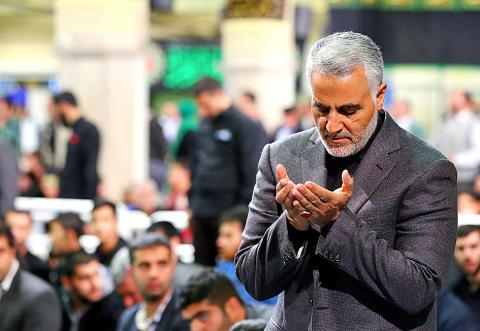
Photo: EPA-EFE
Tens of thousands of angry Iranians took to the streets of Tehran chanting: “Death to America” and holding up posters of Soleimani.
As the US embassy in Baghdad urged all Americans to leave Iraq “immediately,” Trump tweeted a picture of the US flag without any comment.
A volley of missiles early yesterday struck a convoy at the airport belonging to Hashed al-Shaabi, an Iraqi paramilitary force with close ties to Iran.
Hours later, the Iranian Revolutionary Guard Corps announced that Soleimani “was martyred in an attack by America.”
Security sources said that nine people died in the strike, which a US defense official said had been carried out by a drone.
Hashed al-Shaabi confirmed that both Soleimani and its deputy chief, Abu Mahdi al-Muhandis, were among those killed.
Hashed al-Shaabi is a network of mostly Shiite armed units, many of whom have close ties to Tehran, but which have been officially incorporated into Iraqi state security forces.
A leading member, Hadi al-Ameri, said that the attack would “only make us more determined.”
The network said “Iranian advisers” were among those killed, but did not specify how many.
Soleimani headed the Islamic Revolutionary Guard Corps’ Quds Force foreign operations arm and also served as Iran’s point man on Iraq, visiting the nation in times of turmoil.
Khamenei swiftly named Quds Force No. 2 Esmail Qaani to replace him. Al-Muhandis was Hashed al-Shaabi deputy chief, but was widely recognized as the real shot-caller within the group.
Both were targeted by US sanctions.
The pair are to be buried today while the Iraqi parliament holds an emergency meeting on the strike.
Al-Ameri urged lawmakers “to take a bold decision to oust foreign troops from Iraq, because their presence has become a threat for Iraqis.”
The Pentagon said Soleimani had been “actively developing plans to attack American diplomats and service members in Iraq, and throughout the region.”
It said it took “decisive defensive action to protect US personnel abroad by killing Qasem Soleimani,” but did not specify how.
Iranian Minister of Foreign Affairs Mohammad Javad Zarif criticized the US strike as “extremely dangerous and a foolish escalation,” as Khamenei declared three days of mourning.
Iraqi Prime Minister Adel Abdel Mahdi said that the strike was a “flagrant violation” of a security accord with the US, warning it would “spark a devastating war in Iraq.”
However, there were daring celebrations in Baghdad’s Tahrir Square, the epicenter of a three-month protest movement that has criticized the Iraqi government as corrupt and beholden to Tehran.
“Oh Qasem Soleimani, this is a divine victory,” protesters chanted as some danced in the streets.

CROSS-STRAIT COLLABORATION: The new KMT chairwoman expressed interest in meeting the Chinese president from the start, but she’ll have to pay to get in Beijing allegedly agreed to let Chinese Nationalist Party (KMT) Chairwoman Cheng Li-wun (鄭麗文) meet with Chinese President Xi Jinping (習近平) around the Lunar New Year holiday next year on three conditions, including that the KMT block Taiwan’s arms purchases, a source said yesterday. Cheng has expressed interest in meeting Xi since she won the KMT’s chairmanship election in October. A source, speaking on condition of anonymity, said a consensus on a meeting was allegedly reached after two KMT vice chairmen visited China’s Taiwan Affairs Office Director Song Tao (宋濤) in China last month. Beijing allegedly gave the KMT three conditions it had to

STAYING ALERT: China this week deployed its largest maritime show of force to date in the region, prompting concern in Taipei and Tokyo, which Beijing has brushed off Deterring conflict over Taiwan is a priority, the White House said in its National Security Strategy published yesterday, which also called on Japan and South Korea to increase their defense spending to help protect the first island chain. Taiwan is strategically positioned between Northeast and Southeast Asia, and provides direct access to the second island chain, with one-third of global shipping passing through the South China Sea, the report said. Given the implications for the US economy, along with Taiwan’s dominance in semiconductors, “deterring a conflict over Taiwan, ideally by preserving military overmatch, is a priority,” it said. However, the strategy also reiterated
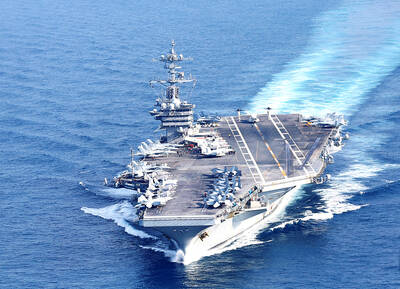
‘BALANCE OF POWER’: Hegseth said that the US did not want to ‘strangle’ China, but to ensure that none of Washington’s allies would be vulnerable to military aggression Washington has no intention of changing the “status quo” in the Taiwan Strait, US Secretary of Defense Pete Hegseth said on Saturday, adding that one of the US military’s main priorities is to deter China “through strength, not through confrontation.” Speaking at the annual Reagan National Defense Forum in Simi Valley, California, Hegseth outlined the US Department of Defense’s priorities under US President Donald Trump. “First, defending the US homeland and our hemisphere. Second, deterring China through strength, not confrontation. Third, increased burden sharing for us, allies and partners. And fourth, supercharging the US defense industrial base,” he said. US-China relations under
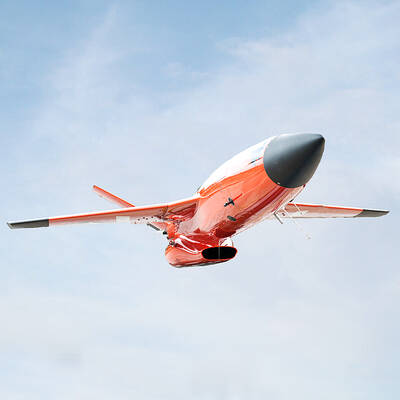
The Chien Feng IV (勁蜂, Mighty Hornet) loitering munition is on track to enter flight tests next month in connection with potential adoption by Taiwanese and US armed forces, a government source said yesterday. The kamikaze drone, which boasts a range of 1,000km, debuted at the Taipei Aerospace and Defense Technology Exhibition in September, the official said on condition of anonymity. The Chungshan Institute of Science and Technology and US-based Kratos Defense jointly developed the platform by leveraging the engine and airframe of the latter’s MQM-178 Firejet target drone, they said. The uncrewed aerial vehicle is designed to utilize an artificial intelligence computer


 RSS
RSS