


Pro-Iran demonstrators yesterday ended a sit-in at the US embassy in Iraq’s capital after an order from the Hashed al-Shaabi military force, an Agence France-Presse correspondent said, a day after their dramatic incursion.
“We burned them!” the demonstrators shouted as they streamed out of the high-security Green Zone housing the embassy just as easily as they had walked in on Tuesday.
Trucks picked up the tents and makeshift barricades that had been brought in for the planned sit-in.
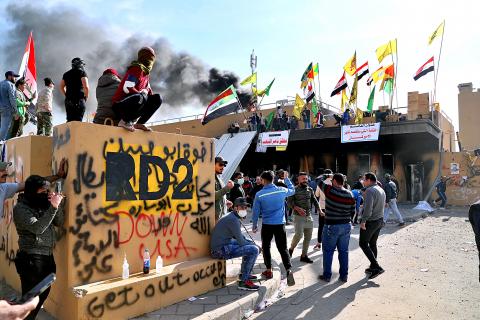
Photo: AP
The Hashed, a powerful paramilitary network integrated into Iraq’s state security forces, ordered its backers to end their protest outside the US mission.
“You delivered your message,” it said in a statement.
Thousands had massed outside the embassy in anger at deadly US airstrikes on pro-Iran Hashed faction, Kataib Hezbollah, that killed 25 paramilitary fighters on Sunday.
Iraqi Prime Minister Adel Abdel Mahdi had called on the Hashed supporters to leave the embassy on Tuesday, but most spent the night in dozens of tents pitched outside the perimeter wall.
Earlier yesterday, a leading Kataib Hezbollah commander told reporters that they would stay outside the embassy.
“We in Kataib Hezbollah won’t withdraw even if the others do,” said the commander, who was among those outside.
US President Donald Trump on Tuesday warned Tehran that it would “pay a very big price” for the attack on the embassy and his government said it was sending hundreds more troops to the Middle East.
US Secretary of State Mike Pompeo said the attack was “orchestrated by terrorists,” one of whom he named as Abu Mahdi al-Muhandis.
Al-Muhandis has been identified as second-in-command of Hashed al-Shaabi.
US Secretary of Defense Mark Esper said that about 750 troops from a rapid response unit of the 82nd Airborne Division were prepared to deploy to the region over the next few days.
“This deployment is an appropriate and precautionary action taken in response to increased threat levels against US personnel and facilities, such as we witnessed in Baghdad today,” he said.
Prior to the announcement, a US official said that “up to 4,000 [troops] may ultimately be deployed.”
The US had already flown a rapid response team of marines into Baghdad to reinforce its embassy after the attack, which left smoke and flames rising from the embassy entrance and further heightened tension between Washington and Tehran.
Trump blamed Tehran for the embassy attack and warned that it would face punishment if Americans are killed.
“Iran will be held fully responsible for lives lost, or damage incurred, at any of our facilities,” Trump wrote on Twitter.
“They will pay a very BIG PRICE! This is not a Warning, it is a Threat,” wrote Trump, adding “Happy New Year!”
Trump later told reporters that he did not foresee war with Tehran.

CROSS-STRAIT COLLABORATION: The new KMT chairwoman expressed interest in meeting the Chinese president from the start, but she’ll have to pay to get in Beijing allegedly agreed to let Chinese Nationalist Party (KMT) Chairwoman Cheng Li-wun (鄭麗文) meet with Chinese President Xi Jinping (習近平) around the Lunar New Year holiday next year on three conditions, including that the KMT block Taiwan’s arms purchases, a source said yesterday. Cheng has expressed interest in meeting Xi since she won the KMT’s chairmanship election in October. A source, speaking on condition of anonymity, said a consensus on a meeting was allegedly reached after two KMT vice chairmen visited China’s Taiwan Affairs Office Director Song Tao (宋濤) in China last month. Beijing allegedly gave the KMT three conditions it had to

STAYING ALERT: China this week deployed its largest maritime show of force to date in the region, prompting concern in Taipei and Tokyo, which Beijing has brushed off Deterring conflict over Taiwan is a priority, the White House said in its National Security Strategy published yesterday, which also called on Japan and South Korea to increase their defense spending to help protect the first island chain. Taiwan is strategically positioned between Northeast and Southeast Asia, and provides direct access to the second island chain, with one-third of global shipping passing through the South China Sea, the report said. Given the implications for the US economy, along with Taiwan’s dominance in semiconductors, “deterring a conflict over Taiwan, ideally by preserving military overmatch, is a priority,” it said. However, the strategy also reiterated
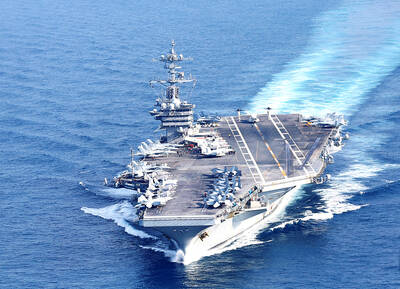
‘BALANCE OF POWER’: Hegseth said that the US did not want to ‘strangle’ China, but to ensure that none of Washington’s allies would be vulnerable to military aggression Washington has no intention of changing the “status quo” in the Taiwan Strait, US Secretary of Defense Pete Hegseth said on Saturday, adding that one of the US military’s main priorities is to deter China “through strength, not through confrontation.” Speaking at the annual Reagan National Defense Forum in Simi Valley, California, Hegseth outlined the US Department of Defense’s priorities under US President Donald Trump. “First, defending the US homeland and our hemisphere. Second, deterring China through strength, not confrontation. Third, increased burden sharing for us, allies and partners. And fourth, supercharging the US defense industrial base,” he said. US-China relations under
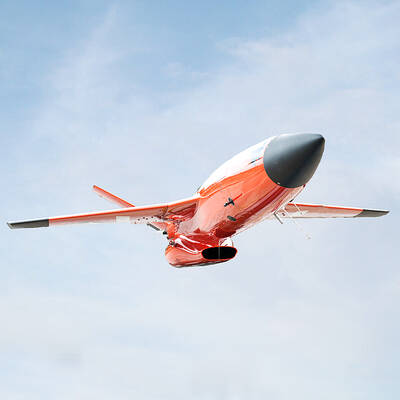
The Chien Feng IV (勁蜂, Mighty Hornet) loitering munition is on track to enter flight tests next month in connection with potential adoption by Taiwanese and US armed forces, a government source said yesterday. The kamikaze drone, which boasts a range of 1,000km, debuted at the Taipei Aerospace and Defense Technology Exhibition in September, the official said on condition of anonymity. The Chungshan Institute of Science and Technology and US-based Kratos Defense jointly developed the platform by leveraging the engine and airframe of the latter’s MQM-178 Firejet target drone, they said. The uncrewed aerial vehicle is designed to utilize an artificial intelligence computer


 RSS
RSS