


The Taipei Police Department is to deploy a counterterrorism unit of 800 officers and five police dogs to enhance public security at New Year’s Eve celebrations in the capital tonight.
With the Taipei New Year’s Eve Party at Taipei City Hall Plaza and the Taipei 101 fireworks to take place in Xinyi District (信義) between 6:30pm tonight and 1am tomorrow, and an expected crowd of more than 100,000 people, Xinyi Precinct yesterday released its plans to enhance public safety.
“The department is to deploy 800 police officers and will implement three stages of traffic controls,” Xinyi Precinct Deputy Chief Chen Yung-hua (陳勇華) said.
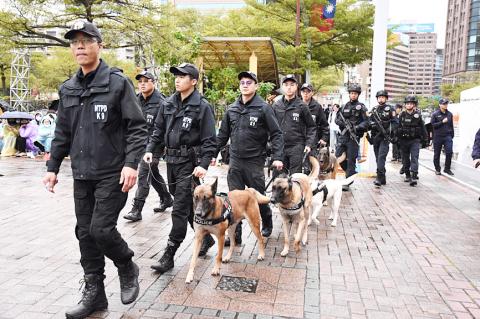
Photo: Yao Yueh-hung, Taipei Times
The counterterrorism unit is to patrol the party venue and its surrounding areas, including Shin Kong Mitsukoshi Plaza and Taipei 101, making sure that prohibited items, such as illegal drugs, guns, knives and explosives, are not brought into the area, Chen said.
Continuing a rule from last year, any type of balloon, including LED-lit and glowing balloons, and drones that have not been approved by event organizers, are not allowed in the controlled area, he said.
Quadcopters equipped with devices that interfere with the radio frequency of conventional drones are to prevent unapproved drone operations over the controlled area, he said, adding that five police dogs would be sniffing for explosives.
People should use public transportation to attend the event, Chen said, adding that large signs at the venue would display a QR code that people could use to direct their smart devices to online information about the event, traffic control measures and parking.
The department’s Traffic Division said the first stage of traffic controls are to begin at 7pm, when vehicles would not be allowed to enter the area bordered by Songren, Zhongxiao E, Xinyi, Yixian, Songgao and Keelung roads.
The second stage is to begin at 8pm, expanding the controlled area to include the whole of Yixian Road and Renai Road between Guangfu S and Yixian roads.
The final stage is to start at 10pm, when all vehicles would be prohibited from entering the area bordered by Songde, Xinyi, Songren, Zhuangjing, Guangfu S and Zhongxiao E roads, as well as Zhongxiao E Road, Sec 5, Lane 236, until 3pm on Wednesday.
More traffic information, including recommended public transportation methods, can be found on the Taipei New Year’s Eve Party’s Web site at www.newyear2020.taipei/en/traffic.html.
The department urges people who are attending the event to follow event staff and police officers’ instructions to avoid incidents, Chen said, adding that they should also take care of their personal belongings, and pay special attention to children and elderly people in the crowd.

CROSS-STRAIT COLLABORATION: The new KMT chairwoman expressed interest in meeting the Chinese president from the start, but she’ll have to pay to get in Beijing allegedly agreed to let Chinese Nationalist Party (KMT) Chairwoman Cheng Li-wun (鄭麗文) meet with Chinese President Xi Jinping (習近平) around the Lunar New Year holiday next year on three conditions, including that the KMT block Taiwan’s arms purchases, a source said yesterday. Cheng has expressed interest in meeting Xi since she won the KMT’s chairmanship election in October. A source, speaking on condition of anonymity, said a consensus on a meeting was allegedly reached after two KMT vice chairmen visited China’s Taiwan Affairs Office Director Song Tao (宋濤) in China last month. Beijing allegedly gave the KMT three conditions it had to

STAYING ALERT: China this week deployed its largest maritime show of force to date in the region, prompting concern in Taipei and Tokyo, which Beijing has brushed off Deterring conflict over Taiwan is a priority, the White House said in its National Security Strategy published yesterday, which also called on Japan and South Korea to increase their defense spending to help protect the first island chain. Taiwan is strategically positioned between Northeast and Southeast Asia, and provides direct access to the second island chain, with one-third of global shipping passing through the South China Sea, the report said. Given the implications for the US economy, along with Taiwan’s dominance in semiconductors, “deterring a conflict over Taiwan, ideally by preserving military overmatch, is a priority,” it said. However, the strategy also reiterated
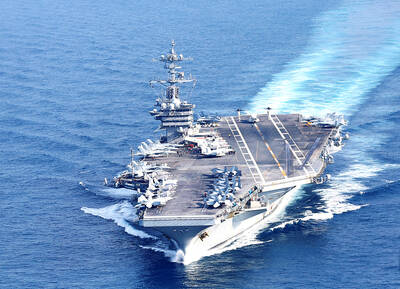
‘BALANCE OF POWER’: Hegseth said that the US did not want to ‘strangle’ China, but to ensure that none of Washington’s allies would be vulnerable to military aggression Washington has no intention of changing the “status quo” in the Taiwan Strait, US Secretary of Defense Pete Hegseth said on Saturday, adding that one of the US military’s main priorities is to deter China “through strength, not through confrontation.” Speaking at the annual Reagan National Defense Forum in Simi Valley, California, Hegseth outlined the US Department of Defense’s priorities under US President Donald Trump. “First, defending the US homeland and our hemisphere. Second, deterring China through strength, not confrontation. Third, increased burden sharing for us, allies and partners. And fourth, supercharging the US defense industrial base,” he said. US-China relations under
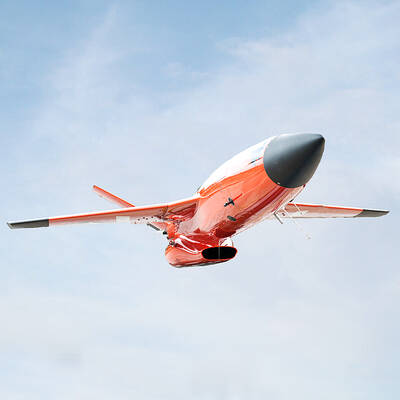
The Chien Feng IV (勁蜂, Mighty Hornet) loitering munition is on track to enter flight tests next month in connection with potential adoption by Taiwanese and US armed forces, a government source said yesterday. The kamikaze drone, which boasts a range of 1,000km, debuted at the Taipei Aerospace and Defense Technology Exhibition in September, the official said on condition of anonymity. The Chungshan Institute of Science and Technology and US-based Kratos Defense jointly developed the platform by leveraging the engine and airframe of the latter’s MQM-178 Firejet target drone, they said. The uncrewed aerial vehicle is designed to utilize an artificial intelligence computer


 RSS
RSS