


North Korea has opened a high-profile political conference to discuss how to overcome “harsh trials and difficulties,” state media reported yesterday, days before a year-end deadline set by Pyongyang for Washington to make concessions in nuclear negotiations.
Some observers predict North Korea might use the conference to announce that it plans to abandon faltering diplomacy with the US and lift its moratorium on major weapons tests.
The Korean Central News Agency (KCNA) reported that North Korean leader Kim Jong-un presided over a plenary meeting of the Central Committee of the Workers’ Party of Korea convened in Pyongyang on Saturday.
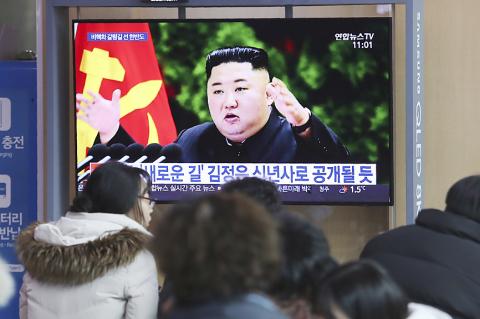
Photo: AP
It called the gathering the “first-day session,” suggesting it would continue for at least another day.
The meeting is intended to “overcome the manifold and harsh trials and difficulties, and further accelerate the development of the revolution with transparent anti-imperialist independent stand and firm will,” the KCNA said.
“Important matters” regarding the party and national defense would also be discussed at the meeting, it said.
Kim made a speech on general state affairs and the work of the central committee, it said, but gave no further details.
In April last year, at the start of nuclear talks with the US, North Korea held a similar party meeting, and announced that it would suspend nuclear and intercontinental ballistic missile tests and shift its national focus to developing the economy.
After his second summit with US President Donald Trump in February in Vietnam failed, Kim gave the US until the end of this year to offer new initiatives to salvage the nuclear negotiations.
North Korea has warned that its resumption of tests of long-range missiles and nuclear devices depends on US action.
Restarting nuclear and missile tests would be a blow to Trump, who has boasted that North Korea’s moratorium was a major foreign policy win.
However, that would also likely completely derail diplomacy with the US and further dim the prospect that North Korea would get badly needed sanctions relief to rebuild its troubled economy, some experts said.
North Korea is pushing for major sanctions relief in return for limited denuclearization steps, but the US maintains that sanctions must stay in place until North Korea takes significant steps toward ridding itself of nuclear weapons and technology.

CROSS-STRAIT COLLABORATION: The new KMT chairwoman expressed interest in meeting the Chinese president from the start, but she’ll have to pay to get in Beijing allegedly agreed to let Chinese Nationalist Party (KMT) Chairwoman Cheng Li-wun (鄭麗文) meet with Chinese President Xi Jinping (習近平) around the Lunar New Year holiday next year on three conditions, including that the KMT block Taiwan’s arms purchases, a source said yesterday. Cheng has expressed interest in meeting Xi since she won the KMT’s chairmanship election in October. A source, speaking on condition of anonymity, said a consensus on a meeting was allegedly reached after two KMT vice chairmen visited China’s Taiwan Affairs Office Director Song Tao (宋濤) in China last month. Beijing allegedly gave the KMT three conditions it had to

STAYING ALERT: China this week deployed its largest maritime show of force to date in the region, prompting concern in Taipei and Tokyo, which Beijing has brushed off Deterring conflict over Taiwan is a priority, the White House said in its National Security Strategy published yesterday, which also called on Japan and South Korea to increase their defense spending to help protect the first island chain. Taiwan is strategically positioned between Northeast and Southeast Asia, and provides direct access to the second island chain, with one-third of global shipping passing through the South China Sea, the report said. Given the implications for the US economy, along with Taiwan’s dominance in semiconductors, “deterring a conflict over Taiwan, ideally by preserving military overmatch, is a priority,” it said. However, the strategy also reiterated
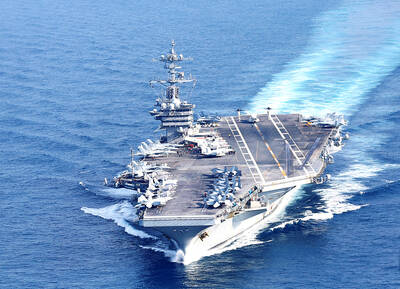
‘BALANCE OF POWER’: Hegseth said that the US did not want to ‘strangle’ China, but to ensure that none of Washington’s allies would be vulnerable to military aggression Washington has no intention of changing the “status quo” in the Taiwan Strait, US Secretary of Defense Pete Hegseth said on Saturday, adding that one of the US military’s main priorities is to deter China “through strength, not through confrontation.” Speaking at the annual Reagan National Defense Forum in Simi Valley, California, Hegseth outlined the US Department of Defense’s priorities under US President Donald Trump. “First, defending the US homeland and our hemisphere. Second, deterring China through strength, not confrontation. Third, increased burden sharing for us, allies and partners. And fourth, supercharging the US defense industrial base,” he said. US-China relations under
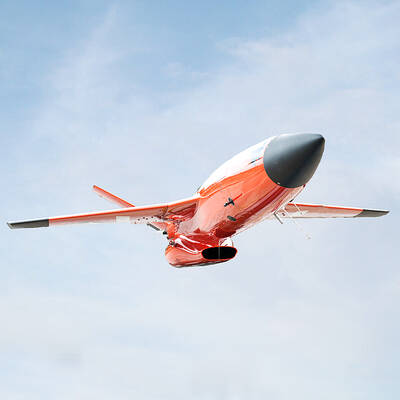
The Chien Feng IV (勁蜂, Mighty Hornet) loitering munition is on track to enter flight tests next month in connection with potential adoption by Taiwanese and US armed forces, a government source said yesterday. The kamikaze drone, which boasts a range of 1,000km, debuted at the Taipei Aerospace and Defense Technology Exhibition in September, the official said on condition of anonymity. The Chungshan Institute of Science and Technology and US-based Kratos Defense jointly developed the platform by leveraging the engine and airframe of the latter’s MQM-178 Firejet target drone, they said. The uncrewed aerial vehicle is designed to utilize an artificial intelligence computer


 RSS
RSS