


Japan yesterday revised a roadmap for the cleanup of the Fukushima Dai-ichi nuclear power plant, further delaying the removal of thousands of spent fuel units that remain in cooling pools since the 2011 disaster.
It is a key step in the decades-long process, underscoring high radiation and other risks.
The government and plant operator Tokyo Electric Power Co (TEPCO) have set a completion target of 30 to 40 years.
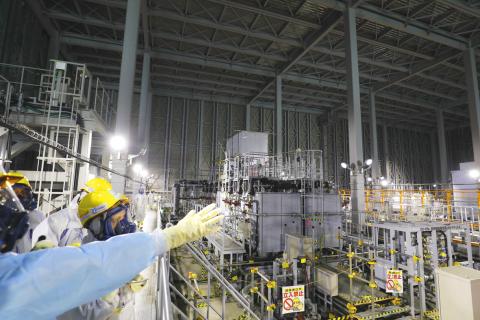
Photo: Bloomberg
More than 4,700 units of fuel rods remain inside the three melted reactors, and two other reactors that survived the 2011 earthquake and tsunami.
They pose a high risk, as their storage pools are uncovered and a loss of water in the case of another disaster could cause fuel rods to melt, releasing radiation.
Their removal at the No. 1 and No. 2 reactors is being delayed by up to 10 years from the initial target of last year, with more preparation needed to reduce radiation, and clear debris and other risks.
TEPCO has been unable to release the 1.2 million tonnes of treated, but radioactive water kept in nearly 1,000 tanks at the plant, fearing public repercussions and the effects on the area’s struggling fishing and farming enterprises.
The water keeps growing by 170 tonnes daily, because it is used to cool the melted fuel.
Removal of an estimated 880 tonnes of molten fuel from the plant’s three melted reactors is an unprecedented challenge.
The removal of the melted fuel is to begin with just a spoonful, which is to be carefully measured and analyzed in compliance with International Atomic Energy Agency instructions.
The Japanese government hopes to gradually expand the scale of the removal, although further expertise and robotic development is needed.
Japan has yet to develop a plan to dispose of the highly radioactive melted fuel and other debris that came out of the reactors.
There would be an estimated 770,000 tonnes of solid radioactive waste by 2030, including contaminated debris and soil, sludge from water treatment, scrapped tanks and other waste.
The waste is to be sorted out, treated and compacted for safe storage under a plan to be finalized by 2028.
The Japanese government has estimated the cost of decommissioning the plant to be ¥8 trillion (US$73 billion), but compensation, decontamination of the surrounding areas and medium-term storage facilities could bring the total to ¥22 trillion.
More than 10,000 workers are needed annually in the coming years, with about one-third assigned to do work related to the radioactive water.
Securing an experienced workforce for the decades-long cleanup is a challenge in a country with a rapidly aging population.

CROSS-STRAIT COLLABORATION: The new KMT chairwoman expressed interest in meeting the Chinese president from the start, but she’ll have to pay to get in Beijing allegedly agreed to let Chinese Nationalist Party (KMT) Chairwoman Cheng Li-wun (鄭麗文) meet with Chinese President Xi Jinping (習近平) around the Lunar New Year holiday next year on three conditions, including that the KMT block Taiwan’s arms purchases, a source said yesterday. Cheng has expressed interest in meeting Xi since she won the KMT’s chairmanship election in October. A source, speaking on condition of anonymity, said a consensus on a meeting was allegedly reached after two KMT vice chairmen visited China’s Taiwan Affairs Office Director Song Tao (宋濤) in China last month. Beijing allegedly gave the KMT three conditions it had to

STAYING ALERT: China this week deployed its largest maritime show of force to date in the region, prompting concern in Taipei and Tokyo, which Beijing has brushed off Deterring conflict over Taiwan is a priority, the White House said in its National Security Strategy published yesterday, which also called on Japan and South Korea to increase their defense spending to help protect the first island chain. Taiwan is strategically positioned between Northeast and Southeast Asia, and provides direct access to the second island chain, with one-third of global shipping passing through the South China Sea, the report said. Given the implications for the US economy, along with Taiwan’s dominance in semiconductors, “deterring a conflict over Taiwan, ideally by preserving military overmatch, is a priority,” it said. However, the strategy also reiterated
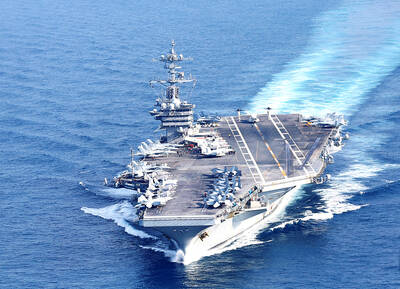
‘BALANCE OF POWER’: Hegseth said that the US did not want to ‘strangle’ China, but to ensure that none of Washington’s allies would be vulnerable to military aggression Washington has no intention of changing the “status quo” in the Taiwan Strait, US Secretary of Defense Pete Hegseth said on Saturday, adding that one of the US military’s main priorities is to deter China “through strength, not through confrontation.” Speaking at the annual Reagan National Defense Forum in Simi Valley, California, Hegseth outlined the US Department of Defense’s priorities under US President Donald Trump. “First, defending the US homeland and our hemisphere. Second, deterring China through strength, not confrontation. Third, increased burden sharing for us, allies and partners. And fourth, supercharging the US defense industrial base,” he said. US-China relations under
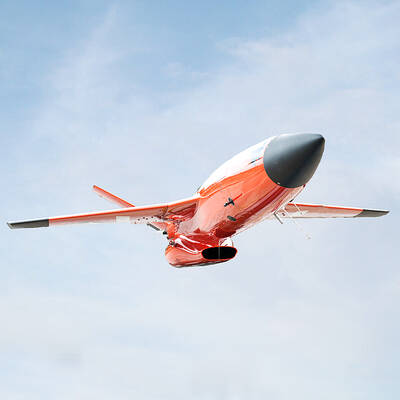
The Chien Feng IV (勁蜂, Mighty Hornet) loitering munition is on track to enter flight tests next month in connection with potential adoption by Taiwanese and US armed forces, a government source said yesterday. The kamikaze drone, which boasts a range of 1,000km, debuted at the Taipei Aerospace and Defense Technology Exhibition in September, the official said on condition of anonymity. The Chungshan Institute of Science and Technology and US-based Kratos Defense jointly developed the platform by leveraging the engine and airframe of the latter’s MQM-178 Firejet target drone, they said. The uncrewed aerial vehicle is designed to utilize an artificial intelligence computer


 RSS
RSS