


President Tsai Ing-wen (蔡英文) and Kaohsiung Mayor Han Kuo-yu (韓國瑜), the Chinese Nationalist Party’s (KMT) presidential candidate, yesterday debated their economic policies and reinstatement of the Special Investigation Division (SID) at the second platform presentation for the Jan. 11 election.
Tsai, who won a draw to speak first, began her presentation by touting her economic achievements.
Under her administration, the nation has experienced growth for 14 straight quarters, with Taiwan outperforming the four Asian Tigers, she said, adding that the economy contracted for the three years prior to that, under then-president Ma Ying-jeou (馬英九).
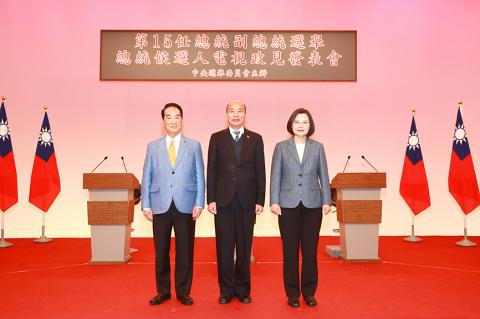
Photo courtesy of China Television
As many of Han’s advisers come from Ma’s administration, “I really do not know how Taiwanese would ‘get rich,’” Tsai said, referring to one of Han’s campaign slogans.
If re-elected, she would deepen economic ties with countries targeted by the New Southbound Policy, signing more bilateral investment agreements and building new supply chains, Tsai added.
Tsai said that she would also seek to establish a bilateral free-trade agreement with the US.
Her administration would aim to transform Taiwan into a new center for advanced manufacturing and research, a hub for finance and asset management, and Asia’s green energy supply chain, she said.
Commenting on Han’s plan to reinstate the SID, Tsai said that the agency was abolished in 2017 because it was “turned into a tool for political wrangling by the KMT.”
In a case involving former SID prosecutor-general Huang Shih-ming (黃世銘), who was later sentenced to one year and three months in prison, the division was found to have wiretapped the Legislative Yuan before providing the transcripts to then-president Ma, she said.
Han said that if elected, he would improve the economy by continuing the Economic Cooperation Framework Agreement (ECFA), and establish free economic pilot zones in Taichung and Kaohsiung.
He said he would establish a sovereign wealth fund of about NT$10 trillion (US$331.1 billion) and require that Taiwanese representatives to other nations promote Taiwan’s exports.
“I would launch the biggest talent fostering program in history, which would be named Mantianxing (滿天星) or Daguangming (大光明), to connect Taiwan’s young people to the world,” Han said.
He called Tsai an incompetent president whose administration has been hijacked by Presidential Office Secretary-General Chen Chu (陳菊) and Premier Su Tseng-chang (蘇貞昌).
Taiwan’s real crisis is having Tsai as its president, Han said, adding that her lack of power has allowed her administration to grow corrupt.
Since proposing the reinstatement of the SID, Han said that everywhere he has traveled, “people have asked for the division to be re-established immediately.”
People First Party Chairman James Soong (宋楚瑜) said the DPP and KMT have become increasingly radical, adding that he offers a more balanced alternative for voters.
“Taiwan will not disappear if Tsai is not re-elected and the Republic of China will not be destroyed if Han loses the election,” Soong said, adding that voting for him would let people prove that they are not controlled by the two largest parties.
The presentation, held at a China Television (中視) studio, was the second planned by the Central Election Commission. A third is to be held tomorrow at 7pm and broadcast live on Taiwan Television.

CROSS-STRAIT COLLABORATION: The new KMT chairwoman expressed interest in meeting the Chinese president from the start, but she’ll have to pay to get in Beijing allegedly agreed to let Chinese Nationalist Party (KMT) Chairwoman Cheng Li-wun (鄭麗文) meet with Chinese President Xi Jinping (習近平) around the Lunar New Year holiday next year on three conditions, including that the KMT block Taiwan’s arms purchases, a source said yesterday. Cheng has expressed interest in meeting Xi since she won the KMT’s chairmanship election in October. A source, speaking on condition of anonymity, said a consensus on a meeting was allegedly reached after two KMT vice chairmen visited China’s Taiwan Affairs Office Director Song Tao (宋濤) in China last month. Beijing allegedly gave the KMT three conditions it had to

STAYING ALERT: China this week deployed its largest maritime show of force to date in the region, prompting concern in Taipei and Tokyo, which Beijing has brushed off Deterring conflict over Taiwan is a priority, the White House said in its National Security Strategy published yesterday, which also called on Japan and South Korea to increase their defense spending to help protect the first island chain. Taiwan is strategically positioned between Northeast and Southeast Asia, and provides direct access to the second island chain, with one-third of global shipping passing through the South China Sea, the report said. Given the implications for the US economy, along with Taiwan’s dominance in semiconductors, “deterring a conflict over Taiwan, ideally by preserving military overmatch, is a priority,” it said. However, the strategy also reiterated
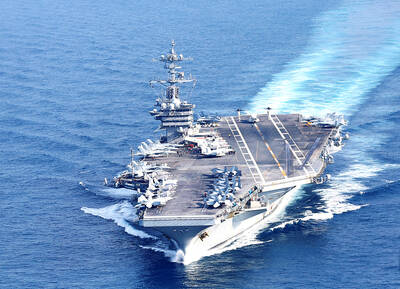
‘BALANCE OF POWER’: Hegseth said that the US did not want to ‘strangle’ China, but to ensure that none of Washington’s allies would be vulnerable to military aggression Washington has no intention of changing the “status quo” in the Taiwan Strait, US Secretary of Defense Pete Hegseth said on Saturday, adding that one of the US military’s main priorities is to deter China “through strength, not through confrontation.” Speaking at the annual Reagan National Defense Forum in Simi Valley, California, Hegseth outlined the US Department of Defense’s priorities under US President Donald Trump. “First, defending the US homeland and our hemisphere. Second, deterring China through strength, not confrontation. Third, increased burden sharing for us, allies and partners. And fourth, supercharging the US defense industrial base,” he said. US-China relations under
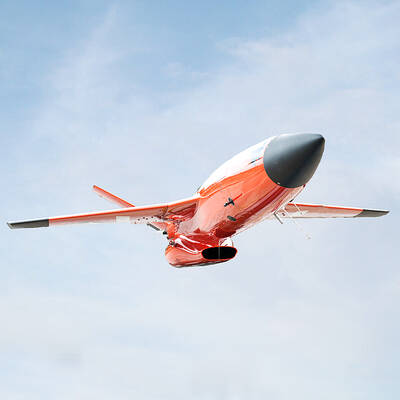
The Chien Feng IV (勁蜂, Mighty Hornet) loitering munition is on track to enter flight tests next month in connection with potential adoption by Taiwanese and US armed forces, a government source said yesterday. The kamikaze drone, which boasts a range of 1,000km, debuted at the Taipei Aerospace and Defense Technology Exhibition in September, the official said on condition of anonymity. The Chungshan Institute of Science and Technology and US-based Kratos Defense jointly developed the platform by leveraging the engine and airframe of the latter’s MQM-178 Firejet target drone, they said. The uncrewed aerial vehicle is designed to utilize an artificial intelligence computer


 RSS
RSS