


In a landmark summit, the leaders of Japan and South Korea signaled that they would not let relations spin out of control even as they made little progress in resolving disputes that have plunged relations to new depths.
South Korean President Moon Jae-in told Japanese Prime Minister Shinzo Abe that cooperation was crucial in the face of regional security threats as the two began their 45-minute meeting on the sidelines of a trilateral summit hosted by Chinese Premier Li Keqiang (李克強) in Chengdu, China.
Abe agreed, and said he also hoped to improve the relationship.
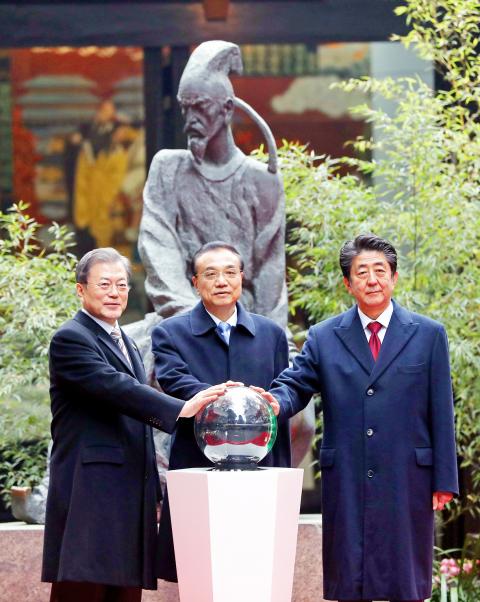
Photo: EPA-EFE
“In the current difficult security situation in East Asia, relations between Japan and South Korea are extremely important. South Korea is an important neighbor,” Abe told reporters after the meeting.
Disputes rooted in disagreement over whether Japan has shown sufficient contrition for its history have hurt trade and hindered cooperation between the two US allies on dealing with North Korea.
The leaders’ meeting came after Pyongyang signaled it might fire a long-range missile as nuclear talks with US President Donald Trump’s administration stall ahead of a year-end deadline for progress set by North Korean leader Kim Jong-un.
No breakthroughs were made and the two aired grievances, but Abe and Moon indicated they would not let their relations spin out of control.
Their simmering feud has raised concerns about whether their fight would hurt global supply chains, and if they could cooperate with Washington as it seeks to put a check on China’s military expansion in the region and curb North Korea’s nuclear ambitions.
Japan and South Korea “are geographically, historically and culturally the closest neighbors, as well as the most important, mutually beneficial partners in terms of human exchanges,” Moon told Abe.
“Our relationship is one that cannot be made distant, even if there is temporarily an uncomfortable issue,” he said.
Moon urged Japan to reverse the tighter trade controls it had placed on South Korea, his spokeswoman Ko Min-jung said after the meeting.
Abe said trade officials would discuss the issue.
For his part, Abe called on Seoul to resolve a disagreement over South Korean court rulings holding Japanese companies liable for cases of forced labor during the 1910-1945 colonization.
The talks had been seen as a positive step that could make it easier for the two nations to bridge differences on simmering disputes that include Japan’s export curbs on goods vital to South Korea’s massive technology sector, part of which was eased last week.
The standoff has damaged trade and tourism ties, with the number of South Koreans visiting Japan last month falling by almost two-thirds on the previous year, while Japan’s beer exports to its neighbor collapsed to virtually zero in October.
However, under pressure from the US, South Korea last month suspended its plan to withdraw from a military information-sharing pact with Japan. Since then, there have been hints of a potential thaw in ties.

National Taiwan University (NTU) yesterday said it disqualified a person from an entrance examination for using AI smart glasses to cheat, along with two others for making untruthful statements in their curriculum vitae. The three applicants were given null scores, Taiwan’s highest-ranked university said, calling on prospective students to be honest in the admissions process. NTU registrar Lee Hung-sen (李宏森) said that the cheating applicant wore a hat and thick-rimmed glasses to the second written exam for medical school, claiming that they felt cold. Suspicions were aroused when the applicant stared oddly at the test for long stretches while steadily bringing the paper
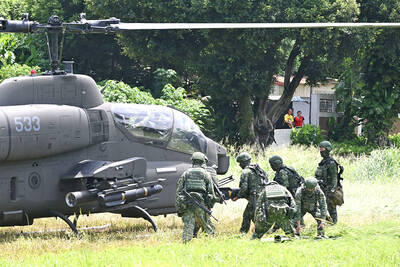
MILITARY ISSUES: A partisan divide between the Cabinet and the legislature ‘raised questions about Taiwan’s ability to adequately fund its defense,’ the report said Taiwan’s defense budget, military personnel numbers and resilience are challenges to its ability to meet national defense goals, the US Naval Institute said in a report published on Tuesday. In response to the perception of a growing military threat posed by China, Taiwan has embarked on an effort to enhance the capabilities needed to deter an attempt by Beijing to annex the nation by force, the institute said in the US Congressional Research Service report, titled Taiwan: Defense and Military Issues, which was filed on Thursday last week. Taiwan’s defense budget increased by about 7.5 percent from 2024 to last year, it

66 FIGHTER JETS: The aircraft is likely undergoing preparations for its transfer to Taiwan — a significant step forward in the nation’s modernization program, a lawmaker said The first of Taiwan’s order of F-16V Block 70 aircraft has been sighted in Texas ahead of delivery, Democratic Progressive Party (DPP) Legislator Wang Ting-yu (王定宇) said. Taiwan’s first F-16V Block 70 two-seat aircraft, tail number 6831, was seen flying from Lockheed Martin’s production facility in Greenville, South Carolina, to Naval Air Station Joint Reserve Base Fort Worth in Texas, Wang wrote on Facebook yesterday. The plane is likely undergoing preparations for its transfer to Taiwan, marking a significant step forward in the Republic of China Air Force’s modernization program, Wang said, citing military analysts. The F-16V Block 70 is a new-build version
NOT JUST NUMBERS: What matters to intelligence work is crucial, reliable information, so even a few credible leads can be highly valuable to national security, a legislator said The National Security Bureau (NSB) yesterday said it has finished the establishment of an information-reporting channel for Chinese nationals, the aim of which is to broaden intelligence gathering on China’s political, military, economic and social developments. Chinese nationals can submit information on the Web page, https://report.nsb.gov.tw, the NSB said in a statement. The move aims to expand the bureau’s diverse intelligence sources and is pursuant to the National Intelligence Services Act (國家情報工作法), it said, adding that it referenced practices adopted by intelligence agencies in the US, the UK and Israel. An increasing number of people are approaching Taiwanese agencies to provide information, as


 RSS
RSS