


Several Kaohsiung city councilors yesterday criticized Kaohsiung Mayor Han Kuo-yu (韓國瑜) for missing an event the city government held to mark his first anniversary in office.
The event, hosted by Kaohsiung Deputy Mayor Yeh Kuang-shih (葉匡時), marked the first year since Han’s swearing-in by reviewing his policy results.
Han, the Chinese Nationalist Party’s (KMT) presidential candidate, on Oct. 16 took leave from his mayoral duties to campaign for the Jan. 11 elections and would not be back until Jan. 12.
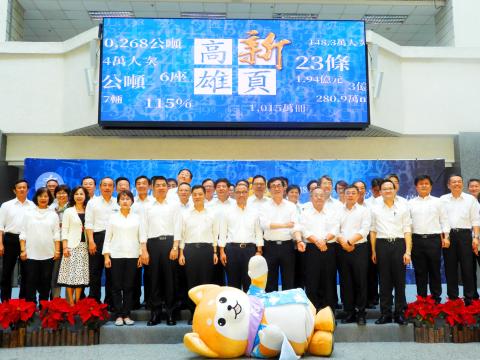
Photo: Ko Yu-hao, Taipei Times
New Power Party Kaohsiung City Councilor Huang Jie (黃捷) said Han’s absence has further confirmed his image of “Han the telephone operator,” referring to a nickname given by Internet users because of his tendency to make his subordinates answer questions for him during question-and-answer sessions at the city council.
While Han’s lack of interest in running the city is no longer news, that he would skip a news conference to explain his policies and answer reporters’ questions raises the question of whether he has “entirely given up on Kaohsiung,” Huang wrote on Facebook.
Although Han is the mayor, his subordinates have been doing all the work, she said.
“As Han has stopped answering to the city, Kaohsiung residents might as well do away with this telephone operator,” she added.
Democratic Progressive Party (DPP) councilors said that Han has been “full of lies” and “irresponsible” over the past year.
Han lied about never playing mahjong after being elected mayor and about not having proposed drilling for oil in the waters off Itu Aba Island (Taiping Island, 太平島) when running for mayor, DPP Kaohsiung City Councilor Lin Chih-hung (林智鴻) said.
“His lies have embarrassed Kaohsiung residents,” Lin said.
Han also appears to have forgotten his role as mayor and even organized a rally to oppose a march calling for his recall on Saturday, DPP Kaohsiung City Councilor Lee Chiao-ju (李喬如) said.
“There has never been a Kaohsiung mayor who has put in less effort and cared less about the city” than Han, DPP Kaohsiung City Councilor Chen Chih-chung (陳致中) said.
Han’s campaign office spokeswoman Anne Wang (王淺秋) said Han could not attend the event due to a scheduling conflict, adding that he had applied for leave in accordance with the Central Election Commission’s regulations.
His absence avoided diverting attention from the city government’s policy results, which was the main point of the conference, she said.
“Even if Han had returned to attend the event, certain people would have still accused him of putting on a show,” she said.
Yeh said the DPP city councilors should be thankful to Han for boosting their media exposure and making them “nationally famous.”
“They should wish Han well in the presidential election, because that would give them a chance to question a president-elect during question-and-answer sessions,” he said.
Since Han took office, Kaohsiung residents have regained a sense of glory and pride, as the city has become a center of attention in the Chinese-speaking world, Yeh said.
“Although the mayor is not here, he stays in touch with us all the time to remain informed about city affairs,” he said.
Over the past year, the city government has achieved impressive results in improving road infrastructure, agricultural and fishery exports, and tourist numbers; curbing air pollution; promoting English-language education; and providing support for disadvantaged people, the city government said.
Additional reporting by Wang Jung-hsiang

CROSS-STRAIT COLLABORATION: The new KMT chairwoman expressed interest in meeting the Chinese president from the start, but she’ll have to pay to get in Beijing allegedly agreed to let Chinese Nationalist Party (KMT) Chairwoman Cheng Li-wun (鄭麗文) meet with Chinese President Xi Jinping (習近平) around the Lunar New Year holiday next year on three conditions, including that the KMT block Taiwan’s arms purchases, a source said yesterday. Cheng has expressed interest in meeting Xi since she won the KMT’s chairmanship election in October. A source, speaking on condition of anonymity, said a consensus on a meeting was allegedly reached after two KMT vice chairmen visited China’s Taiwan Affairs Office Director Song Tao (宋濤) in China last month. Beijing allegedly gave the KMT three conditions it had to

STAYING ALERT: China this week deployed its largest maritime show of force to date in the region, prompting concern in Taipei and Tokyo, which Beijing has brushed off Deterring conflict over Taiwan is a priority, the White House said in its National Security Strategy published yesterday, which also called on Japan and South Korea to increase their defense spending to help protect the first island chain. Taiwan is strategically positioned between Northeast and Southeast Asia, and provides direct access to the second island chain, with one-third of global shipping passing through the South China Sea, the report said. Given the implications for the US economy, along with Taiwan’s dominance in semiconductors, “deterring a conflict over Taiwan, ideally by preserving military overmatch, is a priority,” it said. However, the strategy also reiterated
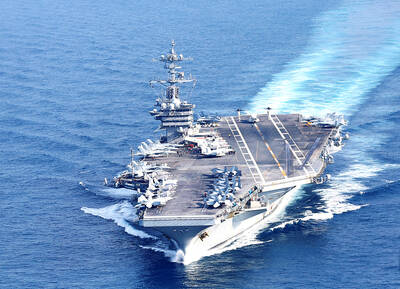
‘BALANCE OF POWER’: Hegseth said that the US did not want to ‘strangle’ China, but to ensure that none of Washington’s allies would be vulnerable to military aggression Washington has no intention of changing the “status quo” in the Taiwan Strait, US Secretary of Defense Pete Hegseth said on Saturday, adding that one of the US military’s main priorities is to deter China “through strength, not through confrontation.” Speaking at the annual Reagan National Defense Forum in Simi Valley, California, Hegseth outlined the US Department of Defense’s priorities under US President Donald Trump. “First, defending the US homeland and our hemisphere. Second, deterring China through strength, not confrontation. Third, increased burden sharing for us, allies and partners. And fourth, supercharging the US defense industrial base,” he said. US-China relations under
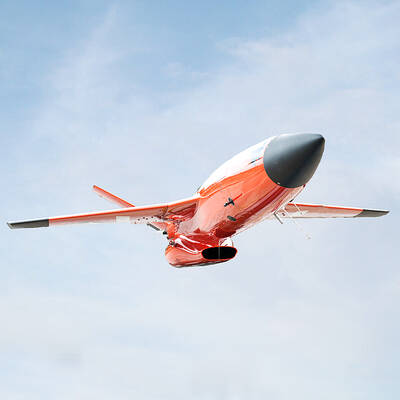
The Chien Feng IV (勁蜂, Mighty Hornet) loitering munition is on track to enter flight tests next month in connection with potential adoption by Taiwanese and US armed forces, a government source said yesterday. The kamikaze drone, which boasts a range of 1,000km, debuted at the Taipei Aerospace and Defense Technology Exhibition in September, the official said on condition of anonymity. The Chungshan Institute of Science and Technology and US-based Kratos Defense jointly developed the platform by leveraging the engine and airframe of the latter’s MQM-178 Firejet target drone, they said. The uncrewed aerial vehicle is designed to utilize an artificial intelligence computer


 RSS
RSS