


Macau yesterday celebrated 20 years since the former Portuguese colony was returned to China, with Chinese President Xi Jinping (習近平) praising the pliant gambling hub for its patriotism, a stark contrast to protest-ravaged Hong Kong.
The day’s festivities centered on the inauguration of a new leader for a territory that Xi described as a “shining chapter” of Beijing’s “one country, two systems” model.
Ho Iat-seng (賀一誠) won a one-horse race this summer to become Macau’s new chief executive — a position that is chosen by a 400-member committee stacked with Beijing loyalists.
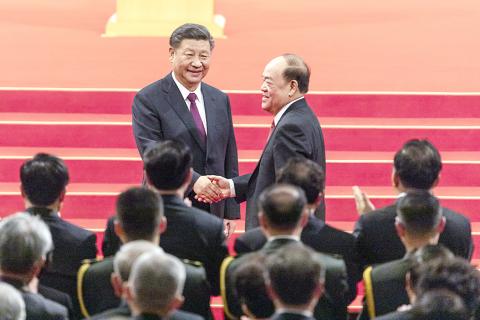
Photo: Bloomberg
Throughout his three-day visit, Xi has seized on Macau’s comparative political calm, a theme he continued in a landmark speech yesterday as he presided over Ho’s swearing-in ceremony.
“A sense of nation and patriotic spirit has deeply taken root in the hearts of young people,” Xi told delegates, adding that loyalty toward Beijing was the “most important reason” for Macau’s success.
He also warned against any foreign powers taking a stance on Hong Kong, which has been shaken by six months of huge and increasingly violent protests against Beijing’s rule.
“We will definitely not allow any foreign forces to interfere with Hong Kong and Macau affairs,” Xi said.
China has repeatedly portrayed Hong Kong’s huge protests as a foreign-backed revolution designed to destabilize the motherland, rejecting any suggestion that Hong Kongers have legitimate political grievances.
Hong Kong and Macau are run on Beijing’s “one country, two systems” model that allows them to retain certain liberties, such as an independent judiciary, a free market and a separate currency.
However, while Hong Kong seethes with popular resentment toward Beijing, Macau has steadily become more like the mainland.
Macau has witnessed little dissent and has become hugely wealthy thanks to being the only place in China where gambling is allowed — although Xi omitted any reference to the gaming industry during his visit.
China’s leadership has used Macau’s handover anniversary to showcase the benefits of deference to authoritarian rule, a pointed signal to protesters across the Pearl River Delta in Hong Kong.
Macau’s fortunes have risen in lockstep with China’s huge economic growth, Ho said.
“Macau and the motherland are intertwined and destined to develop as one,” he said in his inauguration speech.
Xi also singled out mainland style anti-sedition laws in Macau that have been bitterly opposed for years in Hong Kong.
There had been speculation that Xi might unveil a series of economic measures rewarding Macau for its loyalty, but none were announced in his speech.
When Xi visited Hong Kong in 2017 for the territory’s handover celebrations, he delivered a tough speech warning that any challenge to the authority of the central government was a “red line and absolutely impermissible.”
Shortly after Xi finished his speech yesterday, office workers went out in Hong Kong’s main commercial district during their lunch break to protest.
The rally was sparked by police freezing HK$70 million (US$9 million) the day before from a fund that collects donations to help arrested pro-democracy protesters.

CROSS-STRAIT COLLABORATION: The new KMT chairwoman expressed interest in meeting the Chinese president from the start, but she’ll have to pay to get in Beijing allegedly agreed to let Chinese Nationalist Party (KMT) Chairwoman Cheng Li-wun (鄭麗文) meet with Chinese President Xi Jinping (習近平) around the Lunar New Year holiday next year on three conditions, including that the KMT block Taiwan’s arms purchases, a source said yesterday. Cheng has expressed interest in meeting Xi since she won the KMT’s chairmanship election in October. A source, speaking on condition of anonymity, said a consensus on a meeting was allegedly reached after two KMT vice chairmen visited China’s Taiwan Affairs Office Director Song Tao (宋濤) in China last month. Beijing allegedly gave the KMT three conditions it had to
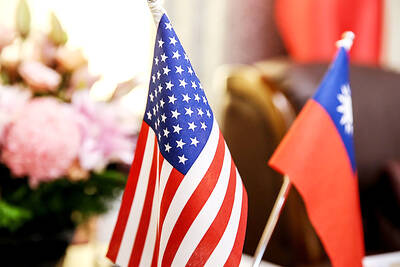
STAYING ALERT: China this week deployed its largest maritime show of force to date in the region, prompting concern in Taipei and Tokyo, which Beijing has brushed off Deterring conflict over Taiwan is a priority, the White House said in its National Security Strategy published yesterday, which also called on Japan and South Korea to increase their defense spending to help protect the first island chain. Taiwan is strategically positioned between Northeast and Southeast Asia, and provides direct access to the second island chain, with one-third of global shipping passing through the South China Sea, the report said. Given the implications for the US economy, along with Taiwan’s dominance in semiconductors, “deterring a conflict over Taiwan, ideally by preserving military overmatch, is a priority,” it said. However, the strategy also reiterated
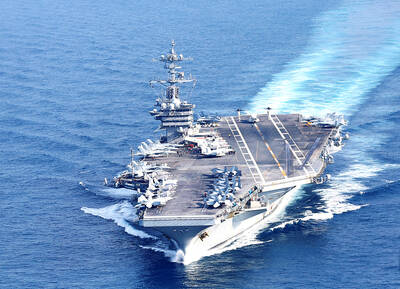
‘BALANCE OF POWER’: Hegseth said that the US did not want to ‘strangle’ China, but to ensure that none of Washington’s allies would be vulnerable to military aggression Washington has no intention of changing the “status quo” in the Taiwan Strait, US Secretary of Defense Pete Hegseth said on Saturday, adding that one of the US military’s main priorities is to deter China “through strength, not through confrontation.” Speaking at the annual Reagan National Defense Forum in Simi Valley, California, Hegseth outlined the US Department of Defense’s priorities under US President Donald Trump. “First, defending the US homeland and our hemisphere. Second, deterring China through strength, not confrontation. Third, increased burden sharing for us, allies and partners. And fourth, supercharging the US defense industrial base,” he said. US-China relations under
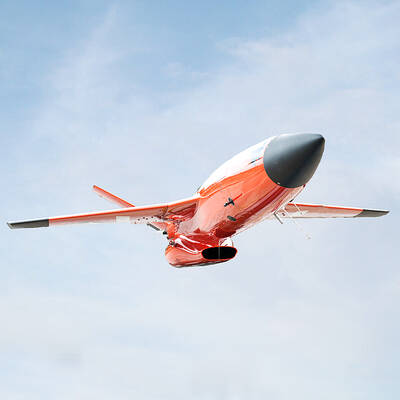
The Chien Feng IV (勁蜂, Mighty Hornet) loitering munition is on track to enter flight tests next month in connection with potential adoption by Taiwanese and US armed forces, a government source said yesterday. The kamikaze drone, which boasts a range of 1,000km, debuted at the Taipei Aerospace and Defense Technology Exhibition in September, the official said on condition of anonymity. The Chungshan Institute of Science and Technology and US-based Kratos Defense jointly developed the platform by leveraging the engine and airframe of the latter’s MQM-178 Firejet target drone, they said. The uncrewed aerial vehicle is designed to utilize an artificial intelligence computer


 RSS
RSS