


The Ministry of Foreign Affairs yesterday welcomed a joint letter by 161 US representatives that urged US Trade Representative Robert Lighthizer to support signing a Taiwan-US bilateral trade agreement.
While the US and China on Friday last week reached an enforceable agreement on a “phase one” trade deal that requires structural reforms and other changes to China’s economic and trade regime in the areas of intellectual property, technology transfers, agriculture and financial services, the annual meeting on the Taiwan-US Trade and Investment Framework Agreement, the main platform for bilateral talks on trade, has been suspended since it was last held in Washington in October 2016.
More than one-third of the members of the US House of Representatives on Thursday issued a joint letter to Lighthizer, calling for bilateral negotiations between the US and Taiwan on a trade agreement.
Photo: Lu Yi-hsuen, Taipei Times
The US’ Taiwan Relations Act (TRA) “has facilitated decades of economic, security and trade relations that have benefited the global community and increased the prosperity of the United Sates and Taiwan. With this in mind, we strongly believe you should work toward beginning negotiations for a bilateral trade agreement with Taiwan,” the letter says.
“As the trade and investment relationship with Taiwan already supports an estimated 373,000 US jobs, working toward the negotiation of a high-standard and comprehensive US-Taiwan bilateral trade agreement would further enhance our shared goal of enhancing the global competitiveness of US industries, while spurring American job creation,” it says.
“For the last four decades, the cornerstones of this relationship have been set forth in the TRA and the ‘six assurances.’ We strongly think that your continued work toward trade agreement negotiations would demonstrate our continued commitment to Taiwan and the region as a whole,” it adds.
The letter was signed by 161 US representatives, including Steve Chabot, Gerry Connolly, Mario Diaz-Balart and Albio Sires — the cochairs of the US Congressional Taiwan Caucus.
It was also endorsed by US representatives Michael McCaul, chairman of the House Committee on Foreign Affairs; Mac Thornberry, chairman of the House Committee on Armed Services; Bennie Thompson, chairman of the House Committee on Homeland Security; and Eddie Bernice Johnson, chairman of the House Committee on Science, Space and Technology.
Ministry of Foreign Affairs spokeswoman Joanne Ou (歐江安) thanked the US Congress for again demonstrating its strong bipartisan support for Taiwan.
The administration of US President Donald Trump has been promoting “a free and open Indo-Pacific strategy,” which advocates a rule-based international order that hinges on fair and free trade, she said in a statement.
Taiwan is glad to deepen its collaborations with the US, she said, adding that the ministry would continue to advance bilateral trade interactions and partnerships, based on firm and positive foundations.

CROSS-STRAIT COLLABORATION: The new KMT chairwoman expressed interest in meeting the Chinese president from the start, but she’ll have to pay to get in Beijing allegedly agreed to let Chinese Nationalist Party (KMT) Chairwoman Cheng Li-wun (鄭麗文) meet with Chinese President Xi Jinping (習近平) around the Lunar New Year holiday next year on three conditions, including that the KMT block Taiwan’s arms purchases, a source said yesterday. Cheng has expressed interest in meeting Xi since she won the KMT’s chairmanship election in October. A source, speaking on condition of anonymity, said a consensus on a meeting was allegedly reached after two KMT vice chairmen visited China’s Taiwan Affairs Office Director Song Tao (宋濤) in China last month. Beijing allegedly gave the KMT three conditions it had to
STAYING ALERT: China this week deployed its largest maritime show of force to date in the region, prompting concern in Taipei and Tokyo, which Beijing has brushed off Deterring conflict over Taiwan is a priority, the White House said in its National Security Strategy published yesterday, which also called on Japan and South Korea to increase their defense spending to help protect the first island chain. Taiwan is strategically positioned between Northeast and Southeast Asia, and provides direct access to the second island chain, with one-third of global shipping passing through the South China Sea, the report said. Given the implications for the US economy, along with Taiwan’s dominance in semiconductors, “deterring a conflict over Taiwan, ideally by preserving military overmatch, is a priority,” it said. However, the strategy also reiterated
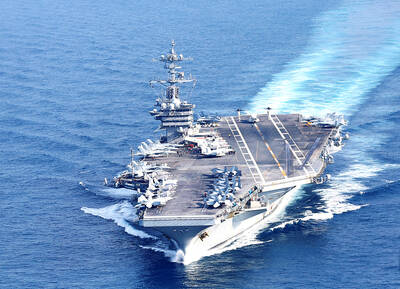
‘BALANCE OF POWER’: Hegseth said that the US did not want to ‘strangle’ China, but to ensure that none of Washington’s allies would be vulnerable to military aggression Washington has no intention of changing the “status quo” in the Taiwan Strait, US Secretary of Defense Pete Hegseth said on Saturday, adding that one of the US military’s main priorities is to deter China “through strength, not through confrontation.” Speaking at the annual Reagan National Defense Forum in Simi Valley, California, Hegseth outlined the US Department of Defense’s priorities under US President Donald Trump. “First, defending the US homeland and our hemisphere. Second, deterring China through strength, not confrontation. Third, increased burden sharing for us, allies and partners. And fourth, supercharging the US defense industrial base,” he said. US-China relations under
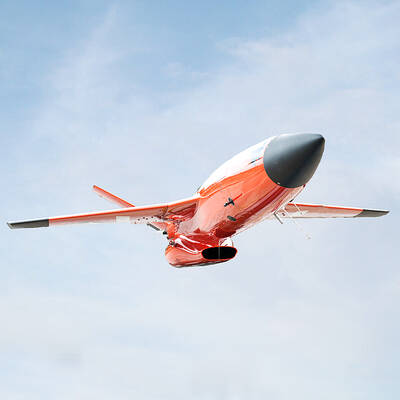
The Chien Feng IV (勁蜂, Mighty Hornet) loitering munition is on track to enter flight tests next month in connection with potential adoption by Taiwanese and US armed forces, a government source said yesterday. The kamikaze drone, which boasts a range of 1,000km, debuted at the Taipei Aerospace and Defense Technology Exhibition in September, the official said on condition of anonymity. The Chungshan Institute of Science and Technology and US-based Kratos Defense jointly developed the platform by leveraging the engine and airframe of the latter’s MQM-178 Firejet target drone, they said. The uncrewed aerial vehicle is designed to utilize an artificial intelligence computer


 RSS
RSS