


The masterminds of the Philippines’ worst political massacre were yesterday found guilty of murder a decade after they led the killings of 58 people, rare convictions of powerful figures in a country notorious for its culture of impunity.
However, with dozens of other accused gunmen acquitted, and 80 suspects never having been caught, relatives of the victims, as well as rights groups, gave a mixed response to the verdicts.
Leaders of the powerful Ampatuan family dynasty orchestrated the killings on Nov. 23, 2009, in a remote part of the conflict-plagued south of the Philippines in a bid to quash an election challenge from a rival clan.
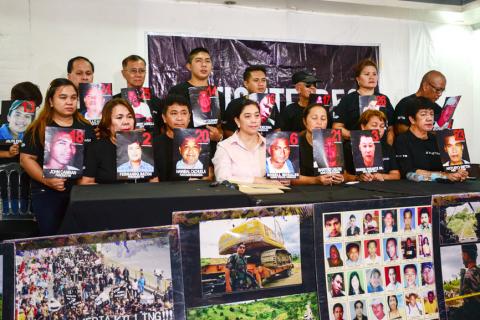
Photo: AFP
Thirty-two journalists, traveling in a convoy to report on the filing of an Ampatuan rival’s election candidacy, were among those murdered, making the killings one of the worst-ever globally of media workers.
A Manila court yesterday found 43 people guilty as principals or accessories to 57 of the murders. They were found not guilty of the 58th murder, because the body of the final victim was never recovered.
Andal Ampatuan Jr, who had been planning to succeed his namesake father by running for governor of Maguindanao Province, was among those found guilty of murder.
As principal suspects, Ampatuan Jr and 27 others — including seven of his relatives — were each sentenced to at least 30 years in jail without parole.
“Their acts were deliberate and obviously in pursuance of their plan to kill,” the court said.
Fourteen members of the local police and a member of the Ampatuan family’s armed militia force were sentenced to between eight and 10 years in prison as accessories.
However, two clan leaders and more than 50 other police officers and alleged members of the Ampatuan militia were acquitted.
The cases against them had not been proved beyond a reasonable doubt, the court said in a filing.
“This makes us sad and happy at the same time, because some of the major suspects were convicted,” Esmael Mangudadatu, the Ampatuans’ rival, told reporters outside the courtroom.
The massacre unfolded when Mangudadatu sent his wife and two sisters to file his candidacy for governor of Maguindanao in an open challenge to the Ampatuans.
Gunmen blocked the convoy, which included the journalists, and herded them to a nearby hill, where they were killed in a hail of gunfire and buried in mass graves, along with their vehicles, prosecutors said.
The Ampatuans had until then ruled Maguindanao and were allowed to build a heavily armed militia by then-Philippine president Gloria Arroyo to serve as a buffer against a long-running Muslim insurgency in the region.
The murders had cast a spotlight on the Philippines’ notorious culture of impunity, in which powerful and wealthy figures often operate above the law.
During the case’s years of delays, patriarch Andal Ampatuan Sr and seven other defendants died, while some witnesses were murdered.
The Ampatuans remain a political force in the south.
Ampatuan family members won 25 local seats in May elections, including Sajid Ampatuan, one of Andal Ampatuan Jr’s brothers who was among those acquitted yesterday, but did not show up in court.

CROSS-STRAIT COLLABORATION: The new KMT chairwoman expressed interest in meeting the Chinese president from the start, but she’ll have to pay to get in Beijing allegedly agreed to let Chinese Nationalist Party (KMT) Chairwoman Cheng Li-wun (鄭麗文) meet with Chinese President Xi Jinping (習近平) around the Lunar New Year holiday next year on three conditions, including that the KMT block Taiwan’s arms purchases, a source said yesterday. Cheng has expressed interest in meeting Xi since she won the KMT’s chairmanship election in October. A source, speaking on condition of anonymity, said a consensus on a meeting was allegedly reached after two KMT vice chairmen visited China’s Taiwan Affairs Office Director Song Tao (宋濤) in China last month. Beijing allegedly gave the KMT three conditions it had to

STAYING ALERT: China this week deployed its largest maritime show of force to date in the region, prompting concern in Taipei and Tokyo, which Beijing has brushed off Deterring conflict over Taiwan is a priority, the White House said in its National Security Strategy published yesterday, which also called on Japan and South Korea to increase their defense spending to help protect the first island chain. Taiwan is strategically positioned between Northeast and Southeast Asia, and provides direct access to the second island chain, with one-third of global shipping passing through the South China Sea, the report said. Given the implications for the US economy, along with Taiwan’s dominance in semiconductors, “deterring a conflict over Taiwan, ideally by preserving military overmatch, is a priority,” it said. However, the strategy also reiterated

‘BALANCE OF POWER’: Hegseth said that the US did not want to ‘strangle’ China, but to ensure that none of Washington’s allies would be vulnerable to military aggression Washington has no intention of changing the “status quo” in the Taiwan Strait, US Secretary of Defense Pete Hegseth said on Saturday, adding that one of the US military’s main priorities is to deter China “through strength, not through confrontation.” Speaking at the annual Reagan National Defense Forum in Simi Valley, California, Hegseth outlined the US Department of Defense’s priorities under US President Donald Trump. “First, defending the US homeland and our hemisphere. Second, deterring China through strength, not confrontation. Third, increased burden sharing for us, allies and partners. And fourth, supercharging the US defense industrial base,” he said. US-China relations under
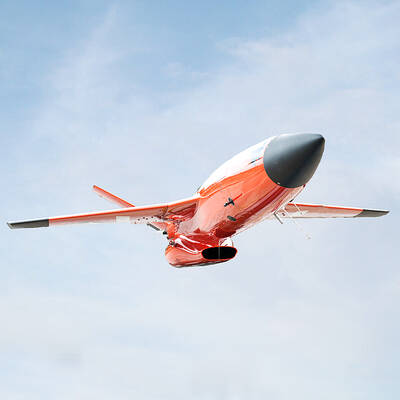
The Chien Feng IV (勁蜂, Mighty Hornet) loitering munition is on track to enter flight tests next month in connection with potential adoption by Taiwanese and US armed forces, a government source said yesterday. The kamikaze drone, which boasts a range of 1,000km, debuted at the Taipei Aerospace and Defense Technology Exhibition in September, the official said on condition of anonymity. The Chungshan Institute of Science and Technology and US-based Kratos Defense jointly developed the platform by leveraging the engine and airframe of the latter’s MQM-178 Firejet target drone, they said. The uncrewed aerial vehicle is designed to utilize an artificial intelligence computer


 RSS
RSS