


Former New Taipei City mayor Eric Chu (朱立倫) yesterday accused the Democratic Progressive Party (DPP) of a double standard when examining the Chinese Nationalist Party’s (KMT) interactions with the Chinese Communist Party (CCP).
Chu made the remark to reporters in New Taipei City when asked about media reports that a KMT Central Standing Committee member has obtained evidence of President Tsai Ing-wen (蔡英文) having interactions with high-level Chinese officials.
Citing the unnamed committee member, local media on Wednesday reported that there is evidence of Tsai interacting with leading CCP figures and that the DPP’s connections with China must be examined using the same standard it has applied to the KMT.
Chu yesterday said that regardless of the authenticity of the reports, at the very least the KMT would not accuse the DPP of colluding with the CCP.
The DPP accuses the KMT of selling out Taiwan whenever KMT members meet with CCP officials, he said.
In contrast, when the DPP meets with CCP officials, it considers them normal cross-strait exchanges, he added.
“Of all the DPP officials, which one of them can say that they have never met with an important CCP figure?” Chu asked.
Former premier William Lai (賴清德), the DPP’s vice presidential candidate in the Jan. 11 election, and Presidential Office Secretary-General Chen Chu (陳菊) have both met with key CCP figures in visits to China, Chu said.
Tsai should take a more rational approach toward cross-strait exchanges, he said.
Everyone loves the Republic of China and would safeguard Taiwan, Chu said, adding that only when both major parties stop accusing each other of selling out the nation would rational policy discussion be possible.
Asked about the purported evidence, DPP Chairman Cho Jung-tai (卓榮泰) said that he hopes the KMT will stop bluffing.
If the KMT does have any evidence that no one else knows about, “please tell us if you obtained it when [Kaohsiung Mayor] Han Kuo-yu (韓國瑜) visited China’s liaison office,” Cho said, referring to a meeting the now-KMT presidential candidate had with Chinese officials in Hong Kong.
The KMT should take responsibility and resolve any problems about its ties with China, which it has caused for itself, instead of accusing others of the same, he said.
Additional reporting by CNA

CROSS-STRAIT COLLABORATION: The new KMT chairwoman expressed interest in meeting the Chinese president from the start, but she’ll have to pay to get in Beijing allegedly agreed to let Chinese Nationalist Party (KMT) Chairwoman Cheng Li-wun (鄭麗文) meet with Chinese President Xi Jinping (習近平) around the Lunar New Year holiday next year on three conditions, including that the KMT block Taiwan’s arms purchases, a source said yesterday. Cheng has expressed interest in meeting Xi since she won the KMT’s chairmanship election in October. A source, speaking on condition of anonymity, said a consensus on a meeting was allegedly reached after two KMT vice chairmen visited China’s Taiwan Affairs Office Director Song Tao (宋濤) in China last month. Beijing allegedly gave the KMT three conditions it had to
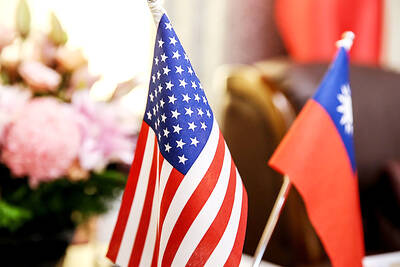
STAYING ALERT: China this week deployed its largest maritime show of force to date in the region, prompting concern in Taipei and Tokyo, which Beijing has brushed off Deterring conflict over Taiwan is a priority, the White House said in its National Security Strategy published yesterday, which also called on Japan and South Korea to increase their defense spending to help protect the first island chain. Taiwan is strategically positioned between Northeast and Southeast Asia, and provides direct access to the second island chain, with one-third of global shipping passing through the South China Sea, the report said. Given the implications for the US economy, along with Taiwan’s dominance in semiconductors, “deterring a conflict over Taiwan, ideally by preserving military overmatch, is a priority,” it said. However, the strategy also reiterated
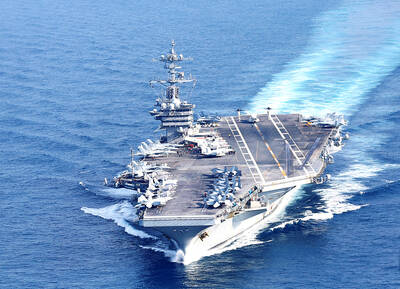
‘BALANCE OF POWER’: Hegseth said that the US did not want to ‘strangle’ China, but to ensure that none of Washington’s allies would be vulnerable to military aggression Washington has no intention of changing the “status quo” in the Taiwan Strait, US Secretary of Defense Pete Hegseth said on Saturday, adding that one of the US military’s main priorities is to deter China “through strength, not through confrontation.” Speaking at the annual Reagan National Defense Forum in Simi Valley, California, Hegseth outlined the US Department of Defense’s priorities under US President Donald Trump. “First, defending the US homeland and our hemisphere. Second, deterring China through strength, not confrontation. Third, increased burden sharing for us, allies and partners. And fourth, supercharging the US defense industrial base,” he said. US-China relations under
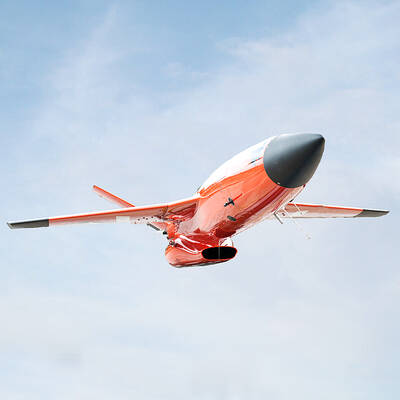
The Chien Feng IV (勁蜂, Mighty Hornet) loitering munition is on track to enter flight tests next month in connection with potential adoption by Taiwanese and US armed forces, a government source said yesterday. The kamikaze drone, which boasts a range of 1,000km, debuted at the Taipei Aerospace and Defense Technology Exhibition in September, the official said on condition of anonymity. The Chungshan Institute of Science and Technology and US-based Kratos Defense jointly developed the platform by leveraging the engine and airframe of the latter’s MQM-178 Firejet target drone, they said. The uncrewed aerial vehicle is designed to utilize an artificial intelligence computer


 RSS
RSS