


The top US representative in talks with North Korea yesterday slammed Pyongyang’s demands as hostile and unnecessary as its end-of-year deadline approaches, but held open the door for fresh negotiations.
The North has insisted that Washington offer it new concessions by the end of the year, with the process largely deadlocked since the collapse of a summit in Hanoi in February.
Pyongyang has issued a series of increasingly strident declarations in recent weeks, and US Special Representative for North Korea Stephen Biegun told reporters in Seoul: “We have heard them all.”
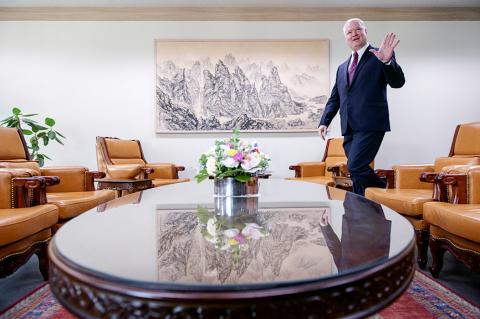
Photo: Reuters
“It is regrettable that the tone of these statements towards the United States, the Republic of Korea, Japan and our friends in Europe have been so hostile and negative and so unnecessary,” he said.
“The US does not have a deadline, we have a goal,” he added.
Tensions between the US and the nuclear-armed North reached a peak in 2017, with US President Donald Trump and North Korean leader Kim Jong-un trading mutual insults and threats of renewed conflict.
A rapid diplomatic detente followed, climaxing with the Singapore summit, when the two men signed a vague statement on denuclearization, but Washington still stations 28,500 troops in South Korea to protect its ally.
Pyongyang has said that if Washington fails to make it an acceptable offer, it would adopt a so far unspecified “new way.”
It has carried out a series of static tests at its Sohae rocket facility this month, after a number of weapons launches in recent weeks, some of them described as ballistic missiles by Japan and others — which Pyongyang is banned from testing under UN sanctions.
Biegun, who met yesterday with South Korean President Moon Jae-in, said that the US was “fully aware of the strong potential for North Korea to conduct a major provocation in the days ahead.”
“To say the least, such an action will be most unhelpful in achieving lasting peace on the Korean Peninsula,” he said.
Directly addressing “our counterparts in North Korea,” Biegun added: “It is time for us to do our jobs. Let’s get this done. We are here and you know how to reach us.”

CROSS-STRAIT COLLABORATION: The new KMT chairwoman expressed interest in meeting the Chinese president from the start, but she’ll have to pay to get in Beijing allegedly agreed to let Chinese Nationalist Party (KMT) Chairwoman Cheng Li-wun (鄭麗文) meet with Chinese President Xi Jinping (習近平) around the Lunar New Year holiday next year on three conditions, including that the KMT block Taiwan’s arms purchases, a source said yesterday. Cheng has expressed interest in meeting Xi since she won the KMT’s chairmanship election in October. A source, speaking on condition of anonymity, said a consensus on a meeting was allegedly reached after two KMT vice chairmen visited China’s Taiwan Affairs Office Director Song Tao (宋濤) in China last month. Beijing allegedly gave the KMT three conditions it had to

STAYING ALERT: China this week deployed its largest maritime show of force to date in the region, prompting concern in Taipei and Tokyo, which Beijing has brushed off Deterring conflict over Taiwan is a priority, the White House said in its National Security Strategy published yesterday, which also called on Japan and South Korea to increase their defense spending to help protect the first island chain. Taiwan is strategically positioned between Northeast and Southeast Asia, and provides direct access to the second island chain, with one-third of global shipping passing through the South China Sea, the report said. Given the implications for the US economy, along with Taiwan’s dominance in semiconductors, “deterring a conflict over Taiwan, ideally by preserving military overmatch, is a priority,” it said. However, the strategy also reiterated

‘BALANCE OF POWER’: Hegseth said that the US did not want to ‘strangle’ China, but to ensure that none of Washington’s allies would be vulnerable to military aggression Washington has no intention of changing the “status quo” in the Taiwan Strait, US Secretary of Defense Pete Hegseth said on Saturday, adding that one of the US military’s main priorities is to deter China “through strength, not through confrontation.” Speaking at the annual Reagan National Defense Forum in Simi Valley, California, Hegseth outlined the US Department of Defense’s priorities under US President Donald Trump. “First, defending the US homeland and our hemisphere. Second, deterring China through strength, not confrontation. Third, increased burden sharing for us, allies and partners. And fourth, supercharging the US defense industrial base,” he said. US-China relations under

The Chien Feng IV (勁蜂, Mighty Hornet) loitering munition is on track to enter flight tests next month in connection with potential adoption by Taiwanese and US armed forces, a government source said yesterday. The kamikaze drone, which boasts a range of 1,000km, debuted at the Taipei Aerospace and Defense Technology Exhibition in September, the official said on condition of anonymity. The Chungshan Institute of Science and Technology and US-based Kratos Defense jointly developed the platform by leveraging the engine and airframe of the latter’s MQM-178 Firejet target drone, they said. The uncrewed aerial vehicle is designed to utilize an artificial intelligence computer


 RSS
RSS