


A marathon UN summit yesterday wrapped up with little to show, squeezing hard-earned compromises from countries over a global warming battle plan that fell well short of what science says is needed to tackle the climate crisis.
The COP25 deal “expresses the urgent need” for new carbon cutting commitments to close the gap between current emissions and the Paris treaty goal of capping global temperature rise at below 2°C, host country Spain said in a statement.
“Today the citizens of the world are asking for us to move ahead faster and better, in financing, adaptation, mitigation,” Carolina Schmidt, Chilean minister of the environment and COP25 president, told the closing plenary.
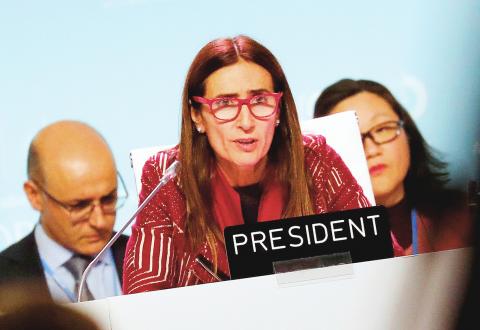
Photo: Reuters
Following a year of deadly extreme weather and weekly strikes by millions of young people demanding action, negotiations in Madrid were under pressure to send a clear signal that governments were willing to double down.
The summit — moved at the last minute from Chile due to unrest — at times teetered on the brink of collapse as rich polluters, emerging powerhouses and climate-vulnerable nations groped for common ground in the face of competing national interests.
“Based on the adopted text, there is a glimmer of hope that the heart of the Paris Agreement is still beating, but its pulse is very weak,” said Mohamed Adow, director of Power Shift, referring to the treaty inked in the French capital.
Negotiators from nearly 200 nations came to Spain’s capital with the aim of finalizing the rulebook for the 2015 agreement.
With the accord set to become operational next year, it had been hoped COP25 would show the world that governments would be moved by protests, irrefutable science, and deadly storms and wildfires that marked this year to redouble their efforts.
Yet greater ambition — how far each country is willing to slash carbon emissions or assist less wealthy peers to do likewise — has largely failed to materialize. Veteran observers of UN climate talks were stunned by the state of play.
“Never have I seen such a disconnect between what the science requires and what the climate negotiations are delivering in terms of meaningful action,” said Alden Meyer, director of strategy and policy at the Union of Concerned Scientists and a 28-year veteran of the climate process.
“Most of the world’s biggest emitting countries are missing in action and resisting calls to raise their ambition,” Meyer said.
The push for a strengthening of voluntary carbon cutting plans is led by small-island and least-developed states, along with the EU.
These have called out nations they see as blocking consensus for all countries to step up, notably the US, Australia and Saudi Arabia.
China and India, the world’s No. 1 and No. 4 carbon emitters respectively, made it clear they see no need to improve on their emissions reduction plans, which run to 2030.
They chose instead to emphasize the historical responsibility of rich nations to lead the way and provide financing to poor countries.
The summit was also meant to finalize a chapter on carbon markets in the Paris rulebook.
Some nations, notably Brazil and Australia, want to count carbon credits accumulated under a previous climate deal as part of their commitments under the Paris goals.
Discussions over markets ended in impasse and the issue is to be handed over to next year’s COP26 in Glasgow.

CROSS-STRAIT COLLABORATION: The new KMT chairwoman expressed interest in meeting the Chinese president from the start, but she’ll have to pay to get in Beijing allegedly agreed to let Chinese Nationalist Party (KMT) Chairwoman Cheng Li-wun (鄭麗文) meet with Chinese President Xi Jinping (習近平) around the Lunar New Year holiday next year on three conditions, including that the KMT block Taiwan’s arms purchases, a source said yesterday. Cheng has expressed interest in meeting Xi since she won the KMT’s chairmanship election in October. A source, speaking on condition of anonymity, said a consensus on a meeting was allegedly reached after two KMT vice chairmen visited China’s Taiwan Affairs Office Director Song Tao (宋濤) in China last month. Beijing allegedly gave the KMT three conditions it had to

STAYING ALERT: China this week deployed its largest maritime show of force to date in the region, prompting concern in Taipei and Tokyo, which Beijing has brushed off Deterring conflict over Taiwan is a priority, the White House said in its National Security Strategy published yesterday, which also called on Japan and South Korea to increase their defense spending to help protect the first island chain. Taiwan is strategically positioned between Northeast and Southeast Asia, and provides direct access to the second island chain, with one-third of global shipping passing through the South China Sea, the report said. Given the implications for the US economy, along with Taiwan’s dominance in semiconductors, “deterring a conflict over Taiwan, ideally by preserving military overmatch, is a priority,” it said. However, the strategy also reiterated

‘BALANCE OF POWER’: Hegseth said that the US did not want to ‘strangle’ China, but to ensure that none of Washington’s allies would be vulnerable to military aggression Washington has no intention of changing the “status quo” in the Taiwan Strait, US Secretary of Defense Pete Hegseth said on Saturday, adding that one of the US military’s main priorities is to deter China “through strength, not through confrontation.” Speaking at the annual Reagan National Defense Forum in Simi Valley, California, Hegseth outlined the US Department of Defense’s priorities under US President Donald Trump. “First, defending the US homeland and our hemisphere. Second, deterring China through strength, not confrontation. Third, increased burden sharing for us, allies and partners. And fourth, supercharging the US defense industrial base,” he said. US-China relations under
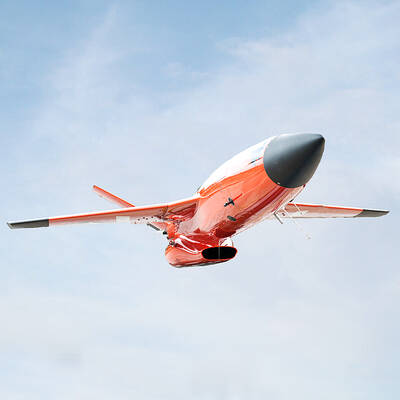
The Chien Feng IV (勁蜂, Mighty Hornet) loitering munition is on track to enter flight tests next month in connection with potential adoption by Taiwanese and US armed forces, a government source said yesterday. The kamikaze drone, which boasts a range of 1,000km, debuted at the Taipei Aerospace and Defense Technology Exhibition in September, the official said on condition of anonymity. The Chungshan Institute of Science and Technology and US-based Kratos Defense jointly developed the platform by leveraging the engine and airframe of the latter’s MQM-178 Firejet target drone, they said. The uncrewed aerial vehicle is designed to utilize an artificial intelligence computer


 RSS
RSS