


The Ministry of Foreign Affairs yesterday called on global organizations not to suppress the right to work of Taiwanese over political factors after the World Bank reportedly required Taiwanese staff to provide Chinese-issued travel documents.
Headquartered in Washington, the World Bank is a part of the UN, but retains its independence, with goals to end extreme poverty and promote shared prosperity. Its member states include China, but not Taiwan.
US news Web site Axios on Friday reported that the bank this year began asking current and prospective Taiwanese employees to present People’s Republic of China (PRC) travel documents to maintain or pursue employment.
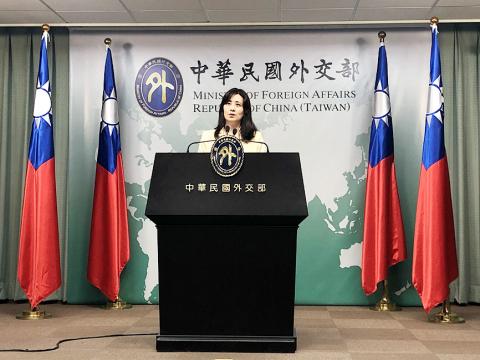
Photo: Lu Yi-hsuen, Taipei Times
A post on the bank’s internal Web site in March showed that Taiwanese could be employed by the bank only if they held a PRC passport, while another last month written by an employee asked why the bank “quietly but systematically” forced its Taiwanese staff to accept PRC passports, the report said.
When contacted by Axios, the bank’s senior management expressed regret and said they took immediate steps to revise the practice, the report said.
Ministry of Foreign Affairs spokeswoman Joanne Ou (歐江安) said in a statement yesterday that the ministry is asking Taiwan’s international partners to push the World Bank to correct the practice.
In a separate statement later yesterday, Ou said that after checking with the World Bank through its international partners, the ministry confirmed that the bank had corrected the improper practice of requiring Taiwanese staff to use PRC passports.
The ministry affirms that the World Bank adheres to its own professionalism and principles, while protecting the rights of its Taiwanese staff, allowing them to contribute to the global community, she said.
The ministry called on all international organizations, including those that are part of the UN, not to suppress the right to work of Taiwanese based on political concerns, which would contravene the founding purposes of UN agencies, and bar Taiwanese from making contributions to the global community, Ou said.
In other news, the ministry yesterday welcomed a joint statement by US President Donald Trump and Paraguayan President Mario Abdo Benitez on Friday that US International Development Finance Corp (USIDFC) would finance construction of a medical center in Asuncion and offer technical support along with Taiwan.
The ministry said that Taiwan in May helped Paraguayan women and economically disadvantaged groups develop businesses by working with the US Overseas Private Investment Corp (OPIC).
Following the successful collaboration with OPIC, Taiwan is willing to join hands with the USIDFC to help its ally boost its medical quality and general well-being, Ou said in a statement.
After the Jerovia Monte Sinai medical center is established in the Paraguayan capital, the US and the Inter-American Development Bank would offer financial resources to Paraguay, while Taiwan would offer medical training and services, she said.
Taiwan and Paraguay share universal values of democracy, freedom, human rights and the rule of law, while the two sides maintain close cooperation in areas of the economy, education, public health and infrastructure, she said.
Taiwan is pleased to continue working with like-minded countries such as the US and Japan to foster prosperity and development in allied nations, she added.

CROSS-STRAIT COLLABORATION: The new KMT chairwoman expressed interest in meeting the Chinese president from the start, but she’ll have to pay to get in Beijing allegedly agreed to let Chinese Nationalist Party (KMT) Chairwoman Cheng Li-wun (鄭麗文) meet with Chinese President Xi Jinping (習近平) around the Lunar New Year holiday next year on three conditions, including that the KMT block Taiwan’s arms purchases, a source said yesterday. Cheng has expressed interest in meeting Xi since she won the KMT’s chairmanship election in October. A source, speaking on condition of anonymity, said a consensus on a meeting was allegedly reached after two KMT vice chairmen visited China’s Taiwan Affairs Office Director Song Tao (宋濤) in China last month. Beijing allegedly gave the KMT three conditions it had to
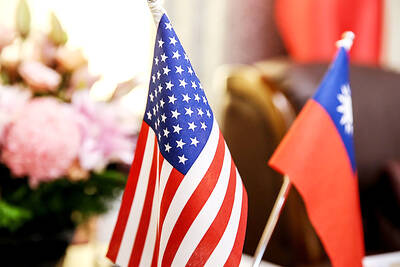
STAYING ALERT: China this week deployed its largest maritime show of force to date in the region, prompting concern in Taipei and Tokyo, which Beijing has brushed off Deterring conflict over Taiwan is a priority, the White House said in its National Security Strategy published yesterday, which also called on Japan and South Korea to increase their defense spending to help protect the first island chain. Taiwan is strategically positioned between Northeast and Southeast Asia, and provides direct access to the second island chain, with one-third of global shipping passing through the South China Sea, the report said. Given the implications for the US economy, along with Taiwan’s dominance in semiconductors, “deterring a conflict over Taiwan, ideally by preserving military overmatch, is a priority,” it said. However, the strategy also reiterated
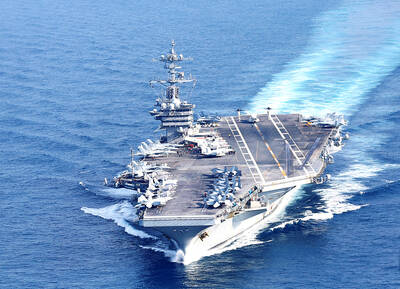
‘BALANCE OF POWER’: Hegseth said that the US did not want to ‘strangle’ China, but to ensure that none of Washington’s allies would be vulnerable to military aggression Washington has no intention of changing the “status quo” in the Taiwan Strait, US Secretary of Defense Pete Hegseth said on Saturday, adding that one of the US military’s main priorities is to deter China “through strength, not through confrontation.” Speaking at the annual Reagan National Defense Forum in Simi Valley, California, Hegseth outlined the US Department of Defense’s priorities under US President Donald Trump. “First, defending the US homeland and our hemisphere. Second, deterring China through strength, not confrontation. Third, increased burden sharing for us, allies and partners. And fourth, supercharging the US defense industrial base,” he said. US-China relations under
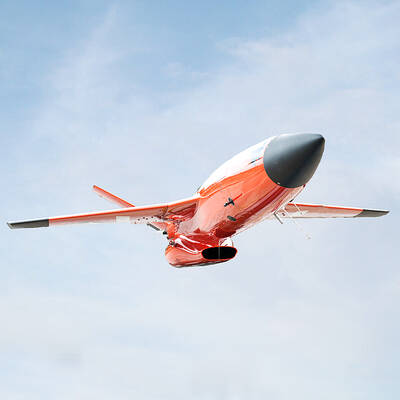
The Chien Feng IV (勁蜂, Mighty Hornet) loitering munition is on track to enter flight tests next month in connection with potential adoption by Taiwanese and US armed forces, a government source said yesterday. The kamikaze drone, which boasts a range of 1,000km, debuted at the Taipei Aerospace and Defense Technology Exhibition in September, the official said on condition of anonymity. The Chungshan Institute of Science and Technology and US-based Kratos Defense jointly developed the platform by leveraging the engine and airframe of the latter’s MQM-178 Firejet target drone, they said. The uncrewed aerial vehicle is designed to utilize an artificial intelligence computer


 RSS
RSS