


Chinese Minister of Foreign Affairs Wang Yi (王毅) yesterday said that the US had seriously damaged the hard-won mutual trust between the countries by criticizing Beijing over issues such as Hong Kong and the treatment of Muslim Uighurs.
“Such behavior is almost paranoid and is indeed rare in international exchanges, seriously damaging the hard-won foundation of mutual trust between China and the United States, and seriously weakening the United States’ international credibility,” Wang said.
There were deep-seated issues that need to be addressed and resolved between both sides, issues that are bringing increasingly severe challenges to the future of the relationship, he said.
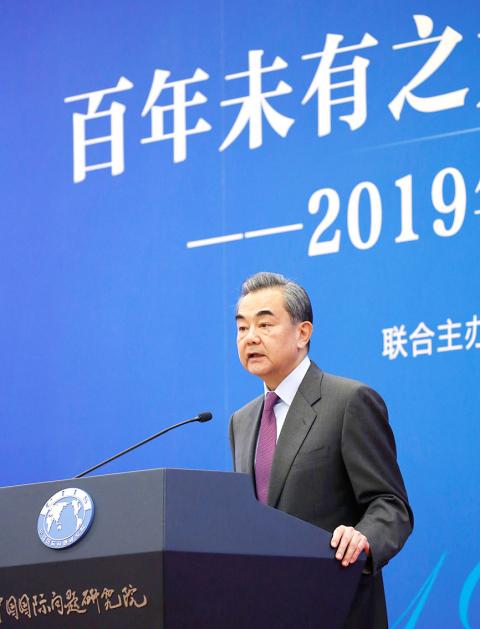
Photo: Reuters
Wang was speaking at an annual symposium in Beijing on international affairs.
The US last month introduced several pieces of legislation that could potentially target top Chinese officials with sanctions over human rights abuses in Hong Kong and Xinjiang. Beijing has strongly condemned the legislation, which it says represents serious interference in its domestic affairs.
Wang said that China would “resolutely fight against external forces that interfere in Hong Kong’s affairs” and “sever the black hands” supporting revolution in Hong Kong.
In Bangkok, the commander of the US Navy’s Pacific Fleet said China’s activities in territory that it claims in the South China Sea are meant to intimidate other nations in the region.
US Admiral John Aquilino said that China’s actions, including constructing islands in the disputed waters, are intended to project its military capacity.
He told journalists at a briefing in the Thai capital that in addition to installing anti-aircraft and anti-ship missile systems, and radar-jamming equipment, China has landed bombers on runways on some of the islands it built atop coral reefs and lagoons that dot one of the world’s busiest waterways.
It is clear that such installations “absolutely have military purpose in order to present an optic to partners and nations in the region that show military strength and ultimately coerce and bully the nations in the region,” he said.
China’s territorial claims clash with other claimants, including Taiwan, Vietnam, the Philippines and Malaysia.
Aquilino called for China to “adhere to the international rights of all, in accordance with international law, as recognized by all nations in the region.”
Additional reporting by AP

CROSS-STRAIT COLLABORATION: The new KMT chairwoman expressed interest in meeting the Chinese president from the start, but she’ll have to pay to get in Beijing allegedly agreed to let Chinese Nationalist Party (KMT) Chairwoman Cheng Li-wun (鄭麗文) meet with Chinese President Xi Jinping (習近平) around the Lunar New Year holiday next year on three conditions, including that the KMT block Taiwan’s arms purchases, a source said yesterday. Cheng has expressed interest in meeting Xi since she won the KMT’s chairmanship election in October. A source, speaking on condition of anonymity, said a consensus on a meeting was allegedly reached after two KMT vice chairmen visited China’s Taiwan Affairs Office Director Song Tao (宋濤) in China last month. Beijing allegedly gave the KMT three conditions it had to
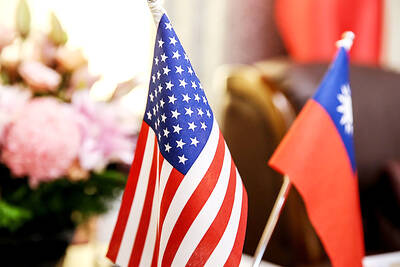
STAYING ALERT: China this week deployed its largest maritime show of force to date in the region, prompting concern in Taipei and Tokyo, which Beijing has brushed off Deterring conflict over Taiwan is a priority, the White House said in its National Security Strategy published yesterday, which also called on Japan and South Korea to increase their defense spending to help protect the first island chain. Taiwan is strategically positioned between Northeast and Southeast Asia, and provides direct access to the second island chain, with one-third of global shipping passing through the South China Sea, the report said. Given the implications for the US economy, along with Taiwan’s dominance in semiconductors, “deterring a conflict over Taiwan, ideally by preserving military overmatch, is a priority,” it said. However, the strategy also reiterated
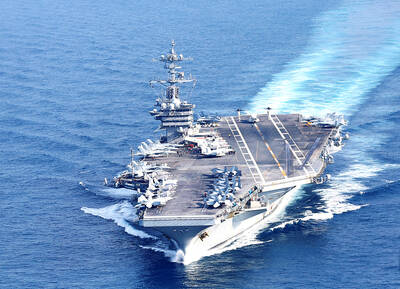
‘BALANCE OF POWER’: Hegseth said that the US did not want to ‘strangle’ China, but to ensure that none of Washington’s allies would be vulnerable to military aggression Washington has no intention of changing the “status quo” in the Taiwan Strait, US Secretary of Defense Pete Hegseth said on Saturday, adding that one of the US military’s main priorities is to deter China “through strength, not through confrontation.” Speaking at the annual Reagan National Defense Forum in Simi Valley, California, Hegseth outlined the US Department of Defense’s priorities under US President Donald Trump. “First, defending the US homeland and our hemisphere. Second, deterring China through strength, not confrontation. Third, increased burden sharing for us, allies and partners. And fourth, supercharging the US defense industrial base,” he said. US-China relations under
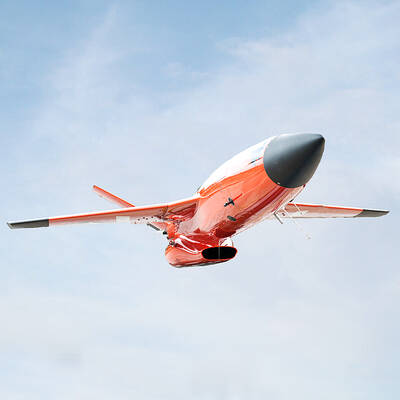
The Chien Feng IV (勁蜂, Mighty Hornet) loitering munition is on track to enter flight tests next month in connection with potential adoption by Taiwanese and US armed forces, a government source said yesterday. The kamikaze drone, which boasts a range of 1,000km, debuted at the Taipei Aerospace and Defense Technology Exhibition in September, the official said on condition of anonymity. The Chungshan Institute of Science and Technology and US-based Kratos Defense jointly developed the platform by leveraging the engine and airframe of the latter’s MQM-178 Firejet target drone, they said. The uncrewed aerial vehicle is designed to utilize an artificial intelligence computer


 RSS
RSS