


Democrats warned that US President Donald Trump was on the verge of dictatorship, while Republicans defended his record at the opening of a stormy debate on impeachment charges in Washington on Wednesday.
The parties held to diametrically opposed views of Trump as they weighed articles of impeachment at the beginning of a two-day debate.
Trump is accused of wielding the power of the presidency for personal and political gain by pressuring Ukraine to interfere in next year’s US presidential election.
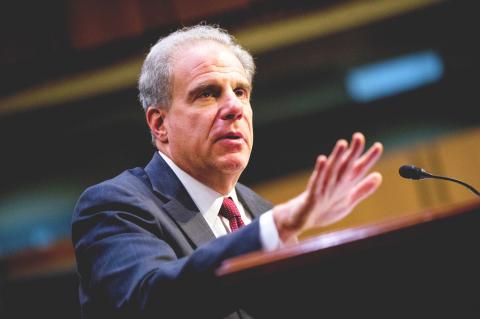
Photo: AP
There is little question about the outcome in the House Judiciary Committee. By the end of the week the majority-Democrat panel is expected to approve the charges and send them to the entire US House of Representatives next week.
Lawmakers in the televised hearing appeared focused on speaking to voters, whose sentiment will be crucial if, as expected, Trump goes on trial in the US Senate next month.
Democratic committee chairman Jerry Nadler opened the hearing.
“Today we begin consideration of two articles of impeachment against President Donald J. Trump,” Nadler said. “Taken together, the two articles charge President Trump with placing his private political interests above our national security, above our free and fair elections, and above our ability to hold public officials accountable.”
“If the president can first abuse his power and then stonewall all congressional requests for information, Congress cannot fulfill its duty to act as a check and balance against the Executive — and the president becomes a dictator,” he said.
Doug Collins, the senior Republican on the committee, said that Democrats have been seeking to impeach Trump ever since he came into office in January 2017 and have no clear case.
“It’s just generic vague statements,” Collins said. “You go home and pick something you don’t like about the president, and there’s your abuse of power.”
“This is as much about political expediency as it is anything else and that should never be an article of impeachment,” he said.
Trump faces becoming only the third president in US history to be impeached and placed on trial in the Senate.
He is accused of pressuring Ukraine for help against former US vice president Joe Biden ahead of next year’s national elections, and holding up military aid to the country which it needed to face Russian aggression, unless it did his bidding.
Republicans say it was a conflict of interest at best that Biden’s son Hunter served on the board of Burisma, a Ukrainian energy firm, while his father was US vice president.
They say there are valid questions about the company’s reputation for corruption and Hunter Biden’s pay of more than US$50,000 a month while his father led US policy on Ukraine and called for a Ukranian prosecutor who was investigating the firm to be fired.
US Representative Jim Jordan said that Democrats were simply refighting their 2016 election loss and hated Trump.
“This is about one basic fact: The Democrats have never accepted the will of the American people,” Jordan said. “They don’t like the 63 million people who voted for this president.”
Separately, the US Department of Justice presented a report on the origins of the previous Russia investigation into Trump.
US Inspector General Michael Horowitz testified before the Senate Judiciary Committee about his findings that there were major flaws in how the FBI investigation was conducted.
Horowitz said that there was a need for policy changes and that the FBI should not be comforted by his findings.
The most serious problems concerned FBI applications for court approval to eavesdrop on a former Trump campaign aide, he said.
He rebuked officials up and down the chain of command for failing to update judges as they learned new information that undercut some of their original assertions.
“It doesn’t vindicate anybody at the FBI who touched this, including the leadership,” Horowitz said.
That was a rejection of the views of former FBI director James Comey, who earlier this week had claimed vindication for the bureau based on Horowitz’s conclusions.
Asked whether he believed the FBI had acted with partisan bias. Horowitz said that the multitude of errors during the surveillance warrant process, which included the altering of an e-mail by an FBI lawyer, was so “inexplicable” and yielded no obvious explanations that he could not be confident about the intention.
Additional reporting by AP

CROSS-STRAIT COLLABORATION: The new KMT chairwoman expressed interest in meeting the Chinese president from the start, but she’ll have to pay to get in Beijing allegedly agreed to let Chinese Nationalist Party (KMT) Chairwoman Cheng Li-wun (鄭麗文) meet with Chinese President Xi Jinping (習近平) around the Lunar New Year holiday next year on three conditions, including that the KMT block Taiwan’s arms purchases, a source said yesterday. Cheng has expressed interest in meeting Xi since she won the KMT’s chairmanship election in October. A source, speaking on condition of anonymity, said a consensus on a meeting was allegedly reached after two KMT vice chairmen visited China’s Taiwan Affairs Office Director Song Tao (宋濤) in China last month. Beijing allegedly gave the KMT three conditions it had to

STAYING ALERT: China this week deployed its largest maritime show of force to date in the region, prompting concern in Taipei and Tokyo, which Beijing has brushed off Deterring conflict over Taiwan is a priority, the White House said in its National Security Strategy published yesterday, which also called on Japan and South Korea to increase their defense spending to help protect the first island chain. Taiwan is strategically positioned between Northeast and Southeast Asia, and provides direct access to the second island chain, with one-third of global shipping passing through the South China Sea, the report said. Given the implications for the US economy, along with Taiwan’s dominance in semiconductors, “deterring a conflict over Taiwan, ideally by preserving military overmatch, is a priority,” it said. However, the strategy also reiterated

‘BALANCE OF POWER’: Hegseth said that the US did not want to ‘strangle’ China, but to ensure that none of Washington’s allies would be vulnerable to military aggression Washington has no intention of changing the “status quo” in the Taiwan Strait, US Secretary of Defense Pete Hegseth said on Saturday, adding that one of the US military’s main priorities is to deter China “through strength, not through confrontation.” Speaking at the annual Reagan National Defense Forum in Simi Valley, California, Hegseth outlined the US Department of Defense’s priorities under US President Donald Trump. “First, defending the US homeland and our hemisphere. Second, deterring China through strength, not confrontation. Third, increased burden sharing for us, allies and partners. And fourth, supercharging the US defense industrial base,” he said. US-China relations under

The Chien Feng IV (勁蜂, Mighty Hornet) loitering munition is on track to enter flight tests next month in connection with potential adoption by Taiwanese and US armed forces, a government source said yesterday. The kamikaze drone, which boasts a range of 1,000km, debuted at the Taipei Aerospace and Defense Technology Exhibition in September, the official said on condition of anonymity. The Chungshan Institute of Science and Technology and US-based Kratos Defense jointly developed the platform by leveraging the engine and airframe of the latter’s MQM-178 Firejet target drone, they said. The uncrewed aerial vehicle is designed to utilize an artificial intelligence computer


 RSS
RSS