


The US government across three White House administrations misled the public about failures in the Afghanistan war, often suggesting success where it did not exist, according to thousands of pages of documents obtained by the Washington Post.
The documents reveal deep frustrations about the US’ conduct of the Afghanistan war, including the ever-changing US strategy, the struggles to develop an effective Afghan fighting force, and persistent failures to defeat the Taliban and combat corruption throughout the government.
“We were devoid of a fundamental understanding of Afghanistan — we didn’t know what we were doing,” Douglas Lute, a three-star US Army general who served as the White House’s Afghan war czar during the administration of former US presidents George W. Bush and Barack Obama, told government interviewers in 2015.
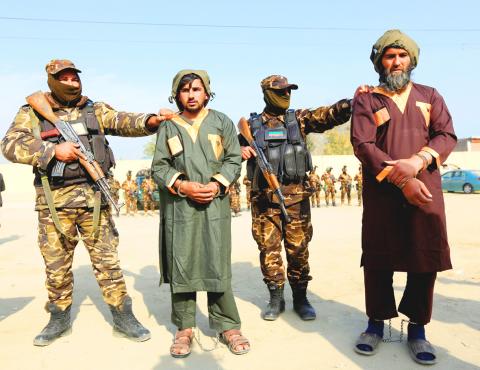
Photo: Reuters
The interviews were conducted as part of a “Lessons Learned” project by the Special Inspector General for Afghanistan Reconstruction (SIGAR) over the past several years.
SIGAR has produced seven reports so far from the more than 400 interviews, and several more are in the works. The Post sought and received raw interview data through the Freedom of Information Act and lawsuits.
The documents quote officials close to the 18-year war effort describing a campaign by the US government to distort the grim reality of the war.
“Every data point was altered to present the best picture possible,” Bob Crowley, a US Army colonel who served as a counterinsurgency adviser to US military commanders in 2013 and 2014, told government interviewers, according to the Post.
“Surveys, for instance, were totally unreliable, but reinforced that everything we were doing was right and we became a self-licking ice cream cone,” he said.
The Pentagon released a statement saying there has been “no intent” by the department to mislead Congress or the public.
US Department of Defense (DOD) officials “have consistently briefed the progress and challenges associated with our efforts in Afghanistan, and DOD provides regular reports to Congress that highlight these challenges,” department spokesman Lieutenant Colonel Thomas Campbell said. “Most of the individuals interviewed spoke with the benefit of hindsight. Hindsight has also enabled the department to evaluate previous approaches and revise our strategy, as we did in 2017 with the launch of the president’s South Asia strategy.”
SIGAR has frequently been vocal about the war’s failures in reports going back more than a decade, including extensive questions about vast waste in the nearly US$1 trillion spent on the conflict.
The Post said SIGAR head John Sopko acknowledged that the documents show “the American people have constantly been lied to.”
SIGAR was created by Congress in 2008 to conduct audits and investigations into waste of government spending on the war in Afghanistan.

CROSS-STRAIT COLLABORATION: The new KMT chairwoman expressed interest in meeting the Chinese president from the start, but she’ll have to pay to get in Beijing allegedly agreed to let Chinese Nationalist Party (KMT) Chairwoman Cheng Li-wun (鄭麗文) meet with Chinese President Xi Jinping (習近平) around the Lunar New Year holiday next year on three conditions, including that the KMT block Taiwan’s arms purchases, a source said yesterday. Cheng has expressed interest in meeting Xi since she won the KMT’s chairmanship election in October. A source, speaking on condition of anonymity, said a consensus on a meeting was allegedly reached after two KMT vice chairmen visited China’s Taiwan Affairs Office Director Song Tao (宋濤) in China last month. Beijing allegedly gave the KMT three conditions it had to

STAYING ALERT: China this week deployed its largest maritime show of force to date in the region, prompting concern in Taipei and Tokyo, which Beijing has brushed off Deterring conflict over Taiwan is a priority, the White House said in its National Security Strategy published yesterday, which also called on Japan and South Korea to increase their defense spending to help protect the first island chain. Taiwan is strategically positioned between Northeast and Southeast Asia, and provides direct access to the second island chain, with one-third of global shipping passing through the South China Sea, the report said. Given the implications for the US economy, along with Taiwan’s dominance in semiconductors, “deterring a conflict over Taiwan, ideally by preserving military overmatch, is a priority,” it said. However, the strategy also reiterated
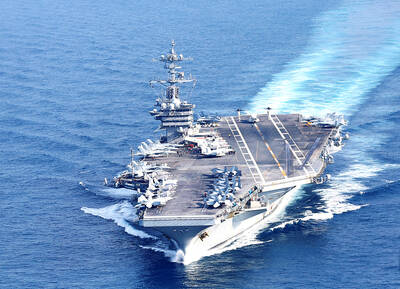
‘BALANCE OF POWER’: Hegseth said that the US did not want to ‘strangle’ China, but to ensure that none of Washington’s allies would be vulnerable to military aggression Washington has no intention of changing the “status quo” in the Taiwan Strait, US Secretary of Defense Pete Hegseth said on Saturday, adding that one of the US military’s main priorities is to deter China “through strength, not through confrontation.” Speaking at the annual Reagan National Defense Forum in Simi Valley, California, Hegseth outlined the US Department of Defense’s priorities under US President Donald Trump. “First, defending the US homeland and our hemisphere. Second, deterring China through strength, not confrontation. Third, increased burden sharing for us, allies and partners. And fourth, supercharging the US defense industrial base,” he said. US-China relations under

The Chien Feng IV (勁蜂, Mighty Hornet) loitering munition is on track to enter flight tests next month in connection with potential adoption by Taiwanese and US armed forces, a government source said yesterday. The kamikaze drone, which boasts a range of 1,000km, debuted at the Taipei Aerospace and Defense Technology Exhibition in September, the official said on condition of anonymity. The Chungshan Institute of Science and Technology and US-based Kratos Defense jointly developed the platform by leveraging the engine and airframe of the latter’s MQM-178 Firejet target drone, they said. The uncrewed aerial vehicle is designed to utilize an artificial intelligence computer


 RSS
RSS