


At least 43 people were killed yesterday in a devastating fire that ripped through a bag factory in the cramped, congested old quarter of the Indian capital, New Delhi, trapping scores of workers who were sleeping inside.
The blaze was the worst in New Delhi since 59 moviegoers died in a cinema in 1997, with the city’s poor planning and enforcement of building and safety regulations often responsible for such incidents.
Tearful relatives spoke of receiving desperate calls from factory workers from about 5am pleading to be freed from the inferno in the dark, poorly lit premises in the commercial hub of Sadar Bazar.
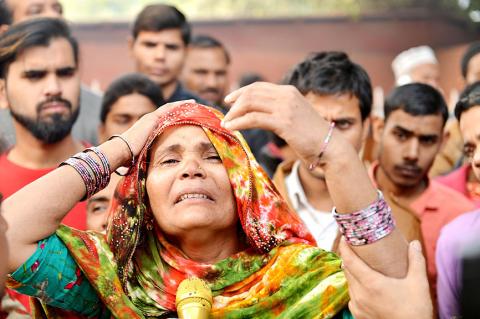
Photo: EPA-EFE/STR
The four-story building was home to a series of manufacturing units producing items including schools bags and packing materials, which only worsened the spread of the fire, officials said.
“Most of the casualties happened because of suffocation,” witness Mohammed Khalil told reporters. “After the fire, people didn’t have any way to get out and I believe many were asleep and because of the smoke, they got suffocated.”
Outside a nearby hospital morgue, anxious relatives and friends gathered to identify the bodies.
Naushad Ahmad, was desperately looking for his friend who remained missing, unable to reach him on his mobile phone.
“I have been to the factory and this tragedy was waiting to happen,” he told reporters. “There was only one exit and entrance to the building, with all the electricity meters installed at the main door... People didn’t get a chance to escape.”
Indian Prime Minister Narendra Modi said on Twitter that the fire was “extremely horrific,” while state and national authorities said they would offer financial assistance to the victims’ families and survivors.
Families of the victims told reporters that they were mostly migrant workers who had come from Bihar, one of India’s most impoverished states.

CROSS-STRAIT COLLABORATION: The new KMT chairwoman expressed interest in meeting the Chinese president from the start, but she’ll have to pay to get in Beijing allegedly agreed to let Chinese Nationalist Party (KMT) Chairwoman Cheng Li-wun (鄭麗文) meet with Chinese President Xi Jinping (習近平) around the Lunar New Year holiday next year on three conditions, including that the KMT block Taiwan’s arms purchases, a source said yesterday. Cheng has expressed interest in meeting Xi since she won the KMT’s chairmanship election in October. A source, speaking on condition of anonymity, said a consensus on a meeting was allegedly reached after two KMT vice chairmen visited China’s Taiwan Affairs Office Director Song Tao (宋濤) in China last month. Beijing allegedly gave the KMT three conditions it had to

STAYING ALERT: China this week deployed its largest maritime show of force to date in the region, prompting concern in Taipei and Tokyo, which Beijing has brushed off Deterring conflict over Taiwan is a priority, the White House said in its National Security Strategy published yesterday, which also called on Japan and South Korea to increase their defense spending to help protect the first island chain. Taiwan is strategically positioned between Northeast and Southeast Asia, and provides direct access to the second island chain, with one-third of global shipping passing through the South China Sea, the report said. Given the implications for the US economy, along with Taiwan’s dominance in semiconductors, “deterring a conflict over Taiwan, ideally by preserving military overmatch, is a priority,” it said. However, the strategy also reiterated
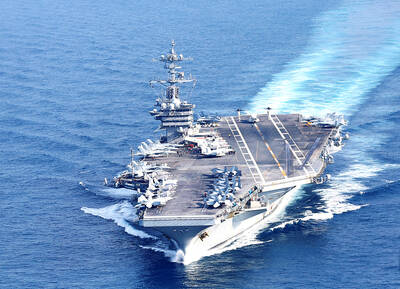
‘BALANCE OF POWER’: Hegseth said that the US did not want to ‘strangle’ China, but to ensure that none of Washington’s allies would be vulnerable to military aggression Washington has no intention of changing the “status quo” in the Taiwan Strait, US Secretary of Defense Pete Hegseth said on Saturday, adding that one of the US military’s main priorities is to deter China “through strength, not through confrontation.” Speaking at the annual Reagan National Defense Forum in Simi Valley, California, Hegseth outlined the US Department of Defense’s priorities under US President Donald Trump. “First, defending the US homeland and our hemisphere. Second, deterring China through strength, not confrontation. Third, increased burden sharing for us, allies and partners. And fourth, supercharging the US defense industrial base,” he said. US-China relations under
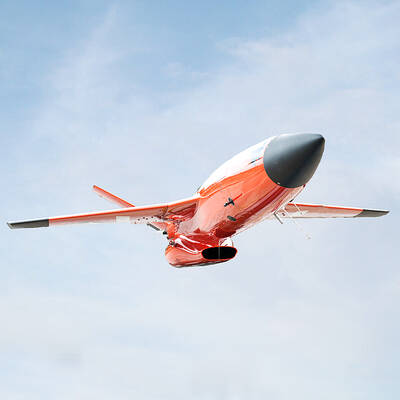
The Chien Feng IV (勁蜂, Mighty Hornet) loitering munition is on track to enter flight tests next month in connection with potential adoption by Taiwanese and US armed forces, a government source said yesterday. The kamikaze drone, which boasts a range of 1,000km, debuted at the Taipei Aerospace and Defense Technology Exhibition in September, the official said on condition of anonymity. The Chungshan Institute of Science and Technology and US-based Kratos Defense jointly developed the platform by leveraging the engine and airframe of the latter’s MQM-178 Firejet target drone, they said. The uncrewed aerial vehicle is designed to utilize an artificial intelligence computer


 RSS
RSS