


Saudi Arabia yesterday sought to distance itself from a student who carried out a fatal shooting at a US naval base as it seeks to repair its image of being an exporter of Muslim extremism.
The Saudi Arabian military student reportedly condemned the US as a “nation of evil” before going on a rampage on Friday at Naval Air Station Pensacola in Florida, killing three people and wounding eight.
The shooting marks a setback in the kingdom’s efforts to shrug off its long-standing reputation for promoting religious extremism after the Sept. 11, 2001, attacks, in which 15 of the 19 hijackers were Saudis.
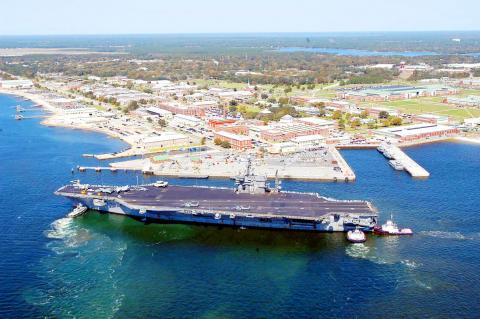
Photo: EPA-EFE / US Navy / Patrick Nichols
The hashtag “Saudis stand with America” gained traction on social media after Saudi King Salman telephoned US President Donald Trump to denounce the shooting as “heinous” and pledge cooperation with US officials to investigate the incident.
The king said in the phone call on Friday that the shooter, who was gunned down by police, “does not represent the Saudi people,” a sentiment echoed by other officials.
“Like many other Saudi military personnel, I was trained in a US military base, and we used that valuable training to fight side by side with our American allies against terrorism and other threats,” Prince Khalid bin Salman, the king’s younger son and the deputy defense minister, wrote on Twitter.
“A large number of Saudi graduates of the Naval Air Station in Pensacola moved on to serve with their US counterparts in battlefronts around the world, helping to safeguard the regional and global security. [The] tragic event is strongly condemned by everyone in Saudi Arabia,” he wrote.
Saudi Minister of State for Foreign Affairs Adel al-Jubeir also expressed his “deepest sympathies and heartfelt condolences” over the shooting.
The incident is unlikely to affect Washington’s close relations with Riyadh, with both governments seeking military and diplomatic cooperation to counter Shiite power Iran.

CROSS-STRAIT COLLABORATION: The new KMT chairwoman expressed interest in meeting the Chinese president from the start, but she’ll have to pay to get in Beijing allegedly agreed to let Chinese Nationalist Party (KMT) Chairwoman Cheng Li-wun (鄭麗文) meet with Chinese President Xi Jinping (習近平) around the Lunar New Year holiday next year on three conditions, including that the KMT block Taiwan’s arms purchases, a source said yesterday. Cheng has expressed interest in meeting Xi since she won the KMT’s chairmanship election in October. A source, speaking on condition of anonymity, said a consensus on a meeting was allegedly reached after two KMT vice chairmen visited China’s Taiwan Affairs Office Director Song Tao (宋濤) in China last month. Beijing allegedly gave the KMT three conditions it had to
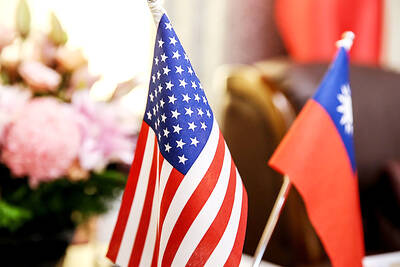
STAYING ALERT: China this week deployed its largest maritime show of force to date in the region, prompting concern in Taipei and Tokyo, which Beijing has brushed off Deterring conflict over Taiwan is a priority, the White House said in its National Security Strategy published yesterday, which also called on Japan and South Korea to increase their defense spending to help protect the first island chain. Taiwan is strategically positioned between Northeast and Southeast Asia, and provides direct access to the second island chain, with one-third of global shipping passing through the South China Sea, the report said. Given the implications for the US economy, along with Taiwan’s dominance in semiconductors, “deterring a conflict over Taiwan, ideally by preserving military overmatch, is a priority,” it said. However, the strategy also reiterated
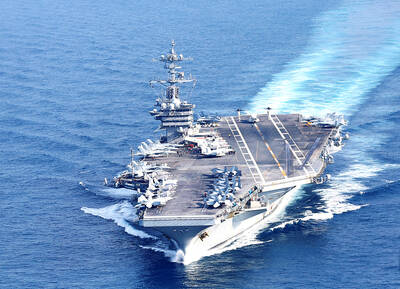
‘BALANCE OF POWER’: Hegseth said that the US did not want to ‘strangle’ China, but to ensure that none of Washington’s allies would be vulnerable to military aggression Washington has no intention of changing the “status quo” in the Taiwan Strait, US Secretary of Defense Pete Hegseth said on Saturday, adding that one of the US military’s main priorities is to deter China “through strength, not through confrontation.” Speaking at the annual Reagan National Defense Forum in Simi Valley, California, Hegseth outlined the US Department of Defense’s priorities under US President Donald Trump. “First, defending the US homeland and our hemisphere. Second, deterring China through strength, not confrontation. Third, increased burden sharing for us, allies and partners. And fourth, supercharging the US defense industrial base,” he said. US-China relations under
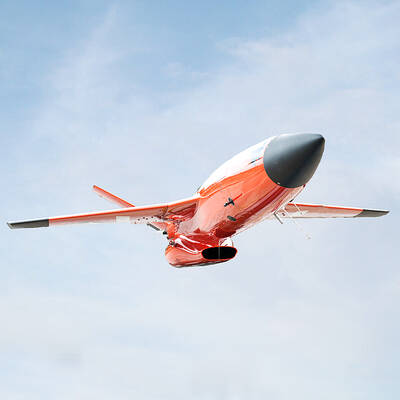
The Chien Feng IV (勁蜂, Mighty Hornet) loitering munition is on track to enter flight tests next month in connection with potential adoption by Taiwanese and US armed forces, a government source said yesterday. The kamikaze drone, which boasts a range of 1,000km, debuted at the Taipei Aerospace and Defense Technology Exhibition in September, the official said on condition of anonymity. The Chungshan Institute of Science and Technology and US-based Kratos Defense jointly developed the platform by leveraging the engine and airframe of the latter’s MQM-178 Firejet target drone, they said. The uncrewed aerial vehicle is designed to utilize an artificial intelligence computer


 RSS
RSS