


Ride-sharing company Uber Technologies Inc, under fire around the world for its safety record, on Thursday said that it had tallied nearly 6,000 sexual assaults in the US over the past couple of years.
That included more than 450 cases of rape, said Uber’s first public report into the issue, which counts attacks by both passengers and drivers in 2017 and last year.
It also revealed 19 fatal assaults related to the company over the two-year period, when it averaged more than 3.1 million trips each day in the US.

Photo: AFP
Sexual assaults were reported on 0.00002 percent of trips, Uber said.
“While these reports are rare, every report represents an individual who came forward to share an intensely painful experience,” it said. “Even one report is one too many.”
Uber said that the figures also showed its drivers were attacked at about the same rate as passengers reporting sexual assault.
“Drivers are victims, too,” it said.
While the report was confined to the US, the company faces complaints worldwide that it is doing too little to protect passengers.
In London, Uber lost its license after transport authorities said the company had failed to fix a litany of safety issues — including at least 14,000 cases of drivers handing their permits to unlicensed friends or relatives.
Uber continues to operate in London pending an appeal.
The US report classified 5,981 sexual assaults ranging from “non-consensual sexual penetration” to unwanted kissing or touching.
It showed that the total number of reported assaults rose last year in three of the five categories covered, but the firm said that the frequency of attacks dropped 16 percent due to a rise in overall passengers.
A woman raped by an Uber driver in India in 2017 filed a US lawsuit accusing the service of invading her privacy and defaming her character.
Chinese authorities in September launched a security audit of ride-hailing giant Didi Chuxing (滴滴出行) following a public outcry over the rape and murder of a passenger the previous month.
Uber’s rival Lyft Inc is facing a series of lawsuits over sexual assault or rape that allegedly occurred in vehicles affiliated with the California company.
Twenty women on Wednesday filed lawsuits against Lyft in San Francisco, following another 14 complaints filed in September.
“The bottom line is that Lyft does not take safety of their passengers seriously, and never has,” said attorney Mike Bomberger, who is representing the women.
He recounted the story of Caroline Miller, who he said was raped by her Lyft driver after going out to celebrate her birthday.
“As a consequence of her assault, they offered her a refund of her ride,” Bomberger said.
A Lyft spokeswoman said that the company understood that women faced “disproportionate risks” when they traveled.
“We recognize these risks, which is why we are relentless in our work to build safety into every aspect of our work,” she said.
Both ride-sharing firms have made it more difficult for people to impersonate drivers, tightened controls to detect convicted criminals and added a panic button to their apps.
Bomberger said the panic button was a “joke.”
“Who can operate a smartphone when they are being sexually assaulted?” he said.

CROSS-STRAIT COLLABORATION: The new KMT chairwoman expressed interest in meeting the Chinese president from the start, but she’ll have to pay to get in Beijing allegedly agreed to let Chinese Nationalist Party (KMT) Chairwoman Cheng Li-wun (鄭麗文) meet with Chinese President Xi Jinping (習近平) around the Lunar New Year holiday next year on three conditions, including that the KMT block Taiwan’s arms purchases, a source said yesterday. Cheng has expressed interest in meeting Xi since she won the KMT’s chairmanship election in October. A source, speaking on condition of anonymity, said a consensus on a meeting was allegedly reached after two KMT vice chairmen visited China’s Taiwan Affairs Office Director Song Tao (宋濤) in China last month. Beijing allegedly gave the KMT three conditions it had to

STAYING ALERT: China this week deployed its largest maritime show of force to date in the region, prompting concern in Taipei and Tokyo, which Beijing has brushed off Deterring conflict over Taiwan is a priority, the White House said in its National Security Strategy published yesterday, which also called on Japan and South Korea to increase their defense spending to help protect the first island chain. Taiwan is strategically positioned between Northeast and Southeast Asia, and provides direct access to the second island chain, with one-third of global shipping passing through the South China Sea, the report said. Given the implications for the US economy, along with Taiwan’s dominance in semiconductors, “deterring a conflict over Taiwan, ideally by preserving military overmatch, is a priority,” it said. However, the strategy also reiterated

‘BALANCE OF POWER’: Hegseth said that the US did not want to ‘strangle’ China, but to ensure that none of Washington’s allies would be vulnerable to military aggression Washington has no intention of changing the “status quo” in the Taiwan Strait, US Secretary of Defense Pete Hegseth said on Saturday, adding that one of the US military’s main priorities is to deter China “through strength, not through confrontation.” Speaking at the annual Reagan National Defense Forum in Simi Valley, California, Hegseth outlined the US Department of Defense’s priorities under US President Donald Trump. “First, defending the US homeland and our hemisphere. Second, deterring China through strength, not confrontation. Third, increased burden sharing for us, allies and partners. And fourth, supercharging the US defense industrial base,” he said. US-China relations under
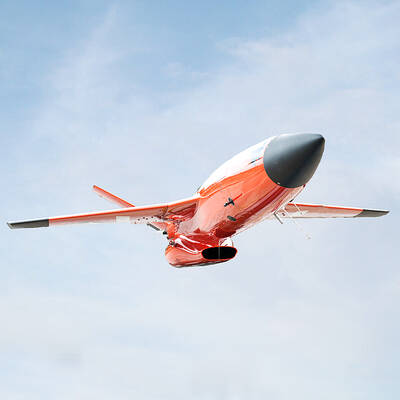
The Chien Feng IV (勁蜂, Mighty Hornet) loitering munition is on track to enter flight tests next month in connection with potential adoption by Taiwanese and US armed forces, a government source said yesterday. The kamikaze drone, which boasts a range of 1,000km, debuted at the Taipei Aerospace and Defense Technology Exhibition in September, the official said on condition of anonymity. The Chungshan Institute of Science and Technology and US-based Kratos Defense jointly developed the platform by leveraging the engine and airframe of the latter’s MQM-178 Firejet target drone, they said. The uncrewed aerial vehicle is designed to utilize an artificial intelligence computer


 RSS
RSS