


Already strained relations between China and the US were yesterday further muddied after the US Congress overwhelmingly approved a bill targeting Beijing’s mass crackdown on ethnic Muslim minorities, less than one week after US President Donald Trump signed separate human rights legislation on Hong Kong.
The Chinese Communist Party (CCP) has long regarded Hong Kong and Xinjiang as crucial areas for asserting territorial sovereignty, and has responded with fury to what it considers foreign meddling.
“Xinjiang is China’s Xinjiang,” said a statement from the Chinese State Ethnic Affairs Commission, echoing another government mantra: “Hong Kong is China’s Hong Kong.”

Photo: AP
The Uighur Human Rights Policy Act denounces the detention of an estimated 1 million Uighurs, Kazakhs and others in Xinjiang, home to the predominantly Muslim minority groups.
It would require the US Department of State to evaluate whether Chinese officials would meet the criteria for sanctions for their roles in enacting oppressive policies.
The bill “disregards the facts and mixes up black and white,” said the Foreign Affairs Committee of the Chinese National People’s Congress (NPC) in one of a slew of strongly worded rebukes from government departments.
“It is regrettable that US Congress has not only turned a blind eye to Xinjiang’s efforts to combat terrorism and protect human rights in accordance with laws and regulations, but also to Xinjiang’s current economic development, social stability, national unity and religious harmony,” the NPC commission said.
Former detainees and their family members have said that they were arbitrarily held in heavily secured, prison-like camps where they were pressured to renounce their faith and express gratitude to the CCP.
A leak last month of classified Chinese government documents revealed a blueprint for rewiring the thoughts of ethnic minorities who had not committed any crimes.
Beijing has said that the measures are necessary to combat terrorism and eradicate religious extremism, calling the facilities “vocational training centers” for those who lack employable skills.
“The US bill smears our efforts in counterterrorism and deradicalization, which only reveals America’s double standards on counterterrorism and further exposes to the Chinese people its hypocrisy and malicious intentions,” Chinese Ministry of Foreign Affairs spokeswoman Hua Chunying (華春瑩) told a regular media briefing in Beijing.
Tensions over the US bills have cast doubt over the potential for a trade deal between the two countries, which have been embroiled in a 16-month tariff dispute.
Trump on Tuesday said that he has “no deadline” for striking an agreement and that he might wait until after the US presidential election in November next year, triggering a sell-off in global markets.
Asked about Trump’s comments, Hua yesterday said that Beijing too had no timeline for ending the protracted trade dispute.
“We will not set any time limit on when the deal will or will not be reached,” Hua said.
“This agreement and these negotiations must be based on equality and mutual respect,” she said.
“If we are faced with the pressure of unilateralism, protectionism, and trade bullying, we will have no choice and must take resolute and decisive measures to defend our legitimate and lawful interests,” Hua added.

CROSS-STRAIT COLLABORATION: The new KMT chairwoman expressed interest in meeting the Chinese president from the start, but she’ll have to pay to get in Beijing allegedly agreed to let Chinese Nationalist Party (KMT) Chairwoman Cheng Li-wun (鄭麗文) meet with Chinese President Xi Jinping (習近平) around the Lunar New Year holiday next year on three conditions, including that the KMT block Taiwan’s arms purchases, a source said yesterday. Cheng has expressed interest in meeting Xi since she won the KMT’s chairmanship election in October. A source, speaking on condition of anonymity, said a consensus on a meeting was allegedly reached after two KMT vice chairmen visited China’s Taiwan Affairs Office Director Song Tao (宋濤) in China last month. Beijing allegedly gave the KMT three conditions it had to

STAYING ALERT: China this week deployed its largest maritime show of force to date in the region, prompting concern in Taipei and Tokyo, which Beijing has brushed off Deterring conflict over Taiwan is a priority, the White House said in its National Security Strategy published yesterday, which also called on Japan and South Korea to increase their defense spending to help protect the first island chain. Taiwan is strategically positioned between Northeast and Southeast Asia, and provides direct access to the second island chain, with one-third of global shipping passing through the South China Sea, the report said. Given the implications for the US economy, along with Taiwan’s dominance in semiconductors, “deterring a conflict over Taiwan, ideally by preserving military overmatch, is a priority,” it said. However, the strategy also reiterated

‘BALANCE OF POWER’: Hegseth said that the US did not want to ‘strangle’ China, but to ensure that none of Washington’s allies would be vulnerable to military aggression Washington has no intention of changing the “status quo” in the Taiwan Strait, US Secretary of Defense Pete Hegseth said on Saturday, adding that one of the US military’s main priorities is to deter China “through strength, not through confrontation.” Speaking at the annual Reagan National Defense Forum in Simi Valley, California, Hegseth outlined the US Department of Defense’s priorities under US President Donald Trump. “First, defending the US homeland and our hemisphere. Second, deterring China through strength, not confrontation. Third, increased burden sharing for us, allies and partners. And fourth, supercharging the US defense industrial base,” he said. US-China relations under
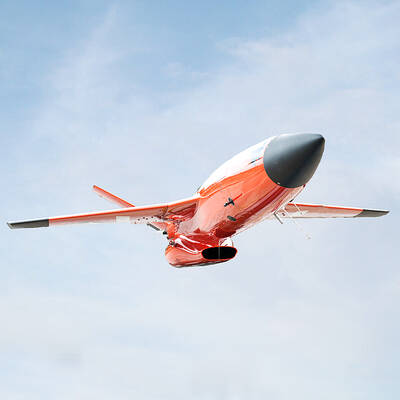
The Chien Feng IV (勁蜂, Mighty Hornet) loitering munition is on track to enter flight tests next month in connection with potential adoption by Taiwanese and US armed forces, a government source said yesterday. The kamikaze drone, which boasts a range of 1,000km, debuted at the Taipei Aerospace and Defense Technology Exhibition in September, the official said on condition of anonymity. The Chungshan Institute of Science and Technology and US-based Kratos Defense jointly developed the platform by leveraging the engine and airframe of the latter’s MQM-178 Firejet target drone, they said. The uncrewed aerial vehicle is designed to utilize an artificial intelligence computer


 RSS
RSS