


China yesterday said it would suspend US Navy visits to Hong Kong and sanction several US-based pro-democracy organizations in retaliation for the signing into law of legislation supporting human rights in the territory.
While the nature of the sanctions remained unclear, the move appeared to back up Chinese threats that the US would bear the costs of the decision.
The steps are “in response to the US’ unreasonable behavior,” Chinese Ministry of Foreign Affairs spokeswoman Hua Chunying (華春瑩) said, adding that the Hong Kong Human Rights and Democracy Act “seriously interfered” in China’s internal affairs.
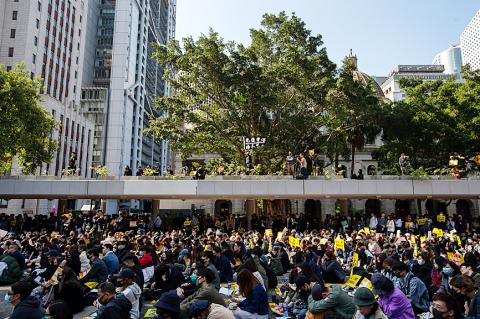
Photo: EPA-EFE
“China urges the United States to correct its mistakes and stop any words and deeds that interfere in Hong Kong and China’s internal affairs,” she said at a daily briefing in Beijing.
The law, signed on Wednesday by US President Donald Trump, mandates sanctions on Chinese and Hong Kong officials who carry out human rights abuses and requires an annual review of the favorable trade status that Washington grants Hong Kong.
China would sanction organizations including the National Endowment for Democracy, the National Democratic Institute for International Affairs, Human Rights Watch, the International Republican Institute, Freedom House and others that Hua said had “performed badly” in the Hong Kong unrest.
“China urges the United States to correct its mistakes and stop any words and deeds that interfere in Hong Kong and China’s internal affairs,” Hua said, adding that China could take “further necessary actions” depending on how matters develop.
Hua accused the groups of instigating protesters to engage in “radical violent crimes and inciting separatist activities.”
“These organizations deserve to be sanctioned and must pay a price,” Hua said.
She did not provide details on how China would sanction the groups, which are already restricted from operating in China.
“This seems to be an empty threat, because these groups don’t operate inside mainland China,” Patrick Poon (潘燊昌), a Hong Kong-based China researcher at Amnesty International, told Bloomberg. “But if there are more tangible threats on staffers and representatives for these organizations operating in Hong Kong, it would be a serious clampdown on freedom of expression.”
The National Endowment for Democracy receives funding directly from the US Congress, while others generally draw their running costs from a mixture of private and public grants.
While China has in the past suspended visits by US military ships and aircraft, sanctioning NGOs, especially those with connections to the US government, would bring conditions for civil society in Hong Kong significantly closer to those in mainland China.
Meanwhile, several hundred people in Hong Kong who work in advertising yesterday started a five-day strike to show support for anti-government protests, saying that they would not go to work, respond to work e-mails or take part in conference calls.
Some held up signs with protest slogans as they listened to speakers at an early afternoon rally to launch the action in Chater Garden.

CROSS-STRAIT COLLABORATION: The new KMT chairwoman expressed interest in meeting the Chinese president from the start, but she’ll have to pay to get in Beijing allegedly agreed to let Chinese Nationalist Party (KMT) Chairwoman Cheng Li-wun (鄭麗文) meet with Chinese President Xi Jinping (習近平) around the Lunar New Year holiday next year on three conditions, including that the KMT block Taiwan’s arms purchases, a source said yesterday. Cheng has expressed interest in meeting Xi since she won the KMT’s chairmanship election in October. A source, speaking on condition of anonymity, said a consensus on a meeting was allegedly reached after two KMT vice chairmen visited China’s Taiwan Affairs Office Director Song Tao (宋濤) in China last month. Beijing allegedly gave the KMT three conditions it had to

STAYING ALERT: China this week deployed its largest maritime show of force to date in the region, prompting concern in Taipei and Tokyo, which Beijing has brushed off Deterring conflict over Taiwan is a priority, the White House said in its National Security Strategy published yesterday, which also called on Japan and South Korea to increase their defense spending to help protect the first island chain. Taiwan is strategically positioned between Northeast and Southeast Asia, and provides direct access to the second island chain, with one-third of global shipping passing through the South China Sea, the report said. Given the implications for the US economy, along with Taiwan’s dominance in semiconductors, “deterring a conflict over Taiwan, ideally by preserving military overmatch, is a priority,” it said. However, the strategy also reiterated
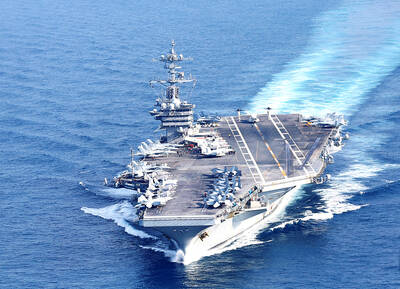
‘BALANCE OF POWER’: Hegseth said that the US did not want to ‘strangle’ China, but to ensure that none of Washington’s allies would be vulnerable to military aggression Washington has no intention of changing the “status quo” in the Taiwan Strait, US Secretary of Defense Pete Hegseth said on Saturday, adding that one of the US military’s main priorities is to deter China “through strength, not through confrontation.” Speaking at the annual Reagan National Defense Forum in Simi Valley, California, Hegseth outlined the US Department of Defense’s priorities under US President Donald Trump. “First, defending the US homeland and our hemisphere. Second, deterring China through strength, not confrontation. Third, increased burden sharing for us, allies and partners. And fourth, supercharging the US defense industrial base,” he said. US-China relations under
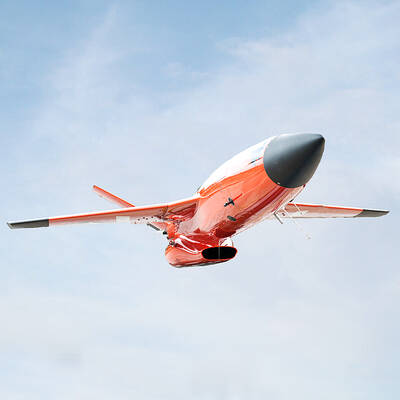
The Chien Feng IV (勁蜂, Mighty Hornet) loitering munition is on track to enter flight tests next month in connection with potential adoption by Taiwanese and US armed forces, a government source said yesterday. The kamikaze drone, which boasts a range of 1,000km, debuted at the Taipei Aerospace and Defense Technology Exhibition in September, the official said on condition of anonymity. The Chungshan Institute of Science and Technology and US-based Kratos Defense jointly developed the platform by leveraging the engine and airframe of the latter’s MQM-178 Firejet target drone, they said. The uncrewed aerial vehicle is designed to utilize an artificial intelligence computer


 RSS
RSS