


Protesters in Australia, Japan and India yesterday launched a fresh round of global demonstrations against climate change, heeding the call to action from 16-year-old climate change campaigner Greta Thunberg.
Hundreds of demonstrators in Sydney — brandishing placards that read: “You’re burning our future” and chanting: “We will rise” — gathered outside the offices of the Liberal Party as Sydney was again enveloped in toxic smoke from hundreds of bushfires that have devastated the country’s southeast in recent weeks.
“My home town was on the frontlines,” said student Sam Galvin, who was protesting in Melbourne. “That kind of shocked me into realizing that this is something that is happening and it’s time I do something about it.”
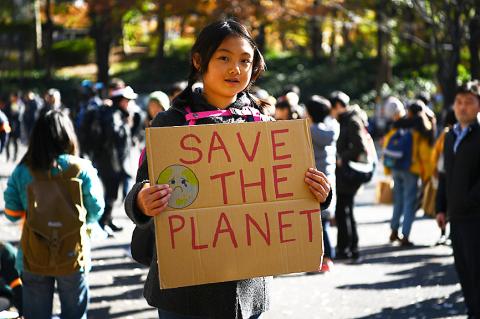
Photo: AFP
The target of the protesters’ ire was Australian Prime Minister Scott Morrison, who has angrily denied any link between the fires and climate change, while defending his support for fossil fuels.
“Our government’s inaction on the climate crisis has supercharged bushfires,” school strike leader Shiann Broderick said. “People are hurting. Communities like ours are being devastated. Summer hasn’t even begun.”
Australia, with a population of 25 million, has low carbon emissions compared with the planet’s biggest polluters, but is one of the world’s leading coal exporters.
Protests also took place in Tokyo, where hundreds marched through the teeming Shinjuku District to raise awareness of the issue.
“I feel a sense of crisis because almost no one in Japan is interested” in climate change, 19-year-old student Mio Ishida said. “I was really inspired by Greta’s actions. I thought that if I didn’t act now, it would be too late. I wanted to do something I could do.”
In New Delhi, about 50 school and university students staged a march to the Indian Ministry of Environment in the world’s most polluted capital, carrying placards and chanting slogans that urged the government to declare a climate emergency.
“This is about doing something that you believe in,” 23-year-old Saumya Chowdhury said. “We want the government to acknowledge this and have a conversation on this issue with people.”
India is one of the biggest sources of greenhouse gases and has 14 of the 15 most polluted cities in the world, according to a UN study.
Last month, millions of people took to the streets in nearly every major global city for a series of “climate strikes.”
The latest demonstrations come as representatives of 200 nations prepare to gather next week in Madrid for a 12-day UN Climate Change Summit.

CROSS-STRAIT COLLABORATION: The new KMT chairwoman expressed interest in meeting the Chinese president from the start, but she’ll have to pay to get in Beijing allegedly agreed to let Chinese Nationalist Party (KMT) Chairwoman Cheng Li-wun (鄭麗文) meet with Chinese President Xi Jinping (習近平) around the Lunar New Year holiday next year on three conditions, including that the KMT block Taiwan’s arms purchases, a source said yesterday. Cheng has expressed interest in meeting Xi since she won the KMT’s chairmanship election in October. A source, speaking on condition of anonymity, said a consensus on a meeting was allegedly reached after two KMT vice chairmen visited China’s Taiwan Affairs Office Director Song Tao (宋濤) in China last month. Beijing allegedly gave the KMT three conditions it had to

STAYING ALERT: China this week deployed its largest maritime show of force to date in the region, prompting concern in Taipei and Tokyo, which Beijing has brushed off Deterring conflict over Taiwan is a priority, the White House said in its National Security Strategy published yesterday, which also called on Japan and South Korea to increase their defense spending to help protect the first island chain. Taiwan is strategically positioned between Northeast and Southeast Asia, and provides direct access to the second island chain, with one-third of global shipping passing through the South China Sea, the report said. Given the implications for the US economy, along with Taiwan’s dominance in semiconductors, “deterring a conflict over Taiwan, ideally by preserving military overmatch, is a priority,” it said. However, the strategy also reiterated

‘BALANCE OF POWER’: Hegseth said that the US did not want to ‘strangle’ China, but to ensure that none of Washington’s allies would be vulnerable to military aggression Washington has no intention of changing the “status quo” in the Taiwan Strait, US Secretary of Defense Pete Hegseth said on Saturday, adding that one of the US military’s main priorities is to deter China “through strength, not through confrontation.” Speaking at the annual Reagan National Defense Forum in Simi Valley, California, Hegseth outlined the US Department of Defense’s priorities under US President Donald Trump. “First, defending the US homeland and our hemisphere. Second, deterring China through strength, not confrontation. Third, increased burden sharing for us, allies and partners. And fourth, supercharging the US defense industrial base,” he said. US-China relations under

The Chien Feng IV (勁蜂, Mighty Hornet) loitering munition is on track to enter flight tests next month in connection with potential adoption by Taiwanese and US armed forces, a government source said yesterday. The kamikaze drone, which boasts a range of 1,000km, debuted at the Taipei Aerospace and Defense Technology Exhibition in September, the official said on condition of anonymity. The Chungshan Institute of Science and Technology and US-based Kratos Defense jointly developed the platform by leveraging the engine and airframe of the latter’s MQM-178 Firejet target drone, they said. The uncrewed aerial vehicle is designed to utilize an artificial intelligence computer


 RSS
RSS