


China has ambitions to rival the US as the world’s diplomatic superpower with the Chinese Ministry of Foreign Affairs running more embassies and consulates around the world than the US Department of State, which still has a quarter of its key positions unfilled.
This year’s Lowy Institute Global Diplomacy Index maps the size and reach of 61 diplomatic networks around the world by embassies, consulates, permanent missions and other diplomatic posts.
Tracking all Organisation for Economic Co-operation and Development (OECD) and G20 countries, and most Asian nations, it showed an emerging China rivaling and, numerically at least, surpassing the US, which it said is caught “in a period of limbo.”
China has 276 posts, three more than the US, and 96 consulates to the US’ 88, a reflection of its emphasis on its economic and diplomatic interests.
Although Beijing has put a significant diplomatic infrastructure in place, it reflects China’s ambition more than its influence, Lowy Institute researcher Bonnie Bley said.
“The US remains the global hub for diplomatic activity,” she said. “It is — by a wide margin — the most important place for countries to locate their diplomatic posts ... China is a distant second.”
China continues to expand its diplomatic footprint — it has added five posts in the past two years — while the US’ footprint has shrunk. The US closed its St Petersburg consulate after its fallout with Russia. The administration of US President Donald Trump has not announced any new posts.
Only 73 percent of the US Department of State’s key positions are filled, the index report said.
This month, former US ambassador to Ukraine Marie Yovanovitch told the US Congress that the “hollowed-out” department is in “crisis,” saying that “the policy process is visibly unraveling.”
Australia went without a US ambassador for two years.
Staff vacancies nearly three years into Trump’s term are concerning, but the US’ diplomatic influence, developed over decades, would not be unwound in a single presidential term, Bley said.
“Instead, President Trump’s abrupt abandonment of multilateral initiatives — the Trans-Pacific Partnership, the Iran nuclear deal, the Paris climate agreement — is a greater threat to enduring US diplomatic influence,” she said.
Significantly, Beijing’s advances have come at Taiwan’s expense. Beijing has opened five embassies — in El Salvador, Burkina Faso, the Gambia, Sao Tome and Principe and the Dominican Republic — all countries that formerly recognized Taiwan.
Australia’s diplomatic footprint ranks 27th in the world. It is second-last in the G20, ahead of only Saudi Arabia — and 20th among the 36 OECD countries.
“Australia continues to run a diplomatic deficit: At 27th place, it is on par with Belgium, despite having more than twice the population and almost three times the economic size,” the report said.
Measuring diplomatic influence is more complex than a sum total of posts, but “looking at where countries are investing resources and building diplomatic infrastructure can tell us a lot about national priorities,” Bley said.

CROSS-STRAIT COLLABORATION: The new KMT chairwoman expressed interest in meeting the Chinese president from the start, but she’ll have to pay to get in Beijing allegedly agreed to let Chinese Nationalist Party (KMT) Chairwoman Cheng Li-wun (鄭麗文) meet with Chinese President Xi Jinping (習近平) around the Lunar New Year holiday next year on three conditions, including that the KMT block Taiwan’s arms purchases, a source said yesterday. Cheng has expressed interest in meeting Xi since she won the KMT’s chairmanship election in October. A source, speaking on condition of anonymity, said a consensus on a meeting was allegedly reached after two KMT vice chairmen visited China’s Taiwan Affairs Office Director Song Tao (宋濤) in China last month. Beijing allegedly gave the KMT three conditions it had to
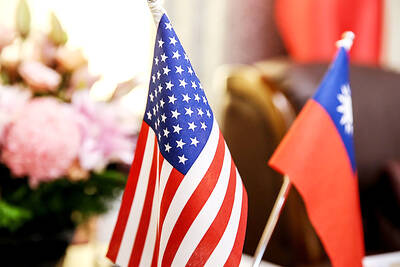
STAYING ALERT: China this week deployed its largest maritime show of force to date in the region, prompting concern in Taipei and Tokyo, which Beijing has brushed off Deterring conflict over Taiwan is a priority, the White House said in its National Security Strategy published yesterday, which also called on Japan and South Korea to increase their defense spending to help protect the first island chain. Taiwan is strategically positioned between Northeast and Southeast Asia, and provides direct access to the second island chain, with one-third of global shipping passing through the South China Sea, the report said. Given the implications for the US economy, along with Taiwan’s dominance in semiconductors, “deterring a conflict over Taiwan, ideally by preserving military overmatch, is a priority,” it said. However, the strategy also reiterated
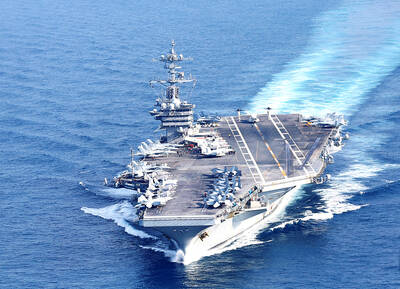
‘BALANCE OF POWER’: Hegseth said that the US did not want to ‘strangle’ China, but to ensure that none of Washington’s allies would be vulnerable to military aggression Washington has no intention of changing the “status quo” in the Taiwan Strait, US Secretary of Defense Pete Hegseth said on Saturday, adding that one of the US military’s main priorities is to deter China “through strength, not through confrontation.” Speaking at the annual Reagan National Defense Forum in Simi Valley, California, Hegseth outlined the US Department of Defense’s priorities under US President Donald Trump. “First, defending the US homeland and our hemisphere. Second, deterring China through strength, not confrontation. Third, increased burden sharing for us, allies and partners. And fourth, supercharging the US defense industrial base,” he said. US-China relations under
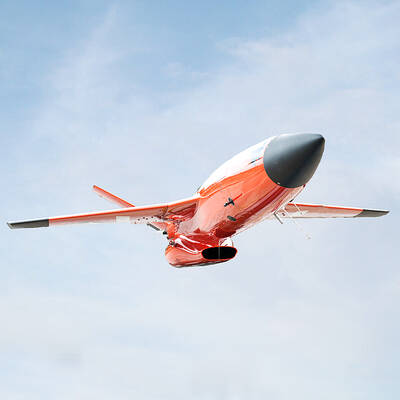
The Chien Feng IV (勁蜂, Mighty Hornet) loitering munition is on track to enter flight tests next month in connection with potential adoption by Taiwanese and US armed forces, a government source said yesterday. The kamikaze drone, which boasts a range of 1,000km, debuted at the Taipei Aerospace and Defense Technology Exhibition in September, the official said on condition of anonymity. The Chungshan Institute of Science and Technology and US-based Kratos Defense jointly developed the platform by leveraging the engine and airframe of the latter’s MQM-178 Firejet target drone, they said. The uncrewed aerial vehicle is designed to utilize an artificial intelligence computer


 RSS
RSS