


China yesterday denied the explosive claims of a self-confessed spy seeking asylum in Australia, saying that he is a convicted fraudster wanted by Shanghai police.
The Nine Network newspapers reported that Chinese defector Wang Liqiang (王立強) has given Australia’s counterespionage agency inside intelligence on how Beijing conducts its interference operations abroad and revealed the identities of China’s senior military intelligence officers in Hong Kong.
Wang said he was involved in the kidnapping in 2015 of one of five Hong Kong booksellers suspected of selling dissident materials.
Using a South Korean passport, Wang said he meddled in Taiwan’s local elections last year and added there were plans to disrupt the presidential and legislative elections on Jan. 11.
He said he currently was living in Sydney with his wife and infant son on a tourist visa and had requested political asylum.
Andrew Hastie, the chair of the Australian Parliamentary Joint Committee on Intelligence and Security, yesterday said that Wang should be allowed to stay.
“I’m of the view that anyone who’s willing to assist us in defending our sovereignty deserves our protection,” Hastie told Australia’s Nine network newspapers.
Hastie, a vocal critic of Beijing, was banned from entering China last week along with another politician.
He has previously said Australia’s sovereignty and freedoms could be threatened by Beijing.
The Chinese embassy hit back at Wang and referenced a statement from Shanghai police, which said Wang was sentenced in China’s Fujian Province in October 2016 to one year and three months in prison for fraud with a suspended sentence of one-and-a-half years.
It said he was wanted in relation to a fraud case from earlier this year.
“On April 19, 2019, the Shanghai police opened an investigation into Wang, who allegedly cheated 4.6 million yuan [US$653,474 at the current exchange rate] from a person surnamed Shu through a fake investment project involving car import in February,” the statement said.
The embassy said Wang left for Hong Kong on April 10 carrying a fake Chinese passport and a fake Hong Kong permanent resident ID.
It said the Shanghai police were investigating the matter.
Wang would be the first Chinese intelligence operative to blow his cover.
He told Nine Network he faced detention and possible execution if he returned to China.
Wang claimed he was part of a Hong Kong-based investment firm that was a front for the Chinese government to conduct political and economic espionage in Hong Kong, including infiltrating universities and directing harassment and cyberattacks against dissidents.
Resource-rich Australia relies on China for one-third of its export earnings, but relations have been frosty for some time.
The Australian government has been trying to neutralize China’s influence by banning foreign political donations and covert foreign interference in domestic politics.
Australian Treasurer Josh Frydenberg on Saturday told reporters that Wang’s claims were “very disturbing.”
“The matter is now in the hands of the appropriate law enforcement agencies,” he said. “The government makes no apologies for the strong measures that we’ve taken to ensure that we have foreign interference laws in place.

CROSS-STRAIT COLLABORATION: The new KMT chairwoman expressed interest in meeting the Chinese president from the start, but she’ll have to pay to get in Beijing allegedly agreed to let Chinese Nationalist Party (KMT) Chairwoman Cheng Li-wun (鄭麗文) meet with Chinese President Xi Jinping (習近平) around the Lunar New Year holiday next year on three conditions, including that the KMT block Taiwan’s arms purchases, a source said yesterday. Cheng has expressed interest in meeting Xi since she won the KMT’s chairmanship election in October. A source, speaking on condition of anonymity, said a consensus on a meeting was allegedly reached after two KMT vice chairmen visited China’s Taiwan Affairs Office Director Song Tao (宋濤) in China last month. Beijing allegedly gave the KMT three conditions it had to

STAYING ALERT: China this week deployed its largest maritime show of force to date in the region, prompting concern in Taipei and Tokyo, which Beijing has brushed off Deterring conflict over Taiwan is a priority, the White House said in its National Security Strategy published yesterday, which also called on Japan and South Korea to increase their defense spending to help protect the first island chain. Taiwan is strategically positioned between Northeast and Southeast Asia, and provides direct access to the second island chain, with one-third of global shipping passing through the South China Sea, the report said. Given the implications for the US economy, along with Taiwan’s dominance in semiconductors, “deterring a conflict over Taiwan, ideally by preserving military overmatch, is a priority,” it said. However, the strategy also reiterated

‘BALANCE OF POWER’: Hegseth said that the US did not want to ‘strangle’ China, but to ensure that none of Washington’s allies would be vulnerable to military aggression Washington has no intention of changing the “status quo” in the Taiwan Strait, US Secretary of Defense Pete Hegseth said on Saturday, adding that one of the US military’s main priorities is to deter China “through strength, not through confrontation.” Speaking at the annual Reagan National Defense Forum in Simi Valley, California, Hegseth outlined the US Department of Defense’s priorities under US President Donald Trump. “First, defending the US homeland and our hemisphere. Second, deterring China through strength, not confrontation. Third, increased burden sharing for us, allies and partners. And fourth, supercharging the US defense industrial base,” he said. US-China relations under
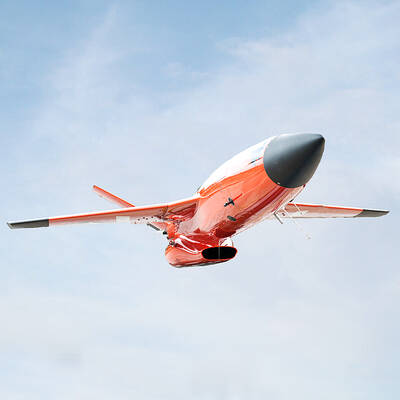
The Chien Feng IV (勁蜂, Mighty Hornet) loitering munition is on track to enter flight tests next month in connection with potential adoption by Taiwanese and US armed forces, a government source said yesterday. The kamikaze drone, which boasts a range of 1,000km, debuted at the Taipei Aerospace and Defense Technology Exhibition in September, the official said on condition of anonymity. The Chungshan Institute of Science and Technology and US-based Kratos Defense jointly developed the platform by leveraging the engine and airframe of the latter’s MQM-178 Firejet target drone, they said. The uncrewed aerial vehicle is designed to utilize an artificial intelligence computer


 RSS
RSS