


Beijing yesterday accused Washington of “provocative” conduct after two US warships earlier this week sailed near islands claimed by Beijing, adding to tensions between the global powers.
The US Navy regularly conducts “freedom of navigation” operations in the disputed South China Sea, to which Taiwan, China, Vietnam, the Philippines, Malaysia and Brunei have competing claims over all or parts of the waterway.
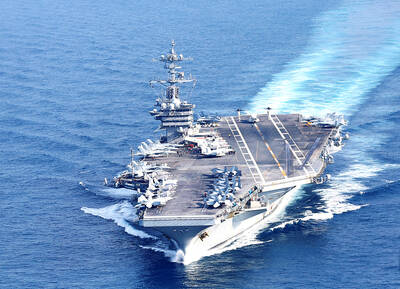
The USS Gabrielle Giffords littoral combat ship on Wednesday sailed near Mischief Reef (Meiji Reef, 美濟礁) in the Spratly Islands (Nansha Islands, 南沙群島) and the USS Wayne E. Meyer guided-missile destroyer on Thursday passed the Paracel Islands (Xisha Islands, 西沙群島), the navy said.
“USS Wayne E. Meyer (DDG-108) challenged the restrictions on innocent passage imposed by China, Taiwan and Vietnam, and also contested China’s claim to straight baselines enclosing the Paracel Islands,” Commander Reann Mommsen, a spokeswoman of the US Seventh Fleet, which is stationed in Japan, told reporters on Thursday.
“USS Gabrielle Giffords demonstrated that Mischief Reef, a low-tide elevation in its natural state, is not entitled to a territorial sea under international law,” she added.
China dispatched military vessels to identify and monitor the US warships and warned them to leave, the Chinese People’s Liberation Army Southern Theater Command said in a statement yesterday.
“Recently, the US has used the pretext of ‘freedom of navigation’ to frequently send warships to the South China Sea area to cause trouble,” it said. “We urge the US to cease this kind of provocative, risky conduct to prevent unforeseen incidents.”
Mommsen said that the operations were designed to “demonstrate that the United States will fly, sail and operate wherever international law allows — regardless of the location of excessive maritime claims and regardless of current events.”
Washington and Beijing are locked in a bruising trade war and have tussled over diplomatic issues, including a bill passed by the US Congress this week in support of pro-democracy protests in Hong Kong.
China has laid claim to nearly all of the South China Sea and has built numerous military outposts on the small islands and atolls of the region, angering other claimants.
In the past few months, the US military has stepped up its freedom of navigation operations in the region, irking Beijing, but not sparking any direct confrontation thus far.
China has effectively drawn a property line around the whole of the Paracels archipelago to claim the entire territory.
However, the US has said that does not accord with international law on archipelagos and territorial seas.

CROSS-STRAIT COLLABORATION: The new KMT chairwoman expressed interest in meeting the Chinese president from the start, but she’ll have to pay to get in Beijing allegedly agreed to let Chinese Nationalist Party (KMT) Chairwoman Cheng Li-wun (鄭麗文) meet with Chinese President Xi Jinping (習近平) around the Lunar New Year holiday next year on three conditions, including that the KMT block Taiwan’s arms purchases, a source said yesterday. Cheng has expressed interest in meeting Xi since she won the KMT’s chairmanship election in October. A source, speaking on condition of anonymity, said a consensus on a meeting was allegedly reached after two KMT vice chairmen visited China’s Taiwan Affairs Office Director Song Tao (宋濤) in China last month. Beijing allegedly gave the KMT three conditions it had to

STAYING ALERT: China this week deployed its largest maritime show of force to date in the region, prompting concern in Taipei and Tokyo, which Beijing has brushed off Deterring conflict over Taiwan is a priority, the White House said in its National Security Strategy published yesterday, which also called on Japan and South Korea to increase their defense spending to help protect the first island chain. Taiwan is strategically positioned between Northeast and Southeast Asia, and provides direct access to the second island chain, with one-third of global shipping passing through the South China Sea, the report said. Given the implications for the US economy, along with Taiwan’s dominance in semiconductors, “deterring a conflict over Taiwan, ideally by preserving military overmatch, is a priority,” it said. However, the strategy also reiterated
‘BALANCE OF POWER’: Hegseth said that the US did not want to ‘strangle’ China, but to ensure that none of Washington’s allies would be vulnerable to military aggression Washington has no intention of changing the “status quo” in the Taiwan Strait, US Secretary of Defense Pete Hegseth said on Saturday, adding that one of the US military’s main priorities is to deter China “through strength, not through confrontation.” Speaking at the annual Reagan National Defense Forum in Simi Valley, California, Hegseth outlined the US Department of Defense’s priorities under US President Donald Trump. “First, defending the US homeland and our hemisphere. Second, deterring China through strength, not confrontation. Third, increased burden sharing for us, allies and partners. And fourth, supercharging the US defense industrial base,” he said. US-China relations under
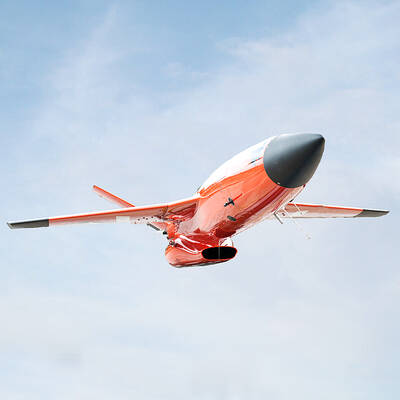
The Chien Feng IV (勁蜂, Mighty Hornet) loitering munition is on track to enter flight tests next month in connection with potential adoption by Taiwanese and US armed forces, a government source said yesterday. The kamikaze drone, which boasts a range of 1,000km, debuted at the Taipei Aerospace and Defense Technology Exhibition in September, the official said on condition of anonymity. The Chungshan Institute of Science and Technology and US-based Kratos Defense jointly developed the platform by leveraging the engine and airframe of the latter’s MQM-178 Firejet target drone, they said. The uncrewed aerial vehicle is designed to utilize an artificial intelligence computer


 RSS
RSS