


Members of the Green Party Taiwan and Taiwan Action Party Alliance yesterday filed a judicial complaint against former Taiwan Provincial Government secretary for foreign affairs Kuo Kuan-ying (郭冠英), saying that he undermined national security when he publicly declared that he represents the Chinese Communist Party (CCP) to monitor the Jan. 11 presidential and legislative elections.
Kuo on Thursday accompanied pro-China candidates of the New Party registering at the Central Election Committee and told the media that he was “representing the CCP to monitor the elections of Taiwan Province.”
The complaint requested that Taipei prosecutors indict Kuo for breaches of the National Security Act (國家安全法) and contravening the Criminal Code as a public official illegally working with and disclosing classified materials to an enemy state.
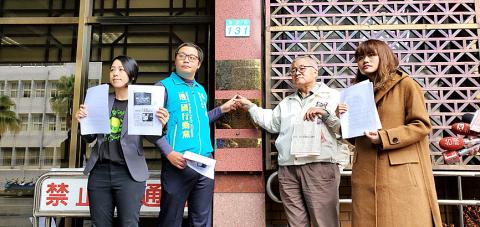
Photo: CNA
“Kuo has openly stated that he is working for the CCP. That is an obvious breach of the National Security Act, and he is likely developing spy networks and providing highly classified materials to China,” Green Party Taiwan executive member Chang Chu-chin (張竹芩) said.
Kuo breached an article in the act prohibiting the collection and transfer of confidential information, or the creation of a covert organization for another nation or China, which carry a maximum penalty of seven years in prison and a fine of up to NT$100 million (US$3.28 million), and could result in the termination of his monthly pension as a civil servant, Chang said.
“Kuo says he works for the CCP, but he is receiving a pension from our government, the Republic of China,” alliance legislative candidate Yang Chih-yuan (楊智淵) said. “He is obviously a traitor and working to subvert our nation.”
Yang called on the public not to vote for parties that are “selling out Taiwan and pandering to China,” warning that Beijing is taking advantage of Taiwan’s freedom and democratic system to infiltrate all sectors of society with money and misinformation.
Amid calls online for him to return his pension, reportedly about NT$60,000 per month, Kuo was yesterday quoted by the Chinese-language Apple Daily as saying that his pension is about NT$48,000.
Kuo previously served in the now-defunct Government Information Office in Toronto. He was dismissed from that post in 2009 for writing several articles calling ethnic Taiwanese taibazi (台巴子, Taiwanese rednecks) and referring to himself as a “high-class Mainlander.”
He also wrote that China should suppress Taiwanese instead of granting them political freedom once it has taken Taiwan by force.
Additional reporting by staff writer

CROSS-STRAIT COLLABORATION: The new KMT chairwoman expressed interest in meeting the Chinese president from the start, but she’ll have to pay to get in Beijing allegedly agreed to let Chinese Nationalist Party (KMT) Chairwoman Cheng Li-wun (鄭麗文) meet with Chinese President Xi Jinping (習近平) around the Lunar New Year holiday next year on three conditions, including that the KMT block Taiwan’s arms purchases, a source said yesterday. Cheng has expressed interest in meeting Xi since she won the KMT’s chairmanship election in October. A source, speaking on condition of anonymity, said a consensus on a meeting was allegedly reached after two KMT vice chairmen visited China’s Taiwan Affairs Office Director Song Tao (宋濤) in China last month. Beijing allegedly gave the KMT three conditions it had to

STAYING ALERT: China this week deployed its largest maritime show of force to date in the region, prompting concern in Taipei and Tokyo, which Beijing has brushed off Deterring conflict over Taiwan is a priority, the White House said in its National Security Strategy published yesterday, which also called on Japan and South Korea to increase their defense spending to help protect the first island chain. Taiwan is strategically positioned between Northeast and Southeast Asia, and provides direct access to the second island chain, with one-third of global shipping passing through the South China Sea, the report said. Given the implications for the US economy, along with Taiwan’s dominance in semiconductors, “deterring a conflict over Taiwan, ideally by preserving military overmatch, is a priority,” it said. However, the strategy also reiterated

‘BALANCE OF POWER’: Hegseth said that the US did not want to ‘strangle’ China, but to ensure that none of Washington’s allies would be vulnerable to military aggression Washington has no intention of changing the “status quo” in the Taiwan Strait, US Secretary of Defense Pete Hegseth said on Saturday, adding that one of the US military’s main priorities is to deter China “through strength, not through confrontation.” Speaking at the annual Reagan National Defense Forum in Simi Valley, California, Hegseth outlined the US Department of Defense’s priorities under US President Donald Trump. “First, defending the US homeland and our hemisphere. Second, deterring China through strength, not confrontation. Third, increased burden sharing for us, allies and partners. And fourth, supercharging the US defense industrial base,” he said. US-China relations under

The Chien Feng IV (勁蜂, Mighty Hornet) loitering munition is on track to enter flight tests next month in connection with potential adoption by Taiwanese and US armed forces, a government source said yesterday. The kamikaze drone, which boasts a range of 1,000km, debuted at the Taipei Aerospace and Defense Technology Exhibition in September, the official said on condition of anonymity. The Chungshan Institute of Science and Technology and US-based Kratos Defense jointly developed the platform by leveraging the engine and airframe of the latter’s MQM-178 Firejet target drone, they said. The uncrewed aerial vehicle is designed to utilize an artificial intelligence computer


 RSS
RSS