


The Mainland Affairs Council (MAC) yesterday warned of a potential humanitarian crisis as clashes intensified between police and protesters at Hong Kong Polytechnic University yesterday, and called on both sides to show restraint to avoid further escalation.
Polytechnic Students’ Union president Woo Kwok-wang (胡國泓), who was still on the campus in Hung Hom, Kowloon, as of yesterday afternoon, said there were about 500 protesters inside, adding that about 70 to 100 people tried to leave the campus, but were met with tear gas fired by police.
A MAC news release said that there might be hundreds of people stranded inside the Polytechnic campus, which poses a serious threat to campus democracy and safety, and could even lead to a humanitarian crisis.
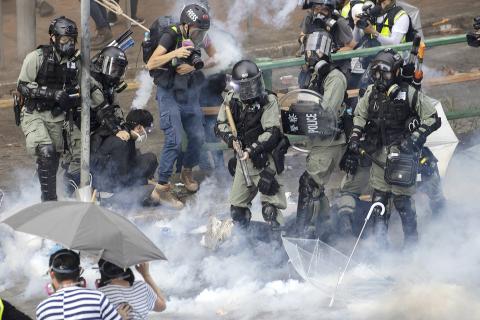
Photo: AP
The council said it condemns all types of violence and the use of lethal force in cracking down on protesters.
It urged all sides to remain calm, exercise self-control and solve the problems through peaceful negotiations to avoid the situation from worsening and scarring society.
The council called on Taiwanese in Hong Kong to be careful of their safety as clashes become more intense and spread to more areas.
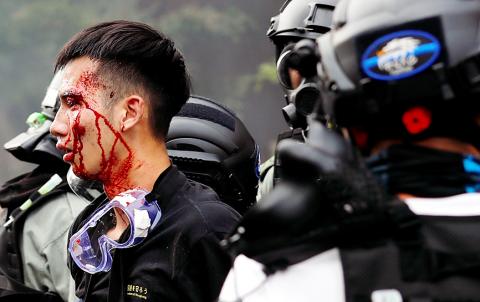
Photo: Reuters
The Taipei Economic and Cultural Office in Hong Kong has established an ad hoc task force to respond to the situation, including a 24-hour emergency assistance hotline (852-6143-9012) for Taiwanese who need emergency help.
More than 60 percent of the 1,021 Taiwanese studying in the territory have returned home, the Ministry of Education said yesterday in a statement.
That includes more than 60 percent of those at the Polytechnic, and 261 from the Chinese University of Hong Kong, it said.
Meanwhile, National Sun Yat-sen University yesterday said two academics from Hong Kong universities — a foreign professor emeritus and a Taiwanese professor — have applied for jobs at the school this month.
Both have passed the reviews for recruitment and can start their new jobs in February, at the earliest, the Kaohsiung school said.
University president Cheng Ying-yao (鄭英耀) said the chaotic situation in Hong Kong has caused universities there to cut their semesters short.
If this results in interruptions to scientific experiments or data collection, or the destruction of databases, the schools might need a few years to repair the damage, Cheng said.
The damage is not limited to science and engineering fields, but also affects the academic freedom of humanities departments, he said, adding that academics cannot conduct research when feeling anxious.
National Taiwan University vice president Chou Chia-pei (周家蓓) said it is hard to tell at the moment whether there would be an exodus of academics in Hong Kong, because the salaries and research funding there are much higher than in Taiwan.
However, if social instability causes important studies to be suspended, it might affect the territory’s research capacity, she added.
Additional reporting by CNA

CROSS-STRAIT COLLABORATION: The new KMT chairwoman expressed interest in meeting the Chinese president from the start, but she’ll have to pay to get in Beijing allegedly agreed to let Chinese Nationalist Party (KMT) Chairwoman Cheng Li-wun (鄭麗文) meet with Chinese President Xi Jinping (習近平) around the Lunar New Year holiday next year on three conditions, including that the KMT block Taiwan’s arms purchases, a source said yesterday. Cheng has expressed interest in meeting Xi since she won the KMT’s chairmanship election in October. A source, speaking on condition of anonymity, said a consensus on a meeting was allegedly reached after two KMT vice chairmen visited China’s Taiwan Affairs Office Director Song Tao (宋濤) in China last month. Beijing allegedly gave the KMT three conditions it had to

STAYING ALERT: China this week deployed its largest maritime show of force to date in the region, prompting concern in Taipei and Tokyo, which Beijing has brushed off Deterring conflict over Taiwan is a priority, the White House said in its National Security Strategy published yesterday, which also called on Japan and South Korea to increase their defense spending to help protect the first island chain. Taiwan is strategically positioned between Northeast and Southeast Asia, and provides direct access to the second island chain, with one-third of global shipping passing through the South China Sea, the report said. Given the implications for the US economy, along with Taiwan’s dominance in semiconductors, “deterring a conflict over Taiwan, ideally by preserving military overmatch, is a priority,” it said. However, the strategy also reiterated

‘BALANCE OF POWER’: Hegseth said that the US did not want to ‘strangle’ China, but to ensure that none of Washington’s allies would be vulnerable to military aggression Washington has no intention of changing the “status quo” in the Taiwan Strait, US Secretary of Defense Pete Hegseth said on Saturday, adding that one of the US military’s main priorities is to deter China “through strength, not through confrontation.” Speaking at the annual Reagan National Defense Forum in Simi Valley, California, Hegseth outlined the US Department of Defense’s priorities under US President Donald Trump. “First, defending the US homeland and our hemisphere. Second, deterring China through strength, not confrontation. Third, increased burden sharing for us, allies and partners. And fourth, supercharging the US defense industrial base,” he said. US-China relations under
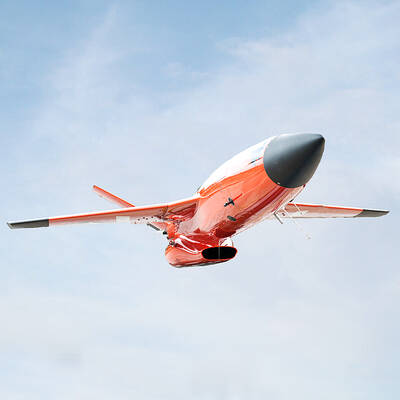
The Chien Feng IV (勁蜂, Mighty Hornet) loitering munition is on track to enter flight tests next month in connection with potential adoption by Taiwanese and US armed forces, a government source said yesterday. The kamikaze drone, which boasts a range of 1,000km, debuted at the Taipei Aerospace and Defense Technology Exhibition in September, the official said on condition of anonymity. The Chungshan Institute of Science and Technology and US-based Kratos Defense jointly developed the platform by leveraging the engine and airframe of the latter’s MQM-178 Firejet target drone, they said. The uncrewed aerial vehicle is designed to utilize an artificial intelligence computer


 RSS
RSS