


Protesters yesterday smashed windows in a subway station and a shopping mall, and police made arrests across Hong Kong amid anger over a demonstrator’s death and the arrest of pro-democracy lawmakers.
Hong Kong is in the sixth month of protests that began in June over a since-shelved extradition bill and have expanded to include demands for greater democracy and other grievances.
Authorities closed the subway station in Sha Tin District after protesters broke windows and damaged a ticket machine.
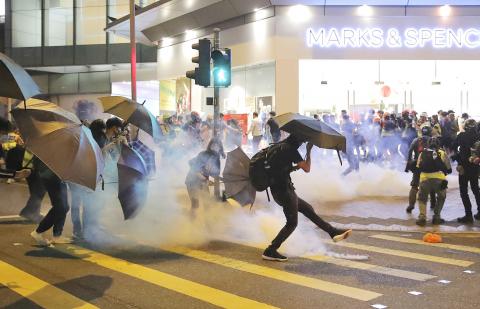
Photo: AP
Reporters saw police arrest three men at a residential complex elsewhere in Sha Tin, but the reason was not clear.
In Tuen Mun, about three dozen people dressed in black, the symbolic color of the protests, stormed through the Citywalk shopping mall.
Most were peaceful, but one used a club to smash windows while others overturned tables in a restaurant.
Spectators on the street outside shouted “Cockroaches!” at police.
In Tsuen Wan, police fired tear gas and took away four men and one woman suspected of vandalizing shops, the Apple Daily reported.
Inside the Festival Walk shopping mall in Kowloon Tong, reporters saw a man lying on a public walkway beside a small pool of blood, with police standing over him. His condition and the reason for possible injuries were unclear.
There were brief shoving matches between police and protesters, some of whom thrust their fists into the air in a gesture of defiance. Police pointed cans of pepper spray at onlookers and reporters.
Protesters are demanding the resignation of Hong Kong Chief Executive Carrie Lam (林鄭月娥).
They mourned the death on Friday of university student Alex Chow (周梓樂), 22, who on Monday last week fell from a parking garage when police fired tear gas at protesters.
The circumstances of the death are unclear, but many accuse police of using heavy-handed tactics, including widespread use of tear gas and pepper spray.
Police denied pushing the student during the incident or delaying emergency treatment.
On Saturday, police announced the arrest of six lawmakers on charges of obstructing the local assembly during a raucous May 11 meeting over the extradition bill. All were freed on bail.
CALL FOR LEGISLATION
Meanwhile, China said the lack of tough security laws in Hong Kong is a key reason for the increasingly violent demonstrations and that the enactment of such legislation is an “urgent task.”
The call came in a lengthy statement issued late on Saturday by the head of the Chinese government department that oversees Hong Kong.
The statement by Hong Kong Liaison Office Director Zhang Xiaoming (張曉明) acknowledged that governance in the territory must be improved, saying that factors such as high housing costs and a growing wealth gap had contributed to the unrest.
However, Zhang also backed a firmer hand, saying laws outlawing subversion and other challenges to Chinese central government control were needed, and stressed that the territory’s leader and legislature must be “patriots” loyal to Beijing.
Efforts by Hong Kong’s Beijing-controlled government to introduce tough security laws in 2003 caused major protests before being shelved.
The lack of such legislation “is one of the main reasons for the intensification of activities of local radical separatist forces,” Zhang said.
“The need to safeguard national security and strengthen law enforcement have become prominent issues and urgent tasks facing the government of the Hong Kong Special Administrative Region and people from all walks of life,” he said.

A signaling system malfunction disrupted high-speed rail (HSR) services beginning at 8am today, with trains temporarily reduced to three northbound and three southbound trains per hour as authorities conduct inspections. The malfunction occurred on a section of track in Miaoli County during pre-operation checks early this morning, forcing northbound and southbound trains to use a single track, the HSR operator said. The regular schedule has been replaced with three hourly trains offering only nonreserved seating in each direction, stopping at every station, it said, adding that business class cars would still have reserved seating. Departures from terminal stations are scheduled at the top

DRONE CENTRAL: Taiwan aims to become Asia’s democratic hub for drones, with most exports focused on high-quality military-grade models, an official said Taiwan’s drone industry is expected to expand significantly by 2030, producing 100,000 units per month and exporting half of them, the Ministry of Economic Affairs said yesterday. Current drone production capacity is about 15,000 units per month, but the industry can quickly scale up as demand increases, Industrial Development Administration Director-General Chiou Chyou-huey (邱求慧) told a news conference in Taipei. Taiwan’s drone output grew 2.5-fold last year to NT$12.9 billion (US$408.3 million) under a government program to develop the uncrewed vehicle sector, he said. The Executive Yuan in October last year approved plans to invest NT$44.2 billion into domestic production of uncrewed aerial

VERBOSE VESSELS: A CGA cutter and a China Coast Guard exchanged verbal barbs for more than a day in Taiwanese-controlled waters before the Chinese vessel left The Taiwanese and Chinese coast guards had a standoff near the strategically located Pratas Islands (Dongsha Islands, 東沙群島) in the north of the South China Sea, the Coast Guard Administration (CGA) said yesterday. The two sides engaged in intense radio exchanges over sovereignty claims during the 33-hour standoff. China Coast Guard vessel 3501 eventually left the restricted waters, 26.6 nautical miles (49.2km) west of the Pratas Islands, at 5pm yesterday, the CGA said. Lying approximately between southern Taiwan and Hong Kong, the Taiwan-controlled Pratas are seen by some security experts as vulnerable to Chinese attack due to their distance — more than
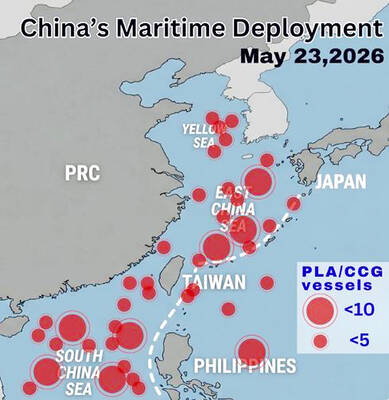
WARNING: China should stop engaging in actions that undermine regional peace and stability, as it would only build resentment among people across the Strait, the CGA said China has deployed more than 100 navy, coast guard and other vessels in waters from the Yellow Sea to the South China Sea and the western Pacific since US President Donald Trump and Chinese President Xi Jinping (習近平) met in Beijing, National Security Council Secretary-General Joseph Wu (吳釗燮) said yesterday. “In this part of the world, #China is the one & only PROBLEM wrecking the #StatusQuo & threatening regional peace & stability,” Wu wrote on X. In a separate post, he said Beijing was coercing Taiwan’s maritime domain, calling it illegal and provocative, after the Coast Guard Administration (CGA) expelled a


 RSS
RSS