


China yesterday warned that Hong Kong’s unrest had gone “far beyond” peaceful protest, after a chaotic weekend of tear gas and clashes illustrated the government’s struggle to quell a leaderless, unpredictable and widespread movement.
Yang Guang (楊光), spokesman for China’s Hong Kong and Macau Affairs Office (HKMAO), told an unprecedented news briefing in Beijing that some “irresponsible people” in the West have applied “strange logic” that prompted them to be sympathetic and tolerant to “violent crimes,” while criticizing the police force’s “due diligence.”
“At the end of the day, their intention is to create trouble in Hong Kong, make Hong Kong a problem to China, in order to contain China’s development,” Yang said, without mentioning any specific individuals or countries.
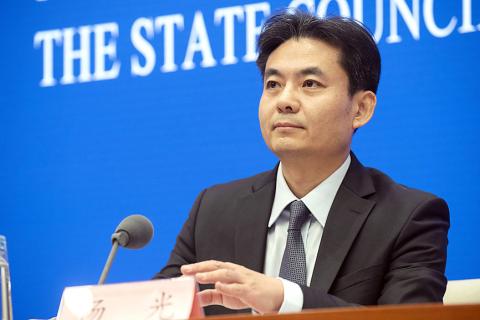
Photo: Bloomberg
He condemned the “evil and criminal acts committed by radical elements.”
“What has happened in Hong Kong recently has gone far beyond the scope of peaceful march and demonstration, undermined Hong Kong’s prosperity and stability, and touched on the bottom line of the principle of ‘one country, two systems,’” Yang said. “No civilized society under the rule of law would ever allow acts of violence to take place.”
Yang did not rule out military action, pointing to a section of law that gave Hong Kong authorities the power to request support.
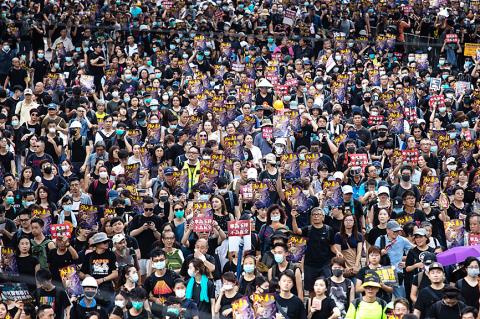
Photo: Bloomberg
He outlined three bottom lines for the territory: No harm to national security, no challenge to the central government’s authority and no using Hong Kong as a base to undermine China.
While officials reaffirmed support for the territory’s government and police force, the decision to address foreign media in Beijing signaled growing concern as eight weeks of unprecedented unrest start to shake business confidence in the former British colony.
“The central government is in quite a difficult situation over Hong Kong,” said Shi Yinhong (時殷弘), a professor of international relations and director of the Center for American Studies at Renmin University in Beijing. “Today’s statements by the Hong Kong affairs office generally is to assure that the central government is supporting the Hong Kong government to take more police action against the violent protesters.”
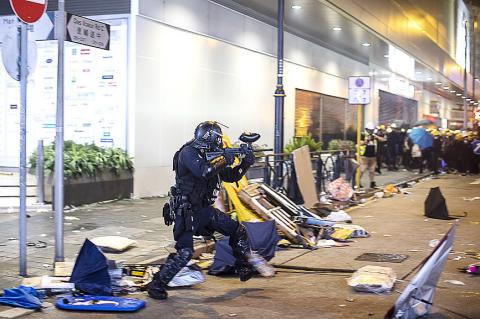
Photo: Bloomberg
The office was compelled to respond after three days of protest that saw unauthorized demonstrations across four districts, including the airport and downtown shopping areas.
The developments raised new fears that the violence may continue to escalate, forcing Chinese President Xi Jinping (習近平) to send in the military or take other actions that undermine the “high degree of autonomy” promised to Hong Kong before its 1997 return.
Xi has so far maintained support for Hong Kong Chief Executive Carrie Lam (林鄭月娥).
Hong Kong’s opposition lawmakers said the agency did little to resolve a crisis that they trace to the territory’s inability to elect its own leaders.
At a news conference in the territory, lawmakers accused the government of shifting the blame to radical protesters, Western countries and the foreign media.
“Beijing tried to make some feeble attempt to help maintain what they assume are the security problems in Hong Kong,” said Claudia Mo (毛孟靜), a legislator and high-profile participant in several peaceful marches. “That won’t help the governance and political crisis that Hong Kong is facing.”
She said she fears that the HKMAO’s statements would further inflame demonstrators.
“I’m so worried that what happened in Beijing this afternoon will actually help fan the fire of what’s already been a tsunami of protests in Hong Kong,” Mo said, given that the office appeared to fully support the police and Lam.
Pro-Beijing lawmakers said the “general wishes of the residents are for the violence to stop immediately.
“Regardless of your stance, I think all this violence should not continue because it brings no benefit to any person,” legislator Starry Lee (李慧瓊) said.
Earlier yesterday, an edition of the Chinese Communist Party’s flagship People’s Daily urged stern action by Hong Kong’s police to restore order.
“At a time like this, the Hong Kong Special Administrative Government and the police should not hesitate or have any unnecessary ‘psychological worries’ about taking necessary steps,” the piece published in the overseas edition of the newspaper said.

Taiwan has arranged for about 8 million barrels of crude oil, or about one-third of its monthly needs, to be shipped from the Red Sea this month to bypass the Strait of Hormuz and ease domestic supply pressures, CPC Corp, Taiwan (CPC, 台灣中油) said yesterday. The state-run oil company has worked with Middle Eastern suppliers to secure routes other than the Strait of Hormuz, through which about 20 percent of the world’s oil and liquefied natural gas typically passes, CPC chairman Fang Jeng-zen (方振仁) said at a meeting of the legislature’s Economics Committee in Taipei. Suppliers in Saudi Arabia have indicated they
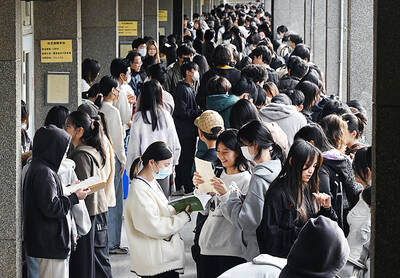
A global survey showed that 60 percent of Taiwanese had attained higher education, second only to Canada, the Ministry of the Interior said. Taiwan easily surpassed the global average of 43 percent and ranked ahead of major economies, including Japan, South Korea and the US, data from the Organisation for Economic Co-operation and Development (OECD) for 2024 showed. Taiwan has a high literacy rate, data released by the ministry showed. As of the end of last year, Taiwan had 20.617 million people aged 15 or older, accounting for 88.5 percent of the total population, with a literacy rate of 99.4 percent, the data
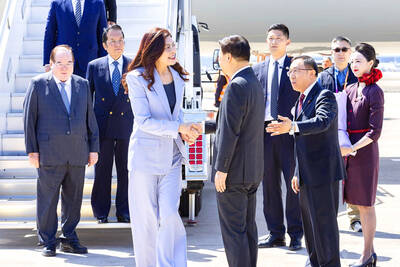
CCP ‘PAWN’? Beijing could use the KMT chairwoman’s visit to signal to the world that many people in Taiwan support the ‘one China’ principle, an academic said Chinese Nationalist Party (KMT) Chairwoman Cheng Li-wun (鄭麗文) yesterday arrived in China for a “peace” mission and potential meeting with Chinese President Xi Jinping (習近平), while a Taiwanese minister detailed the number of Chinese warships currently deployed around the nation. Cheng is visiting at a time of increased Chinese military pressure on Taiwan, as the opposition-dominated Legislative Yuan stalls a government plan for US$40 billion in extra defense spending. Speaking to reporters before going to the airport, Cheng said she was going on a “historic journey for peace,” but added that some people felt uneasy about her trip. “If you truly love Taiwan,

NEW LOW: The council in 2024 based predictions on a pessimistic estimate for the nation’s total fertility rate of 0.84, but last year that rate was 0.69, 17 percent lower An expected National Development Council (NDC) report expects the nation’s population to drop below 12 million by 2065, with the old-age dependency ratio to top 100 percent sooner than 2070, sources said yesterday. The council is slated to release its latest population projections in August, using an ultra-low fertility model, the sources said. The previous report projected that Taiwan’s population would fall to 14.37 million by 2070, but based on a new estimate of the total fertility rate (TFR) — the average number of children born to a woman over her lifetime — the population is expected to reach 12 million by


 RSS
RSS