


EVA Airways Corp (長榮航空) flight attendants yesterday went on strike after a round of employer-employee negotiations broke down, with more than 8,000 passengers expected to be affected by midnight.
The main sources of contention between the carrier and the Taoyuan Flight Attendants’ Union remained a proposal to raise the daily allowance for flight attendants and an appeal, dubbed the “free-rider clause,” by the union that non-union employees be barred from receiving benefits that the airline promises the union in negotiations.
EVA officials took a hard stance and refused to budge on the two items, issuing responses that were identical to those given two years ago when the union first raised the issues.
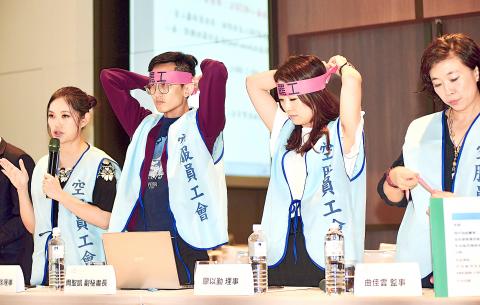
Photo: Chien Jung-fong, Taipei Times
Citing the airline’s “unreasonable distribution” of revenue, union standing director Lee Ying (李瀅) said that EVA employees who have stuck with the airline through times of hardship, such as in the aftermath of the Sept. 11, 2001, terror attacks on the US, and the 2008 to 2009 global economic crisis, have not been allowed to taste the fruits of the company’s steadily growing revenue over the past several years.
However, EVA president Clay Sun (孫嘉明) said that the airline has over the past few years been paying employees up to 16 times their monthly salary when including bonuses, adding that it has also been steadily raising their wages each year.
EVA flight attendants receive a larger daily allowance than their counterparts at China Airlines Ltd (中華航空), as EVA calculates from the time they sign in to the time they sign out of work, while China Airlines calculates based on flight hours, EVA cabin crew division deputy vice president Milly Fung (馮美莉) said.
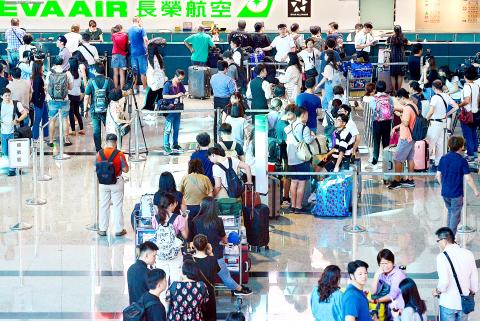
Photo: Chu Pei-hsiung, Taipei Times
The hourly rate for the daily allowance paid to EVA flight attendants, NT$90, is comparable with international standards, she said, asking union representatives on what their demand for a NT$150 hourly rate was based.
Since 2016, the airline has increased employees’ monthly salaries by NT$3,000 to NT$5,000, EVA human resources division deputy vice president Shine Hsu (許平) said.
If the airline approved the free-rider clause, it would be unfair to non-union employees, who would be paid less for doing the same work, which would negatively affect morale and flight safety, Hsu said.
The talks reached a deadlock after an hour and the union announced that it would begin the strike at 4pm.
Sun later said that the strike has caused the airline to cancel 16 international flights, but added that it would strive to mitigate the effects on passengers.
A total of 8,628 passengers were affected by the canceled international flights, EVA said, but added that 14 international flights were unaffected, as were 2,982 passengers on domestic flights.
As of press time last night, the airline said that it would cancel 26 inbound flights — including from Bangkok; Ho Chi Minh City, Vietnam; Manila; Seoul; and Hong Kong to Taiwan Taoyuan International Airport; and from Guangzhou, China, to Kaohsiung — and 45 outbound flights.
“We cannot be sure of how many flight attendants will be on duty, but we will try to maintain 50 percent of all flights unchanged,” EVA operations management department deputy senior vice president Bryan Chang (張玉珩) told reporters.
EVA has about 4,600 flight attendants, of whom 2,949 on June 7 voted in favor of going on strike, the union said.
The airline, which operates an average of 80 international flights per day, might have about 1,600 flight attendants who can work during the strike and said that it welcomes union members to return to work at any time.
Priority would be given to short-haul flights and long-haul flights arriving from or departing for Los Angeles and San Francisco, as they are important transportation hubs, in a bid to reduce the effects of the strike on foreign travelers, Chang said.
EVA said it would help passengers transfer to other airlines and pay compensation of up to US$250 per traveler if their schedules are delayed more than six hours.
Sun dismissed an accusation by the union that the carrier did not compromise in earlier talks, saying that EVA has expressed its willingness to raise the safety bonus for crew.
“When the strike ends will depend on the union, but we urge them to end it soon, as the nation’s aviation and tourism industries will be affected if the strike continues for a long time,” Sun said.
The airline cannot agree with the “free-rider clause” and would not change its stance, he said.
The Ministry of Transportation and Communications activated its emergency response plan immediately after the union announced that it would go on strike, Minister of Transportation and Communications Lin Chia-lung (林佳龍) said, adding that he hoped both sides would sit down and resume negotiations.
Lin, who is in Belize on an official visit, made the remarks in a video published online.
He said that he is making arrangements to return to Taiwan as soon as he finishes his work in one of the nation’s most important Central American allies.
“I have asked the Civil Aeronautics Administration, the Tourism Bureau, Taoyuan International Airport Corp, EVA Airways, Uni Air, China Airlines, Mandarin Airlines and bus operators to prepare to act based on the emergency response plan,” Lin said. “I have also requested that the Ministry of National Defense dispatch military aircraft to transport passengers to and from Lienchiang County. Meanwhile, the Ministry of Health and Welfare should be prepared to offer emergency air medical transportation for patients in outlying islands.”
Deputy Minister of Transportation and Communications Wang Kwo-tsai (王國材), who presided over a ministry emergency response meeting, said that it was unfortunate that the union decided to go on strike, even though the negotiations were an opportunity to let positions from both sides be known to the public.
As of last night, EVA’s domestic flight service had not been affected by the strike, Wang said, adding that domestic flights were expected to continue as scheduled today.
EVA would first help passengers transfer to other carriers, before helping them postpone their trips or cancel tickets, Wang said, adding that it would be responsible for compensating travelers for additional costs incurred from being stranded overseas.
At 7:30pm, about 700 striking flight attendants staged a sit-in outside EVA’s headquarters in Taoyuan’s Nankan (南崁).
At about 8:30pm, 1,000 people had joined the sit-in, the union said.
The entrance to the airline’s headquarters was blocked by union members, making it difficult for flight attendants who have volunteered to work during the strike to report for duty, Wang said.
The strike has also affected 28 tour groups, including 15 groups scheduled to leave and 11 groups that are returning to Taiwan, he said.
The Tourism Bureau and the Travel Agent Association are closely monitoring the situation, he added.
Taiwan International Airport Corp has arranged for transit passengers to rest in the C5, C6 and C7 areas of Terminal 2 or in hotels if they need to stay longer.
“The strike hurt mostly innocent passengers. We hope both sides are willing to make concessions and end the labor dispute as soon as possible, so that the airport can return to normal operation,” Wang said.
Additional reporting by Ann Maxon
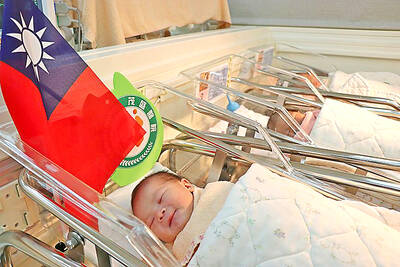
AGING: As of last month, people aged 65 or older accounted for 20.06 percent of the total population and the number of couples who got married fell by 18,685 from 2024 Taiwan has surpassed South Korea as the country least willing to have children, with an annual crude birthrate of 4.62 per 1,000 people, Ministry of the Interior data showed yesterday. The nation was previously ranked the second-lowest country in terms of total fertility rate, or the average number of children a woman has in her lifetime. However, South Korea’s fertility rate began to recover from 2023, with total fertility rate rising from 0.72 and estimated to reach 0.82 to 0.85 by last year, and the crude birthrate projected at 6.7 per 1,000 people. Japan’s crude birthrate was projected to fall below six,
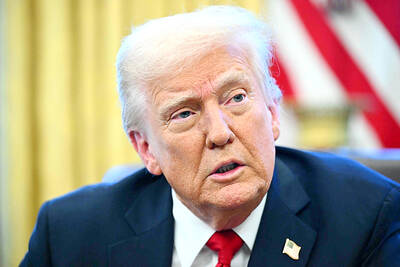
US President Donald Trump in an interview with the New York Times published on Thursday said that “it’s up to” Chinese President Xi Jinping (習近平) what China does on Taiwan, but that he would be “very unhappy” with a change in the “status quo.” “He [Xi] considers it to be a part of China, and that’s up to him what he’s going to be doing, but I’ve expressed to him that I would be very unhappy if he did that, and I don’t think he’ll do that. I hope he doesn’t do that,” Trump said. Trump made the comments in the context
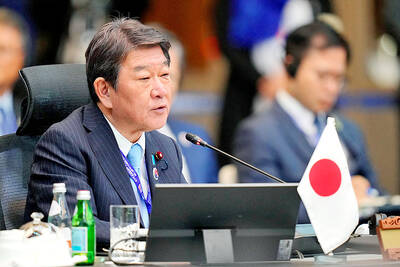
SELF-DEFENSE: Tokyo has accelerated its spending goal and its defense minister said the nation needs to discuss whether it should develop nuclear-powered submarines China is ramping up objections to what it sees as Japan’s desire to acquire nuclear weapons, despite Tokyo’s longstanding renunciation of such arms, deepening another fissure in the two neighbors’ increasingly tense ties. In what appears to be a concerted effort, China’s foreign and defense ministries issued statements on Thursday condemning alleged remilitarism efforts by Tokyo. The remarks came as two of the country’s top think tanks jointly issued a 29-page report framing actions by “right-wing forces” in Japan as posing a “serious threat” to world peace. While that report did not define “right-wing forces,” the Chinese Ministry of Foreign Affairs was
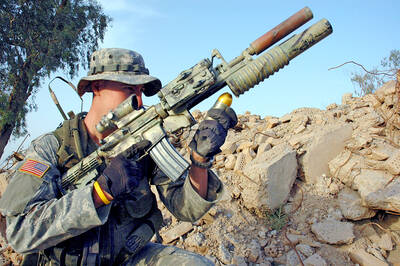
PREPAREDNESS: Given the difficulty of importing ammunition during wartime, the Ministry of National Defense said it would prioritize ‘coproduction’ partnerships A newly formed unit of the Marine Corps tasked with land-based security operations has recently replaced its aging, domestically produced rifles with more advanced, US-made M4A1 rifles, a source said yesterday. The unnamed source familiar with the matter said the First Security Battalion of the Marine Corps’ Air Defense and Base Guard Group has replaced its older T65K2 rifles, which have been in service since the late 1980s, with the newly received M4A1s. The source did not say exactly when the upgrade took place or how many M4A1s were issued to the battalion. The confirmation came after Chinese-language media reported


 RSS
RSS