


China yesterday reacted furiously after a top executive and daughter of the founder of Chinese telecom giant Huawei Technologies Co (華為) was arrested in Canada following a US extradition request, threatening to rattle a trade dispute truce with the US.
The detention of Huawei chief financial officer Meng Wanzhou (孟晚舟) came after US authorities reportedly launched an investigation into suspected Iran sanctions breaches by Huawei, which was already under scrutiny by US intelligence officials who deemed the company a national security threat.
The arrest stirred tensions just as the US and China agreed to a ceasefire in their trade spat while negotiators seek a deal within three months.
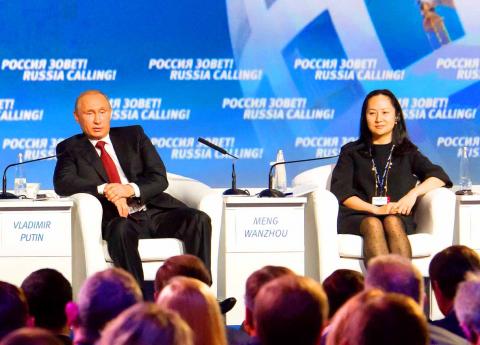
Photo: Reuters
“We have made solemn representations to Canada and the US, demanding that both parties immediately clarify the reasons for the detention and immediately release the detainee to protect the person’s legal rights,” Chinese Ministry of Foreign Affairs spokesman Geng Shuang (耿爽) told a regular press briefing in Beijing.
Meng was arrested in Vancouver on Saturday last week, the Canadian Ministry of Justice said in a statement on Wednesday, prompting China’s embassy in Ottawa to say it had “seriously harmed the human rights of the victim.”
The ministry said the US is seeking her extradition and she faces a bail hearing today, adding that it could not provide further details due to a publication ban that was sought by Meng, whose father, Ren Zhengfei (任正非), is a former Chinese People’s Liberation Army engineer.
Huawei, which overtook Apple Inc as the world’s No. 2 smartphone maker this year, said it was unaware of any wrongdoing by Meng and was provided “very little information” about the charges.
“Huawei complies with all applicable laws and regulations where it operates, including applicable export control and sanction laws, and regulations of the UN, US and EU,” the company said in a statement.
The Wall Street Journal in April reported that the US Department of Justice had opened an investigation into suspected breaches of Iran sanctions by Huawei.
The New York Times said the company had been subpoenaed by the US Department of Commerce and the US Department of the Treasury over alleged contraventions of Iran and North Korea sanctions.
“China is working creatively to undermine our national security interests, and the United States and our allies can’t sit on the sidelines,” US Senator Ben Sasse said in a statement linking the arrest to US sanctions against Iran.
The arrest occurred on the same day that US President Donald Trump and Chinese President Xi Jinping (習近平) agreed the trade dispute truce on the sidelines of the G20 summit in Argentina.
Huawei is not the first Chinese telecommunications equipment company to face the ire of US authorities.
Earlier this year, the US imposed a seven-year ban on the sale of crucial US components to Chinese smartphone maker ZTE Corp (中興) after finding it had failed to take action against staff who were responsible for contravening trade sanctions against Iran and North Korea.
The ban nearly destroyed the Chinese technology company, forcing it to cease major operations in May.
A month later, Washington and Beijing reached a deal that would strike ZTE from the sanctions list — just days after China reportedly offered to ramp up purchases of US goods to reduce the trade imbalance with the US.
US officials denied any connection between the two.
In exchange, ZTE agreed to pay a hefty US$1 billion fine and put an additional US$400 million in escrow in case of future breaches. It was also ordered to replace its board of directors and retain outside monitors.
South Korea has adjusted its electronic arrival card system to no longer list Taiwan as a part of China, a move that the Ministry of Foreign Affairs said would help facilitate exchanges between the two sides. South Korea previously listed “Taiwan” as “Taiwan (China)” in the drop-down menus of its online arrival card system, where people had to fill out where they came from and their next destination. The ministry had requested South Korea make a revision and said it would change South Korea’s name on Taiwan’s online immigration system from “Republic of Korea” to “Korea (South),” should the issue not be

Tainan, Taipei and New Taipei City recorded the highest fines nationwide for illegal accommodations in the first quarter of this year, with fines issued in the three cities each exceeding NT$7 million (US$220,639), Tourism Administration data showed. Among them, Taipei had the highest number of illegal short-term rental units, with 410. There were 3,280 legally registered hotels nationwide in the first quarter, down by 14 properties, or 0.43 percent, from a year earlier, likely indicating operators exiting the market, the agency said. However, the number of unregistered properties rose to 1,174, including 314 illegal hotels and 860 illegal short-term rental
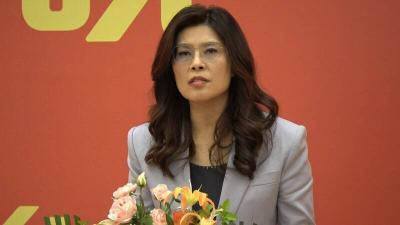
Both sides of the Taiwan Strait share a political foundation based on the “1992 consensus” and opposition to Taiwanese independence, Chinese Nationalist Party (KMT) Chairwoman Cheng Li-wun (鄭麗文) today said during her meeting with Chinese President Xi Jinping (習近平). Both sides of the Strait should plan and build institutionalized and sustainable mechanisms for dialogue and cooperation based on that foundation to make peaceful development across the Strait irreversible, she said. Peace is a shared moral value across the Strait, and both sides should move beyond political confrontation to seek institutionalized solutions to prevent war, she said. Mutually beneficial cross-strait relations are what the
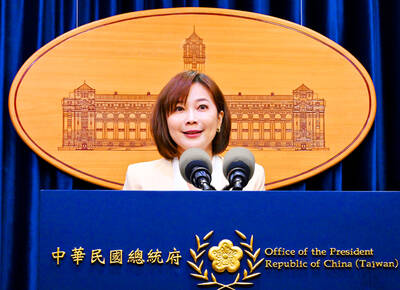
ECONOMIC COERCION: Such actions are often inconsistently applied, sometimes resumed, and sometimes just halted, the Presidential Office spokeswoman said The government backs healthy and orderly cross-strait exchanges, but such arrangements should not be made with political conditions attached and never be used as leverage for political maneuvering or partisan agendas, Presidential Office spokeswoman Karen Kuo (郭雅慧) said yesterday. Kuo made the remarks after China earlier in the day announced 10 new “incentive measures” for Taiwan, following a landmark meeting between Chinese President Xi Jinping (習近平) and Chinese Nationalist Party (KMT) Chairwoman Cheng Li-wun (鄭麗文) in Beijing on Friday. The measures, unveiled by China’s Xinhua news agency, include plans to resume individual travel by residents of Shanghai and China’s Fujian


 RSS
RSS