


The Chinese Nationalist Party’s (KMT) Ting Shou-chung (丁守中) yesterday filed an application with the Taipei District Court to have the ballots from Saturday’s Taipei mayoral election sealed and was expected to file a lawsuit to have the vote annulled after losing the mayoral race to Mayor Ko Wen-je (柯文哲).
The election was held alongside 10 referendums at 1,563 polling stations citywide from 8am to 7:46pm, but the ballot counting in the neck-and-neck race lasted for more than 10 hours until 2:35am yesterday.
In the five-way race, Ko garnered 580,820 votes, or 41.05 percent of the votes cast, against Ting’s 577,566 votes (40.82 percent).
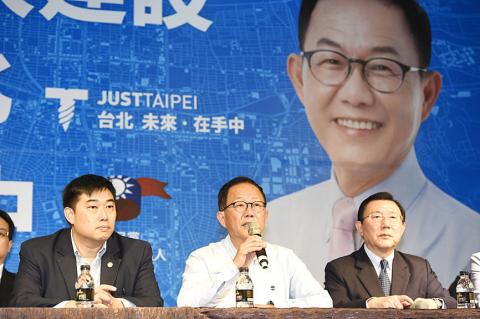
Photo: George Tsorng, Taipei Times
Pasuya Yao (姚文智) of the Democratic Progressive Party (DPP) received 244,641 votes, or 17.29 percent.
Ting, who lost to Ko by 3,254 votes, arrived at the court with his lawyer at about 3:15am yesterday.
At about 6am, the court issued a ruling requiring him to pay a deposit of NT$4.3 million (US$139,150) within 24 hours.
According to the Civil Servants Election and Recall Act (公職人員選舉罷免法), the applicant must pay a deposit of NT$3 per vote for a recount, the court said, adding that 1,427,643 votes were cast in the Taipei mayoral election.
Ting’s application would be rejected if he does not make the deposit, it said.
Ting told reporters in front of the court that he believes there were major illegalities in the voting and counting process.
Taipei was the only city in this year’s elections where the “dump-save effect” could have occurred, he said, referring to strategic voting by the public to sacrifice one candidate for another in the event of a tight race between multiple — usually three — candidates.
Candidates were barred from releasing polls 10 days before the elections to prevent influencing voters and campaigning was not allowed on election day, he said.
Despite the measures, vote counting took place for three hours and 46 minutes as ballots were still being cast on Saturday, he said, adding that no other country in the world would allow this to happen.
Ting also questioned the counting process, which he said took more than nine hours and was paused several times.
New Taipei City has a bigger population than Taipei, but its counting process was faster, he said.
Ting said he suspects the Central Election Commission (CEC) and the Taipei City Election Commission conspired to bring forth the “dump-save effect” in the city, insinuating that pan-green camp voters “sacrificed” Yao to elect Ko, an independent.
It was a “dirty trick” played by the DPP, he added.
Ting said his next step would be to file a lawsuit to invalidate the election.
The CEC and Ko said they respect Ting’s decision.
If Ting emerges as victor in the recount, the court would return his deposit, but he would forfeit the money if he loses the recount, according to the act.
The act also requires that the local government cover the expenses of the recount.
Lawyer Lin Chih-chun (林智群) said that if the KMT claims that simultaneous voting and vote-counting would affect the results of the election, then it should file lawsuits to invalidate all of the elections in the cities and counties where that was the case.
Voting and counting also happened simultaneously in New Taipei City, Taichung and Kaohsiung, cities in which the KMT won, he said.
Ting’s legal team said that alleged illegalities in Taipei were enough to influence the results of the election, adding that the “dump-save effect” only happened in Taipei.
Additional reporting by Chung Hung-liang and CNA

A signaling system malfunction disrupted high-speed rail (HSR) services beginning at 8am today, with trains temporarily reduced to three northbound and three southbound trains per hour as authorities conduct inspections. The malfunction occurred on a section of track in Miaoli County during pre-operation checks early this morning, forcing northbound and southbound trains to use a single track, the HSR operator said. The regular schedule has been replaced with three hourly trains offering only nonreserved seating in each direction, stopping at every station, it said, adding that business class cars would still have reserved seating. Departures from terminal stations are scheduled at the top

DRONE CENTRAL: Taiwan aims to become Asia’s democratic hub for drones, with most exports focused on high-quality military-grade models, an official said Taiwan’s drone industry is expected to expand significantly by 2030, producing 100,000 units per month and exporting half of them, the Ministry of Economic Affairs said yesterday. Current drone production capacity is about 15,000 units per month, but the industry can quickly scale up as demand increases, Industrial Development Administration Director-General Chiou Chyou-huey (邱求慧) told a news conference in Taipei. Taiwan’s drone output grew 2.5-fold last year to NT$12.9 billion (US$408.3 million) under a government program to develop the uncrewed vehicle sector, he said. The Executive Yuan in October last year approved plans to invest NT$44.2 billion into domestic production of uncrewed aerial

VERBOSE VESSELS: A CGA cutter and a China Coast Guard exchanged verbal barbs for more than a day in Taiwanese-controlled waters before the Chinese vessel left The Taiwanese and Chinese coast guards had a standoff near the strategically located Pratas Islands (Dongsha Islands, 東沙群島) in the north of the South China Sea, the Coast Guard Administration (CGA) said yesterday. The two sides engaged in intense radio exchanges over sovereignty claims during the 33-hour standoff. China Coast Guard vessel 3501 eventually left the restricted waters, 26.6 nautical miles (49.2km) west of the Pratas Islands, at 5pm yesterday, the CGA said. Lying approximately between southern Taiwan and Hong Kong, the Taiwan-controlled Pratas are seen by some security experts as vulnerable to Chinese attack due to their distance — more than
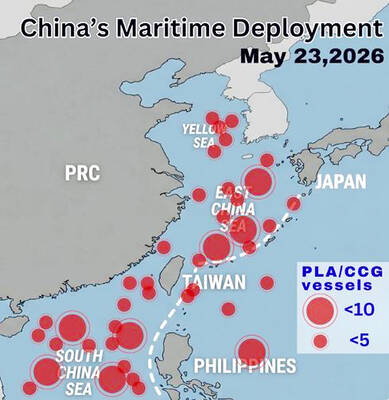
WARNING: China should stop engaging in actions that undermine regional peace and stability, as it would only build resentment among people across the Strait, the CGA said China has deployed more than 100 navy, coast guard and other vessels in waters from the Yellow Sea to the South China Sea and the western Pacific since US President Donald Trump and Chinese President Xi Jinping (習近平) met in Beijing, National Security Council Secretary-General Joseph Wu (吳釗燮) said yesterday. “In this part of the world, #China is the one & only PROBLEM wrecking the #StatusQuo & threatening regional peace & stability,” Wu wrote on X. In a separate post, he said Beijing was coercing Taiwan’s maritime domain, calling it illegal and provocative, after the Coast Guard Administration (CGA) expelled a


 RSS
RSS